Simple Good Back Exercises for Men to Boost Your Fitness
A strong back does much more than fill out your T-shirt. The right routine of good back exercises for men supports your spine, improves posture, powers your lifts, and helps protect you from injury. If you sit a lot, lift weights, or just want to feel stronger and more stable, training your back needs to be a priority, not an afterthought.
Below, you will find simple back exercises you can plug into your workouts, plus clear tips on form, sets, and reps so you know exactly what to do.
Why back training matters for men
Your back is part of your core, not separate from it. The muscles along your spine and around your shoulder blades help you stand tall, rotate, bend, and lift safely. When you only train abs and ignore your back, you create weakness and imbalance that can show up as pain later.
Research referenced by Arthritis Research UK and Men’s Health UK notes that around 10 million people in England and Scotland live with persistent back pain, and structured exercise is considered the most important self-directed treatment for low back pain. That is a strong reason to take your back work seriously now, before problems grow.
A well trained back gives you:
- Better posture and less slumping when you sit
- Stronger compound lifts like squats and deadlifts
- More protection against day to day strains
- A wider, more athletic looking upper body
You get all of that by training both your lower back and your upper back with a mix of stability, strength, and mobility exercises.
Key lower back stability and strength exercises
Start by building a solid base in your lower back and deep core. These moves teach you to control your spine while you move your hips and shoulders, which is the foundation for heavier lifting later.
45 degree back extension
The 45 degree extension is one of the classic good back exercises for men because it trains your lower back and hips together.
How to do it:
- Set up on a 45 degree hyperextension bench with your feet locked in and your thighs supported.
- Cross your arms over your chest or hold a small plate to your chest.
- Brace your abs, keep your spine neutral, and slowly lower your torso by hinging at the hips.
- Stop when you feel a good stretch in your hamstrings but no rounding in your lower back.
- Squeeze your glutes and lower back to raise your torso until it is in line with your legs.
Aim for 3 to 4 sets of 15 reps. Move in a controlled way and avoid whipping your body up and down. The goal is smooth extension, not momentum.
Bird dog
The bird dog looks simple but it is one of the best ways to build baseline spinal stability.
How to do it:
- Start on all fours with hands under shoulders and knees under hips.
- Brace your core as if you are about to be lightly punched in the stomach.
- Extend your right arm forward and your left leg back until both are in line with your body.
- Keep your hips level and avoid twisting or arching your back.
- Hold briefly, then return to the start and switch sides.
Do 3 to 4 sets of 8 reps per side. Focus on staying rock solid in your torso. If your hips sway or your back droops, shorten the reach until you can keep everything stable.
Romanian deadlift
Once you have some stability, you can start loading your lower back and glutes with the Romanian deadlift (RDL). This is one of the most effective strength builders in any back routine.
How to do it:
- Stand tall holding a barbell or dumbbells in front of your thighs with a soft bend in your knees.
- Push your hips back while keeping your spine neutral and your shoulders pulled down and back.
- Let the weight travel down your legs until you feel a strong stretch in your hamstrings.
- Pause briefly at the bottom to maintain control.
- Drive your hips forward and squeeze your glutes to return to standing.
Work for 3 to 4 sets of 8 to 12 reps. Use a weight that feels challenging but never forces your back to round. RDLs should feel like a deep hip hinge with tight hamstrings and glutes, not like a sloppy forward bend.
Simple core moves that support your back
Your back cannot be strong if your core is weak. These bodyweight core exercises directly support a healthy spine and better posture.
Side plank
Side planks hit your obliques and deep core muscles that help keep your spine aligned.
How to do it:
- Lie on your side with your elbow under your shoulder and legs stacked.
- Lift your hips so your body forms a straight line from head to feet.
- Keep your chest open and avoid letting your hips sag.
- Hold for time, then switch sides.
Try 2 to 3 sets per side of 40 seconds. If this is tough, bend your bottom knee and keep it on the floor while you lift your hips. You will still get a strong core and back challenge with less strain.
Glute bridge
The bridge or glute bridge ties your glutes, core, and lower back together in one move.
How to do it:
- Lie on your back with knees bent and feet flat on the floor, hip width apart.
- Tighten your abs and squeeze your butt.
- Press through your heels to lift your hips until your body forms a straight line from knees to shoulders.
- Hold at the top for three deep breaths, keeping your ribs down and your glutes engaged.
- Lower slowly and repeat.
Start with 5 reps per day and gradually build up to 30 controlled reps. Stronger glutes reduce strain on your lower back during everyday activities and heavy lifts.
Mobility and stretch work for a healthier spine
Strength alone is not enough. To feel good and move well, you also need mobility and flexibility. These stretches are quick to add after a workout or at the end of your day.
Knee to chest stretch
This stretch helps open up your lower back and glutes.
- Lie on your back with knees bent and feet flat.
- Pull one knee toward your chest with both hands.
- Tighten your belly muscles and gently press your spine toward the floor.
- Hold for about five seconds, then switch legs.
Repeat 2 to 3 times per leg, ideally twice a day.
Lower back rotational stretch
Rotation helps keep your back from feeling stiff and locked up.
- Lie on your back with knees bent and feet on the floor.
- Slowly roll your bent knees to one side while keeping your shoulders on the ground.
- Stop when you feel a gentle stretch in your lower back and side.
- Hold for 5 to 10 seconds, then return to center and switch sides.
Perform 2 to 3 repetitions on each side, twice a day if you can.
Cat stretch
The cat stretch improves back mobility and relieves tension through controlled flexing and extending.
- Start on your hands and knees.
- Slowly arch your back up toward the ceiling, letting your head drop between your arms.
- Then reverse the movement, letting your back sag while you lift your head and tailbone.
- Move smoothly between these two positions.
Repeat 3 to 5 times, two times per day. Move only as far as feels comfortable.
Upper back builders for strength and size
Now that your lower back and core are covered, you can turn to good back exercises for men that build upper back muscle and pulling strength.
Conventional deadlift
The deadlift is one of the best full body lifts you can do. It trains almost your entire posterior chain in one movement, including traps, delts, rhomboids, erectors, lats, glutes, hamstrings, calves, biceps, and core.
How to do it in brief:
- Stand with feet about hip width and bar over mid foot.
- Grip the bar just outside your legs.
- Brace your core, flatten your back, and pull your chest up.
- Push the floor away through your heels and stand up, keeping the bar close to your body.
- Lower under control, keeping your back neutral.
Use lighter weights at first and focus on perfect form. Heavy deadlifts are excellent for building strength and size, but they demand respect and patience to learn.
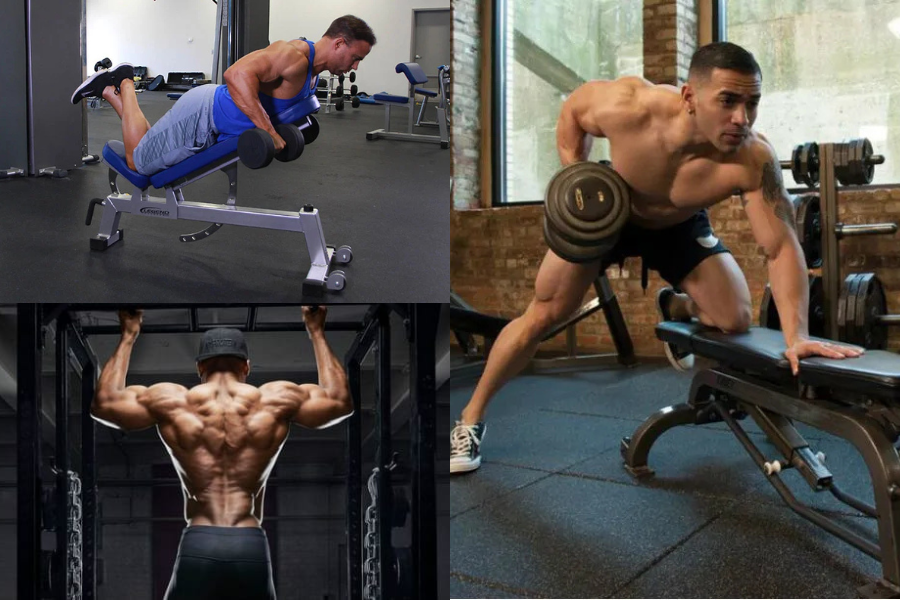
Single arm dumbbell row
Single arm dumbbell rows are a staple for back thickness and balance. They help build your lats, biceps, traps, delts, and core while also correcting side to side strength differences.
How to do it:
- Place one knee and hand on a bench, with your other foot on the floor.
- Hold a dumbbell in your free hand, arm extended toward the floor.
- Pull the weight toward your hip, driving your elbow back and keeping your shoulder pulled down and back.
- Pause briefly at the top, then lower with control.
Aim for 3 to 4 sets of 8 to 12 reps per side. Focus on pulling with your back, not just your arm, and avoid twisting your torso to cheat the weight up.
Pull ups
Pull ups are often called the king of back exercises for men, and for good reason. They build your lats, biceps, rhomboids, delts, traps, and more, and they help create that V shaped torso many men want.
How to do it:
- Grip a pull up bar with palms facing away, slightly wider than shoulder width.
- Start from a dead hang with arms straight and shoulders engaged.
- Pull your chest toward the bar, keeping your ribs down and your legs still.
- Lower slowly until your arms are straight again.
If you cannot do a full pull up yet, you can use a resistance band for assistance, do ring rows, or perform lat pulldowns on a machine. Mix grips over time, such as underhand chin ups and neutral grips, to train your back from different angles.
Rack pulls
Rack pulls are like a partial deadlift from just below or just above the knee. By shortening the range of motion, you can lift heavier loads that heavily tax your erectors, lats, and traps while reducing leg involvement.
Key points:
- Set the bar on safety pins or blocks so it rests just below or above your knees.
- Use a deadlift stance and grip.
- Brace hard and drive your hips forward to stand up with the weight.
- Emphasize control at the top and avoid leaning back.
Rack pulls are helpful for improving your deadlift lockout and for putting more focused stress on your upper and mid back muscles.
Quick daily posture and upper back activators
If you sit at a desk, your upper back and shoulders need extra attention. Strengthening the muscles that retract and stabilize your shoulder blades can improve posture and ease discomfort over time. A 2015 study on upper back exercises found that pulling and rowing movements can reduce common shoulder and back pain in people who sit for long periods, mainly by strengthening postural muscles and preventing slumping.
Shoulder blade squeeze
The shoulder blade squeeze is a simple drill you can do almost anywhere.
- Sit tall on an armless chair with your feet flat on the floor.
- Gently pull your shoulder blades together as if you are trying to pinch a pencil between them.
- Hold for five seconds, then relax.
Do 3 to 5 reps, twice per day. Over time, this helps wake up the muscles that hold your shoulders back instead of letting them roll forward.
How to put these back exercises together
You do not have to do every move in one session. Here is a simple way to structure your training.
Back day template
- Warm up with cat stretch and shoulder blade squeezes
- Strength: Deadlift or Romanian deadlift, 3 to 4 sets
- Row variation: Single arm dumbbell row, 3 to 4 sets
- Vertical pull: Pull up or assisted pull up, 3 to 4 sets
- Core and stability: Bird dog and side plank, 2 to 3 sets each
- Cool down: Knee to chest stretch and lower back rotational stretch
If you train your whole body each session instead, you can pick one lower back move, one row, one pull up variation, and one core exercise and rotate through the list across the week.
Final thoughts
Good back exercises for men do not need to be complicated or use fancy machines. If you consistently hinge, row, pull, and stabilize your spine with the moves above, you will build a stronger, more resilient back that supports everything else you do.
Start with just one or two of these exercises in your next workout and pay close attention to your form. Over the coming weeks, you can gradually add in more variety, more sets, and heavier weights as your strength and confidence grow.
About The Author