Easy Chest Training for Women You’ll Actually Enjoy
Chest training for women can do much more than build visible muscle. When you strengthen your pecs, you support your posture, protect your shoulders, and make everyday tasks like carrying groceries or lifting a suitcase feel easier. You also get a natural lift through the chest area without changing your actual breast size or shape, since you are working the muscles underneath rather than breast tissue itself, as trainers in Franklin, TN point out in their coaching on chest workouts for women.
You might have heard that upper body training will make you look bulky or that chest exercises are just for men. Current guidance flips that narrative. The same moves that work for men also work for you, and when you choose smart variations, you get strength, balance, and a more confident posture without an overly muscular look. Many women actually under train their chest compared to their lower body, which can leave your upper back and shoulders working overtime to keep you upright.
Understand what your chest muscles do
Your main chest muscles are the pectorals, or pecs. They sit between your neck, shoulders, and rib cage and help with any pushing or hugging motion. When you push a door open, press yourself up from the floor, or hold a heavy box out in front of you, your pecs are part of the effort.
Stronger pecs work together with the muscles around your shoulder blade and rib cage to keep your shoulders stable and your chest open. According to trainers who focus on functional strength for women, that stability can reduce the risk of muscle strains, joint sprains, and overuse injuries in your shoulders because the load is shared instead of falling on one small area.
Chest training also supports your breathing. When the muscles around your rib cage, including your pecs and intercostals, are stronger and more flexible, your rib cage can expand and contract more efficiently. That can help you take deeper, easier breaths during workouts and daily life, while also lowering your risk of muscle strain in that area.
Common mistakes women make with chest workouts
If you have ever tried chest exercises and felt mostly shoulder strain or wrist pressure, you are not alone. A few common patterns get in the way of effective chest training for women.
One issue is relying almost entirely on barbell bench presses. Over time, this can emphasize the lower part of your chest and leave your upper chest under trained. Older bodybuilding guidance from Greg Merritt noted that this focus on flat barbell benching can create a droopier look through the lower chest and can increase the risk of shoulder, elbow, and wrist strains and even pec tears when the weight gets heavy.
Another common mistake is living on machines and skipping free weights. Historical examples from the Arnold Schwarzenegger era highlight that the most impressive pec development came largely from free weight pressing and fly movements rather than guided machines. Free weights ask more of your stabilizing muscles and tend to give you better all around chest strength.
Form also matters as much as exercise selection. If you let your shoulders roll forward, or protract your shoulder blades, during pushups or bench presses, your shoulders take over and your chest has to do less. Current recommendations suggest retracting your shoulder blades and grounding them into the bench when you press. This helps you feel more activation in your outer, upper, and inner chest and less strain in the fronts of your shoulders.
Finally, it is easy to chase heavier weight and lose focus on the actual muscles. As Jay Cutler has emphasized in his training principles, you want to work the muscles, not just move the weight. When you rush through reps or use momentum, you reduce tension on your pecs and shift the work to your triceps or hips, which means less progress and more chance of aches.
Warm up the right way
A proper warm up helps your chest muscles fire more effectively and protects you from pulled muscles or other strains. For women, taking a few extra minutes before chest training is especially helpful because many of your daily movements involve rounded shoulders and a tight chest, for example, sitting at a computer or leaning over a phone.
Start with general movement like a few minutes of brisk walking, easy cycling, or light rowing to raise your core temperature. Then move into dynamic stretches that open your chest and shoulders, such as arm circles, gentle band pull aparts, and wall slides. These motions improve your range of motion and remind your nervous system which muscles you want to use.
Before your main sets, add one or two specific warm up exercises with light resistance. Incline wall pushups or very light dumbbell presses are good options. By gradually increasing the load instead of jumping straight to your working weight, you give your joints and connective tissues time to adjust, which lowers your risk of sprains, strains, or tears in your chest muscles.
Learn the movement basics
Good technique lets you get more from lighter weights, which is ideal when you want effective chest training for women without feeling nervous about big barbells.
Shoulder blade position
For any press or pushup, think about gently pulling your shoulder blades together and slightly down your back. This is called retraction. You can picture tucking your shoulder blades into your back pockets while keeping your ribs from flaring. That position opens your chest and gives your shoulder joint a stable base.
Avoid letting your shoulders round forward at the top of a rep. When your shoulder blades protract and roll toward your ears, your chest disengages and the front of your shoulders carry the load instead, which can lead to discomfort over time.
Elbow path and grip
Aim for your upper arms to move at about a 45 degree angle from your torso in most presses and pushups. This middle ground reduces stress on your shoulder joint compared with flaring your elbows straight out or tucking them tightly into your sides. Your wrists should stay stacked over your elbows, not bent back sharply.
Use a grip width that feels natural and does not pinch your shoulders. For most women, that is somewhere just outside shoulder width for standard presses and slightly narrower for close grip variations that emphasize your triceps.
Tempo and tension
Move through each rep under control. Count a slow two to three seconds on the way down, pause briefly at the bottom without bouncing, then press up with intention. At the top, avoid slamming your joints into lockout. Instead, think about squeezing your chest muscles for a moment to get a stronger contraction.
This kind of tempo increases time under tension, which is a key driver of strength and muscle gain. It also helps you focus on what you feel in your chest instead of simply completing the rep as fast as possible.
Beginner friendly chest exercises
You do not need a full gym to start. Many of the best chest exercises for women use your body weight or a simple pair of dumbbells and they recruit your shoulders, triceps, back, and core at the same time, which makes your workout efficient.
Pushup variations
Standard pushups are a classic compound move, but you can scale them to your current strength.
Incline pushups are an ideal starting point. Place your hands on a raised surface like a bench, sturdy coffee table, sofa edge, or even a staircase. The higher the surface, the easier the exercise. Step your feet back, brace your core, and lower your chest toward your hands. This version focuses on your chest and triceps with less load than floor pushups and is commonly recommended for women building up to full pushups.
As you get stronger, you can progress to bench height, then floor pushups, and eventually to more advanced options like eccentric pushups. In an eccentric pushup you take three to five seconds to lower yourself down and then use your knees or a higher surface to help on the way back up. This extended time under tension encourages muscle growth even if you cannot yet perform many regular reps.
Dumbbell presses
Dumbbell chest presses are a staple in chest training for women because they offer stability work, joint friendliness, and an easy way to adjust weight.
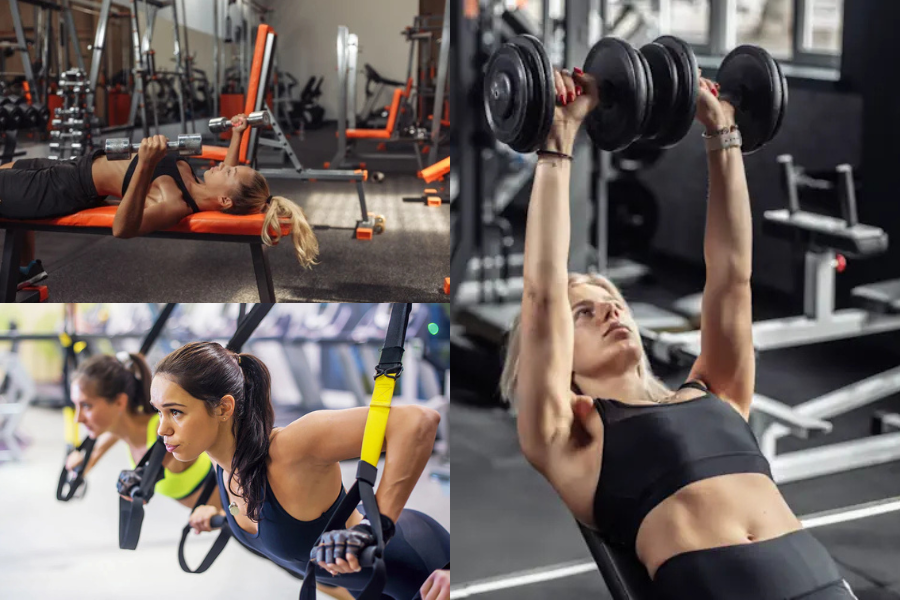
You can perform them lying on a bench, on the floor, or even on a firm sofa if you are working out at home. With a dumbbell in each hand, start with your arms straight above your chest, palms facing forward or slightly turned in. Slowly lower the weights until your elbows are roughly in line with the bench or floor. Pause, then press back up, keeping your shoulder blades gently squeezed together.
Dumbbell presses let each arm move independently, which helps address strength imbalances and can feel more comfortable on your wrists and shoulders than a barbell. They also require your stabilizing muscles to work a bit harder to keep the weights steady, which adds to your overall upper body control.
Close grip presses
A close grip bench or floor press shifts more of the work to your triceps while still involving your chest. Bring your hands closer together than in a regular press, usually shoulder width or slightly narrower, and keep your elbows closer to your sides.
Including this variation in your routine adds variety and extra arm strength that carries over to everyday pushing tasks, such as moving furniture or getting a heavy door open. It is a simple way to target your chest from a slightly different angle without learning a completely new pattern.
Fly variations
Chest fly movements target the inner portion of your chest and help you feel a strong squeeze at the top of the motion. You can do flyes with dumbbells on a bench or floor, or with cables or resistance bands if you have access to a gym.
From a lying position, start with your arms extended above your chest, elbows softly bent. Open your arms out to the sides in a wide arc until you feel a stretch across your chest, then bring them back together as if you were hugging a large tree. Move slowly and keep the bend in your elbows the same throughout so you do not overload your shoulder joint.
Trainers often prefer resistance bands or cable machines for flyes because they keep consistent tension on your chest throughout the entire range of motion. With dumbbells, the resistance is highest in the mid range and lighter at the very top, which can make it harder to get a full contraction if you rush.
Overhead and accessory work
Exercises like the overhead press, lateral raises, and triceps kickbacks do not directly train your chest, but they support it by strengthening your shoulders and arms. A beginner chest workout for women often includes a mix of chest presses, overhead presses, flyes, and triceps moves so your entire pushing chain gets stronger together.
If you find it hard to keep good form in standing overhead presses, try performing them seated. This reduces the temptation to use momentum from your hips or lower back and makes it easier to maintain a neutral spine.
Structure a simple chest workout
To build strength without spending hours in the gym, you can organize your session as a circuit. Research based routines for women often suggest picking 5 to 8 moves, performing them for 10 to 12 controlled reps or about 50 seconds of work each, resting briefly, then repeating the circuit for three total rounds.
A sample beginner circuit might include:
- Incline pushups
- Dumbbell chest press
- Dumbbell chest fly or band fly
- Overhead press
- Triceps kickback or close grip press
You can rest for 30 to 60 seconds between exercises at first, then shorten the rest as you become more comfortable. Performing this chest training routine once or twice per week is usually enough to see steady strength and definition gains. If you are new to resistance training, start with one dedicated chest day per week and build from there as your recovery improves.
To increase intensity without jumping to much heavier weights, you can experiment with techniques like drop sets, where you reduce the weight slightly and continue the set when you reach fatigue, or paused reps, where you hold briefly at the bottom or middle of the movement. These methods challenge your muscles beyond their usual workload and can encourage growth when used occasionally and with good form.
How to progress safely and avoid ego lifting
As you get stronger, it is tempting to add weight quickly. However, lifting more than you can control often leads to form breakdown, which shifts the work away from your chest and onto smaller joints and muscles.
Prioritize gradual progression. When you can complete your sets with solid technique and feel your chest working more than your shoulders, you can increase the weight by a small amount or add an extra set. If any exercise causes sharp pain in your shoulders or wrists, adjust the range of motion, choose a lighter weight, or swap in a more joint friendly variation like an incline dumbbell press.
Women with existing shoulder or wrist issues can also benefit from using supportive gear like wrist wraps, choosing neutral grip positions that keep the palms facing each other, and shortening the bottom portion of a press. You should still feel effort in your chest, but without joint discomfort.
If you keep the focus on what you feel in your pecs, maintain a stable shoulder blade position, and give yourself time to warm up and cool down, chest training becomes something you can look forward to instead of a part of your workout that you avoid.
Key takeaways
- Chest training for women supports posture, shoulder stability, breathing, and everyday strength.
- Free weight presses and flyes, especially in incline and dumbbell variations, build more balanced chest development than relying only on flat barbell bench presses or machines.
- Proper warm ups, shoulder blade retraction, moderate elbow angles, and controlled tempo help you feel your chest working instead of your joints.
- Beginner friendly moves like incline pushups, dumbbell presses, flyes, and simple accessories create an effective circuit you can do one to two times per week.
- Progress weight slowly, avoid ego lifting, and modify exercises as needed so you can train your chest consistently and confidently.
You do not need perfection to get started. Choose one or two of the exercises above, focus on steady breathing and smooth reps, and notice how your upper body feels stronger and more supported with each session.
About The Author