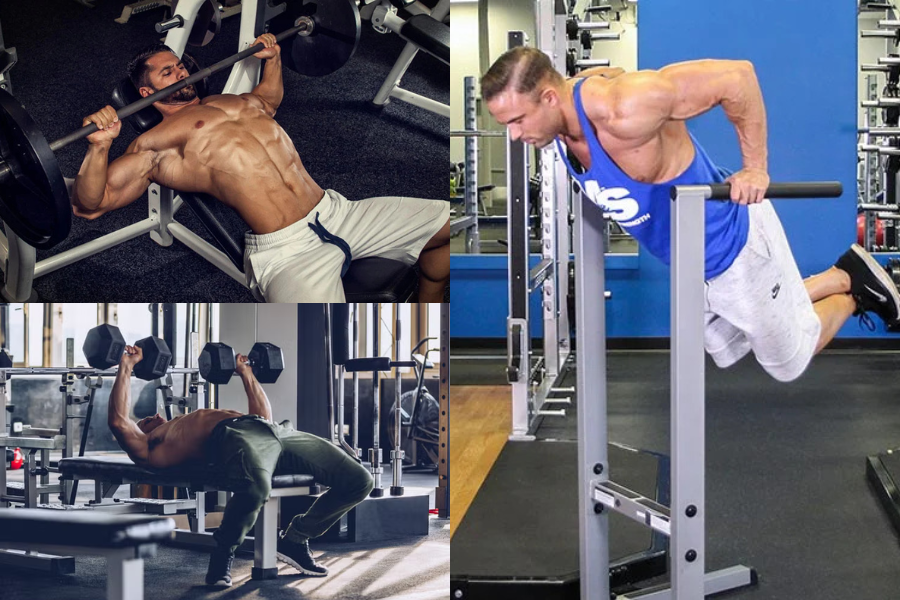
Discover the Best Chest Workouts for Men That Really Work
A strong, defined chest is about more than looks. The best chest workouts for men build strength for pushing, pressing, and stabilizing your upper body in everyday life. With the right mix of exercises, volume, and technique, you can grow your pecs, protect your shoulders, and feel more powerful in and out of the gym.
Below, you will find practical guidance on exercises, form tips, and workout structures that actually work, backed by current training recommendations from Gymshark and others.
Understand how your chest muscles work
To get the most from your chest workouts, it helps to know what you are training. Your main chest muscle, the pectoralis major, has three key regions:
- Upper chest, the clavicular head, running from your collarbone
- Middle chest, the sternal head, spanning the mid chest
- Lower chest, the abdominal head, attaching lower on the ribcage
Each section has fibers that run in slightly different directions. That is why the best chest workouts for men include exercises that press or fly at different angles. Incline movements tend to hit the upper chest more, flat pressing emphasizes the middle, and decline or dipping motions shift stress toward the lower portion.
When you balance your training across these areas, you avoid the bottom heavy, “droopy” look that can happen when you only bench flat, a pattern highlighted by long time bodybuilding writers in 2010 on Simplyshredded.com.
Build a strong foundation with presses
Pressing movements are your main strength builders. They let you overload the chest with heavy weights and recruit supporting muscles like the triceps and shoulders.
Barbell bench press
The barbell bench press remains a staple for chest size and strength. It works your entire chest, especially the inner and mid portions, while involving your anterior deltoids and triceps. Because you can progressively load it with heavier weights, it is one of the best choices if you want raw pressing power, as highlighted in Gymshark’s 2024 chest training guidance.
Focus on:
- Feet planted firmly on the floor
- Shoulder blades pinched together and pressed into the bench
- Bar lowered under control to mid chest, then pressed back up without bouncing
Retracting your scapula like this improves activation across the outer, upper, and inner chest and helps prevent your shoulders and arms from taking over the lift, a cue emphasized in Gymshark’s technique notes.
Incline dumbbell bench press
Most men under train their upper chest, which can leave the torso looking bottom heavy. The incline dumbbell bench press is one of the best solutions.
With the bench set at about 30 to 45 degrees, you shift tension to the clavicular head of the pec major. Using dumbbells increases your range of motion and forces each side to work independently, which helps fix imbalances. Gymshark’s 2024 guide highlights this move for upper chest development, and a 2010 study of 15 males also found that incline dumbbell pressing at these angles improves activation of the upper fibers.
Key tips:
- Stop just short of locking out to keep tension on the chest
- Lower the dumbbells until you feel a comfortable stretch across the pecs
- Keep your wrists stacked over elbows, not drifting inward or outward
Reverse grip bench press
If traditional benching stresses your shoulders, the reverse grip bench press is worth trying. You hold the bar with an underhand grip, which brings your elbows closer to your torso and shifts more work to the upper chest and even the biceps. Research in the Journal of Strength & Conditioning Research shows that this variation activates the upper chest more than the standard grip and can be a more shoulder friendly option.
Start lighter than your usual bench weight, since the grip will feel unfamiliar at first.
Dumbbell and machine chest presses
Dumbbell flat presses add a stability challenge that improves mind muscle connection with your pecs, which Gymshark recommends for balanced development. You are forced to control each arm through the full range, rather than relying on the bar to guide the path.
Machine chest presses also have a place. They let you push close to failure safely and are useful when you do not have a spotter. A common structure is 3 sets of 12 to 15 reps, focusing on slow, controlled movement rather than ego lifting.
Shape and define with flyes and cables
Presses build mass and strength. Flyes and cable movements add stretch, squeeze, and definition by emphasizing horizontal adduction, the motion of your arms coming across your body.
Dumbbell chest flyes
Dumbbell flyes on a flat bench create a strong stretch at the bottom and a focused squeeze at the top. Rather than going heavy, you get more out of moderate weights and perfect control. Many coaches recommend 3 sets of 10 to 12 reps, concentrating on tension instead of flapping the arms.
A common issue with flyes is that resistance drops off at the top of the movement, so it becomes hard to fully contract the pecs. That is where cables help.
Cable fly variations
Cable exercises like the incline bench cable chest fly and single arm cable crossover keep tension on the pecs throughout the movement, which Gymshark’s 2024 recommendations highlight as a big advantage for hypertrophy and definition.
Three useful angles include:
- High to low cable fly (for lower chest)
- Low to high cable fly (for upper chest)
- Horizontal fly at mid chest height (for middle chest)
The low to high cable fly is especially valuable for upper chest work. Studies including Schütz et al. (2022) show that this direction of movement increases shoulder joint motion and activation of the clavicular fibers, which leads to more mechanical tension on the upper pecs.
Aim for slow, controlled reps, bringing your hands slightly across the midline to maximize contraction while keeping your shoulders down and back.
Do not ignore dips and pushups
Bodyweight training is not just for beginners. When you use the right angles and progression, dips and pushups can rival some heavy presses for chest growth.
Dips for chest
Dips performed with a forward lean shift emphasis from the triceps toward the chest. Gymshark notes that this forward torso angle is excellent for targeting the lower portion, and weighted dips are one of the top ways to progressively overload that region.
To emphasize your pecs:
- Lean slightly forward instead of staying perfectly upright
- Let your elbows flare a bit, but not excessively
- Lower until you feel a strong stretch, then press back up without locking out hard
When you add a dip belt or resistance bands, the intensity goes up significantly. Some coaches like to pair dips with high to low cable crossovers as a drop set so the lower chest gets both heavy loading and full range contraction.
Pushup progressions
Pushups are still one of the best chest workouts for men, especially if you train at home. Standard pushups hit the chest, shoulders, and triceps and are often done for 3 to 4 sets of 12 to 15 reps. More advanced variations build strength and power:
- Deficit pushups, hands on blocks or handles, to increase range of motion, 6 to 8 reps
- Plyometric pushups, like clap pushups, to train explosive power, 4 to 6 reps
Decline pushups, where your feet are elevated, shift more of the load to the upper chest and front shoulders. Research referenced in recent training articles shows that this is a highly effective bodyweight option for building upper chest strength and definition.
If you have resistance bands, banded pushups or setups where one hand drives slightly across your body can create a strong mind muscle connection and overload, as some coaches use in bodyweight focused chest programs.
Warm up properly and lift smart
Heavy chest training without a warm up is a fast route to strains or worse. A short, focused warm up prepares your muscles and joints for hard work.
Start with 3 to 5 minutes of light cardio to raise your body temperature. Then use dynamic moves like arm circles, band pull aparts, and light sets of your first exercise. Gymshark stresses that proper warmups increase flexibility and range of motion and help prevent common injuries like sprains, strains, or pec tears.
Form and control matter more than the number on the bar. Avoid “working the weight, not the muscles,” which happens when you use momentum and speed to move loads your chest cannot properly handle. This often shifts work to your shoulders, triceps, and even your lower back, while limiting pec activation.
Two rules help you stay on track:
- Choose a weight that lets you control every rep without bouncing or twisting
- Stop a set when your form starts to break, not several reps after
Ego lifting, using weights that are too heavy to maintain good technique, is a risk factor for shoulder, elbow, and wrist issues and for major pec tears. You will get better long term gains by focusing on muscle tension and progression than by chasing PRs every session.
Structure your weekly chest training
The best chest workouts for men follow a few simple programming principles: enough volume, smart exercise selection, and progressive overload with room for recovery.
How much volume and frequency
A solid starting point for most lifters is at least 10 sets per week for chest, spread over two sessions, as Gymshark recommends in their 2024 analysis. If you are more advanced and recovering well, you can gradually increase to 12 to 16 total working sets per week.
A typical split might look like:
- Day 1: Chest plus triceps
- Day 4 or 5: Chest plus shoulders or a push day
This spacing gives your muscles time to recover and grow while still reinforcing the movement patterns often enough to adapt.
Sample chest focused workout
Here is one example of a gym based chest workout that covers all three regions of the pecs and blends strength and hypertrophy work:
- Barbell bench press
- 4 sets of 4 to 6 reps, heavy, 2 to 3 minutes rest
- Incline dumbbell bench press
- 3 sets of 8 to 10 reps, 90 seconds rest
- Weighted dips, forward lean
- 3 sets of 8 to 10 reps, or bodyweight to near failure
- Low to high cable fly
- 3 sets of 10 to 12 reps, focusing on upper chest squeeze
- Machine chest press or pushups to fatigue
- 2 sets, controlled tempo, as a finisher
For a second weekly session, you can swap some movements for variety, for example incline barbell press instead of flat barbell, or single arm cable crossovers instead of standard flyes. Many coaches suggest rotating main exercises every 3 to 4 weeks to keep progress moving.
If you prefer a more intensive short term plan, Men’s Health UK has shared a 28 day chest building program that alternates two sessions. One focuses on heavy barbell benching, 10 sets of 6 with short rest, plus high rep press up variations for size and strength. The other emphasizes fascial stretching and expansion with incline dumbbell presses, flat and incline flyes, and dips for depth and width. They also stress taking two rest days after the second session before repeating the cycle so you can recover and grow.
At home options if you do not have a gym
You can still build a bigger, stronger chest without machines or barbells. Bodyweight and band exercises are effective when you push them with enough volume and progression.
Mix movements like:
- Hands elevated pressups to build confidence and range
- Standard, decline, and typewriter pushups for different angles and difficulty
- Band resisted pushups for extra load at the top of the movement
Men’s Health UK notes that these types of variations can stand in for gym sessions when you train at home and still deliver impressive strength and muscle gains.
Put it all together
When you design your own plan, remember the key principles that make chest routines work:
- Hit all three regions of the chest with a mix of flat, incline, and dipping angles
- Combine heavy presses for strength with moderate rep flyes and cables for hypertrophy
- Train your chest at least twice per week with around 10 or more total sets
- Warm up thoroughly and avoid ego lifting so you can train hard for years, not weeks
- Progress your volume or load over time and change main exercises every few weeks
Start by adding just one or two of these ideas to your current routine, such as swapping a flat press day for an incline focused one or adding low to high cable flyes after your bench work. As you build consistency with better structure and form, you will feel and see the difference in your chest development.
About The Author





