Fast Results: Chest Workout Routine for Men You’ll Love
A bigger, stronger chest does not have to take hours in the gym or a complicated plan. With the right chest workout routine for men that targets your upper, middle, and lower chest, you can see fast, visible results in a few focused sessions each week.
Below, you will find a simple structure you can follow at the gym or at home, plus clear guidelines on sets, reps, and recovery so you know exactly what to do when you walk into your next workout.
Understand your chest muscles
If you want your chest to grow quickly and evenly, it helps to know what you are training. The pectoralis major, which makes up most of your chest, has three main parts with fibers that run in slightly different directions. These are the upper chest fibers (clavicular head), mid chest fibers (sternal head), and lower chest fibers (abdominal head).
Because of these fiber directions, you feel different areas work harder when you change the angle of your arms or torso. An incline press targets more upper chest, a flat bench hits the mid chest, and dips or decline work emphasize the lower chest. You also need some movements that bring your arms across the midline of your body so the chest can contract fully through its natural range of motion.
When your routine checks all three boxes, upper, middle, lower, and includes that across‑midline squeeze, you get a fuller, more defined chest instead of just a stronger bench.
Key principles for fast results
You do not need a complicated schedule, but you do need a few non negotiable rules if you want fast progress from your chest workout routine for men.
Train with the right frequency
You build muscle when you train hard, then rest enough to recover and grow. For most men, training chest 1 to 3 times per week works well for size and strength, with 1 to 2 times weekly ideal if you are a beginner and around 2 focused sessions per week working best once you have some experience.
Most effective sessions last 30 to 60 minutes and include 4 to 6 exercises and 3 to 4 sets per exercise, combining big compound lifts like bench presses and dips with isolation moves such as cable crossovers or dumbbell flyes. Try to space your chest workouts 2 to 3 days apart so your muscles, joints, and nervous system can recover properly before you hit them hard again.
Prioritize big pushing movements
If your goal is a noticeably bigger chest, you should build your workouts around pushing exercises that allow you to move serious weight safely. Bench presses, incline presses, and push‑ups let you load the chest, shoulders, and triceps in a way that stimulates real growth. Beginners especially should base their chest days on these basics so they can practice good form and progressively add weight without getting overwhelmed by too many fancy variations.
After you have done your main compound work, you can add isolation exercises that let you focus on squeezing and stretching the pecs with lighter loads.
Match your reps to your goal
For muscle growth, most of your sets should live in the 6 to 12 rep range with a weight that feels challenging by the last 2 reps. If you want to push strength a bit more, you can include some heavier sets in the 2 to 6 rep range, especially on your main bench press or incline press.
Aim for 3 to 4 work sets per exercise. You should finish your session feeling worked but not wrecked. If your first rep looks nothing like your last, you are probably going too heavy for effective chest training.
Eat and recover like it matters
Your chest will not grow if you treat recovery as an afterthought. Try to get high quality sleep and manage the volume of other pushing work, like shoulder and triceps sessions, so you are not hammering the same muscles every day.
You also need enough protein for your muscles to repair. A useful target for many men is around 1 gram of protein per pound of bodyweight per day, spread across your meals. Consistency here matters as much as your time under the bar.
The gym based chest workout routine for men
This workout is built to hit all three parts of your chest, overload the muscles with heavy compound lifts, and then finish each area with an across‑midline movement for maximum activation.
If you are newer to training, you can start with 3 exercises instead of the full lineup, then add the rest as your strength and confidence improve.
Exercise 1: Flat barbell bench press (mid chest focus)
The barbell bench press is a classic for a reason. It pushes your mid chest hard while bringing in your front delts and triceps for support. For most men, it is also the easiest lift to track progress on because you can add small amounts of weight over time.
- Sets: 3 to 4
- Reps: 6 to 10
- Rest: 60 to 90 seconds between sets
Focus on keeping your feet planted, shoulder blades pulled back on the bench, and the bar path smooth from chest to lockout. If you are a beginner, start around 3 sets of 6 to 12 reps with a weight that you can control through the full range of motion.
Exercise 2: Incline dumbbell or barbell bench press (upper chest focus)
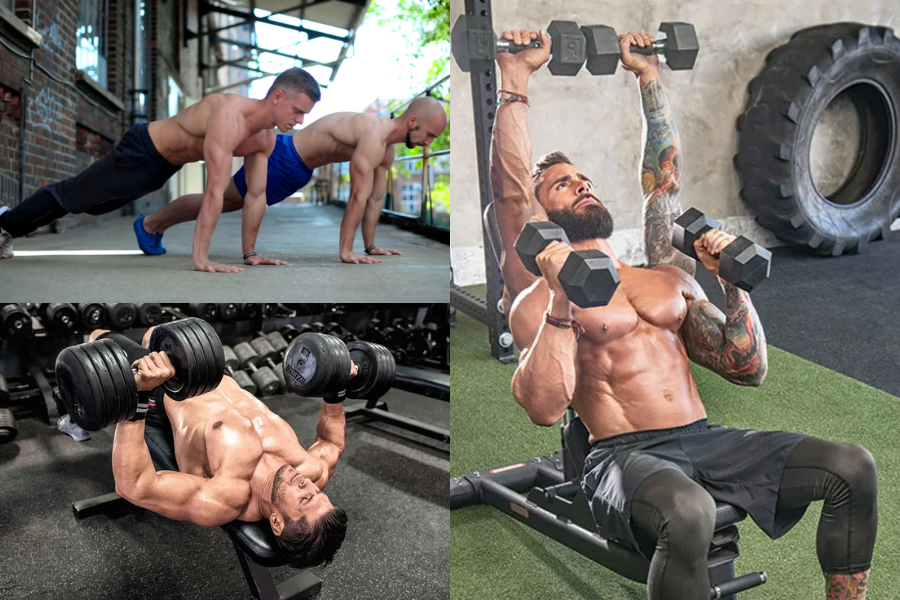
The upper chest can be stubborn for many men. An incline bench, usually set around 30 to 45 degrees, shifts more tension toward the clavicular head of the pec.
You can use either a barbell or dumbbells. Dumbbells allow a slightly larger range of motion and a natural arm path, which many lifters find more comfortable for their shoulders.
- Sets: 3 to 4
- Reps: 6 to 12
- Rest: 60 to 90 seconds
Start lighter than you think so you can lower the weight under control and press through a full range. Your goal is to feel the upper chest work, not just move the heaviest load possible.
Exercise 3: Weighted or assisted dips (lower chest focus)
Dips, especially when you lean your torso slightly forward, are a powerful lower chest builder. If bodyweight dips are too hard at first, you can use an assisted dip machine or loop a band under your knees for support.
- Sets: 3
- Reps: 8 to 12
- Rest: 60 to 90 seconds
As you get stronger, you can add weight with a dip belt or hold a dumbbell between your feet. Keep your shoulders down and chest up, and avoid dropping so low that you feel pain in the front of your shoulder.
Exercise 4: Cable crossovers (across midline work)
Flat, high to low, and low to high cable crossovers all teach your chest to contract fully across the midline of your body. They are great as a follow up to heavy pressing because you can focus on feeling the muscles work without worrying about very heavy loads.
You can pair each compound lift with a matching cable crossover:
- After flat bench: horizontal cable crossover for mid chest
- After incline press: low to high cable crossover for upper chest
- After dips: high to low cable crossover for lower chest
A simple protocol is:
- 3 sets of 12 to 15 reps for the chosen variation
- Minimal momentum, focus on a strong squeeze in the middle
For a more advanced approach, some programs alternate heavy sets of presses with immediate sets of cable crossovers as a type of drop set. You perform your set of, for example, 6, 8, 10, or 12 reps on the barbell bench, then move straight to 15 reps of the cable crossover with no rest in between. After the cable set, you rest, then repeat. This combination can create intense pumps and strong hypertrophy stimulus.
Quick structure: Start with your compound, mid chest bench press, move to an incline press, then dips, and finish with one cable crossover style. That way your entire chest is hit from top to bottom and across the midline.
Exercise 5: Dumbbell flyes or pec deck (optional finisher)
If you enjoy a deep stretch and a strong contraction, you can add dumbbell flyes on a flat or incline bench, or use a pec deck machine. These are isolation exercises that work well after your main pressing work.
- Sets: 2 to 3
- Reps: 10 to 15
Use moderate weights and smooth, controlled movement. Think of hugging a big barrel rather than letting your arms drift too far back, which can strain your shoulders.
The at home chest workout routine for men
You can still build a bigger, more defined chest at home with minimal equipment. A mix of bodyweight moves, dumbbells, and resistance bands covers all the same angles you get in the gym.
Bodyweight push up variations
Push ups train your entire chest along with shoulders, arms, and core, and they are especially friendly for beginners because you can adjust the difficulty.
- Standard push ups for mid chest
- Decline push ups, feet elevated, for more upper chest
- Incline push ups, hands on a bench or sturdy surface, to ease the load or emphasize lower chest
A basic goal is 3 sets of 10 controlled reps. If regular push ups are too hard at first, elevate your hands to reduce the load. If they are too easy, add a weight plate on your back or use a resistance band across your shoulders.
Band and dumbbell chest work
With a resistance band and a pair of dumbbells you can mimic many gym exercises:
- Band or dumbbell floor presses for mid chest
- Incline push ups with feet elevated on a box or step for upper chest
- Band resisted push ups to increase tension at the top of the movement
You can also use banded push up variations that emphasize bringing one hand slightly across your body so you feel the chest working harder near the midline. Over time, you can progress by increasing band tension, adding reps, or slowing the lowering phase.
A simple at home session might look like:
- Decline push ups, 3 sets of 8 to 12
- Standard push ups, 3 sets of max quality reps
- Incline push ups, 3 sets of 10 to 15
- Band flyes or single arm band presses across your body, 2 to 3 sets of 12 to 15
This gives you an upper, mid, and lower chest focus in one short routine.
How to structure your week
You can organize your chest training in a few different ways depending on your schedule and experience level.
If you are a beginner, training chest once or twice per week is enough. You might include chest in a full upper body workout, or pair it with triceps and shoulders on a push day. More advanced lifters often do best with two focused chest sessions per week, for example one heavier strength oriented day and one lighter, higher rep day for volume and definition.
No matter which setup you choose, leave at least 2 days between intense chest workouts so the muscles have time to repair. Also keep an eye on other pushing movements across your week so you are not overloading the same joints without rest.
Putting it all together
Here is a simple way to think about your chest workout routine for men:
- Train chest 1 to 3 times per week for 30 to 60 minutes
- Anchor each session with heavy compound presses and dips
- Add at least one exercise that brings your arms across your body to hit the chest through its full range
- Use 6 to 12 reps for most sets, with 3 to 4 sets per movement
- Space workouts 2 to 3 days apart and give recovery the same respect you give your lifting
Start with the version that fits where you are right now, gym based or at home, then focus on doing it consistently. Add a little more weight, one more rep, or an extra set every week or two, and your chest will respond.
About The Author