Effective Chest Exercises for Female Strength and Confidence
Why chest training matters for women
If you are like many women, you probably spend more time on glutes and legs than on your chest. Yet building a stronger chest is one of the best ways to improve posture, feel more powerful in daily life, and create a balanced upper body.
A well planned chest exercise for female strength does more than sculpt your pecs. It also challenges your shoulders, triceps, back, and core while giving you a useful metabolic boost because your chest muscles are large and involved in many compound movements.
In this guide you will learn why chest training is worth your time, how to move past myths about “bulking up,” and which specific exercises help you build strength and confidence, whether you are at home or in the gym.
Benefits of chest exercises for females
Training your chest is not just about appearance. It supports the way you stand, move, and feel every day.
Better posture and daily strength
Your chest muscles, or pectorals, span the front of your upper body between your neck, shoulders, and rib cage. When they are strong and work in balance with your back muscles, you are more likely to stand tall instead of collapsing forward.
This balance pays off in daily tasks. Carrying groceries, lifting kids, pushing a heavy door, or moving furniture all rely on chest, shoulders, triceps, and core working together. Trainer Elise Young, CPT, CFSC, notes that many women neglect their chest and that strengthening it can make these everyday movements easier and help prevent neck and back issues.
A more balanced, sculpted upper body
Effective chest exercises for females naturally involve your shoulders, triceps, core, and upper back. Compound pushing movements like chest presses and push ups are especially powerful because they let you work several areas at once instead of isolating just one muscle.
Over time, this can lead to:
- More definition through the front of the shoulders and upper arms
- A potentially lifted look to the chest as the underlying muscles firm up
- A more proportional physique if you already train your back and glutes
Metabolic and performance benefits
Because the chest is a large muscle group that helps drive big movements like push ups and bench presses, training it can help you burn more calories during a workout than you might with only small isolation moves. Those compound lifts recruit multiple muscles at once, which challenges your cardiovascular system and supports overall functional fitness.
Research comparing push ups to bench press work in young men suggests that push up programs can produce similar muscle activation and strength gains to the bench press for the upper body. That is promising if you prefer bodyweight training or work out at home.
Clearing up common chest training myths
You might hesitate to add chest exercises to your routine due to some persistent myths. It helps to separate fact from fear before you start.
Myth 1: Chest training will make you look “bulky”
Women generally do not have the hormonal profile to pack on large amounts of upper body muscle without highly targeted training and nutrition. Coach Sam, writing for 1UP Nutrition, explains that chest muscles need effective resistance training to become stronger and more toned and that this does not cause excessive muscle bulk or breast shrinkage.
What you are more likely to notice is slightly firmer tissue and better definition, not a dramatic size increase.
Myth 2: Chest exercises shrink your breasts
Your breast size is largely determined by genetics and body fat, not the size of your chest muscles. Building the pecs underneath can contribute to a more lifted or supported look, especially when combined with good posture. If your overall body fat changes due to weight loss, you may see changes in breast size, but that is not caused by chest training alone.
Myth 3: Chest workouts are only for advanced lifters
Bodyweight moves like incline push ups or modified push ups can be very beginner friendly. You can adjust angles, range of motion, and tempo to match your current strength level. Over time, you can progress to more challenging variations or add dumbbells when you are ready.
Key principles for a chest workout
Before jumping into specific moves, it helps to understand how to structure a chest exercise for female goals like strength, tone, and confidence.
Choose compound moves first
Compound exercises that involve more than one joint and muscle group give you the most return on your time. Chest presses, push ups, and dips challenge your chest, shoulders, triceps, and core at the same time. You can then add one or two isolation moves, like chest flys, for extra definition.
Use smart sets, reps, and rest
A simple, effective structure for a chest focused session is:
- Pick 5 to 8 exercises
- Do 10 to 12 repetitions, or work for about 50 seconds per move
- Rest around 15 seconds between exercises
- Complete 3 total rounds, resting 1 minute between rounds
This format takes roughly 20 to 25 minutes and can be done with a pair of dumbbells and a mat.
Respect form and recovery
Proper technique is essential to protect your shoulders and wrists. Keeping your elbows roughly 45 degrees from your ribs during pushing movements helps you engage your chest without overstraining your shoulder joints. Adequate rest days between intense chest sessions also give your muscles time to adapt and grow stronger.
Best bodyweight chest exercises for women
If you prefer to work out at home or without equipment, these push up variations provide a full chest workout.
Standard push up
Push ups are one of the best bodyweight chest exercises for females. They target your pectoralis major and minor, triceps, front shoulders, and core, and they require no equipment.
To perform them, start in a high plank with your hands slightly wider than shoulder width and your body in a straight line from head to heels. Lower your chest toward the floor while keeping your elbows at about 45 degrees to your sides, then press back up. A regular push up requires lifting roughly 64 percent of your body weight, so do not be discouraged if they feel challenging at first.
Modified and incline push ups
If full push ups are tough right now, you can scale them without losing the benefits.
- Kneeling push ups reduce the load to about 49 percent of your body weight which makes them a smart starting point
- Incline push ups, with your hands on a raised surface like a bench, sofa, or staircase, shift more weight to your feet and reduce the stress on your upper body
Both variations let you build strength progressively. You can gradually lower the height of the surface for incline push ups or move from knees to toes as you gain confidence.
Diamond leg push up
The Diamond leg push up is a beginner friendly variation that gently introduces more triceps and inner chest activation. From a kneeling or full plank position, place your hands closer together so your thumbs and index fingers form a diamond shape. Perform about 10 slow, controlled reps to fatigue your upper body without overwhelming it.
Hand release push up
For greater range of motion and muscle recruitment, try the Hand release push up. Start in a plank, lower your body all the way to the floor, briefly lift your hands off the ground to release tension, then place them back down and press up explosively.
This pause on the ground forces your chest to work harder on every rep and can be a powerful way to build strength with only 10 repetitions per set.
Push up hold and uneven push up
To focus on endurance, add the Push up hold. Lower yourself halfway or near the bottom of a push up and hold that position for a few seconds before pressing back up. Even 5 slow repetitions with holds will challenge both your chest and back muscles.
The Uneven push up adds unilateral work by placing one hand on an elevated object, like a medicine ball or yoga block, and the other on the floor. This forces each arm to work more independently and helps reveal or correct strength imbalances. Aim for about 8 reps per side.
Decline push up
When you are ready for a tougher challenge, elevate your feet on a step or bench while your hands stay on the floor. This Decline push up variation shifts more load toward your upper chest and front shoulders and can be a great next step after standard push ups begin to feel easier.
Effective dumbbell and bench chest exercises
If you have access to dumbbells, a bench, or even just a sturdy floor, you can expand your chest workout options.
Dumbbell chest press
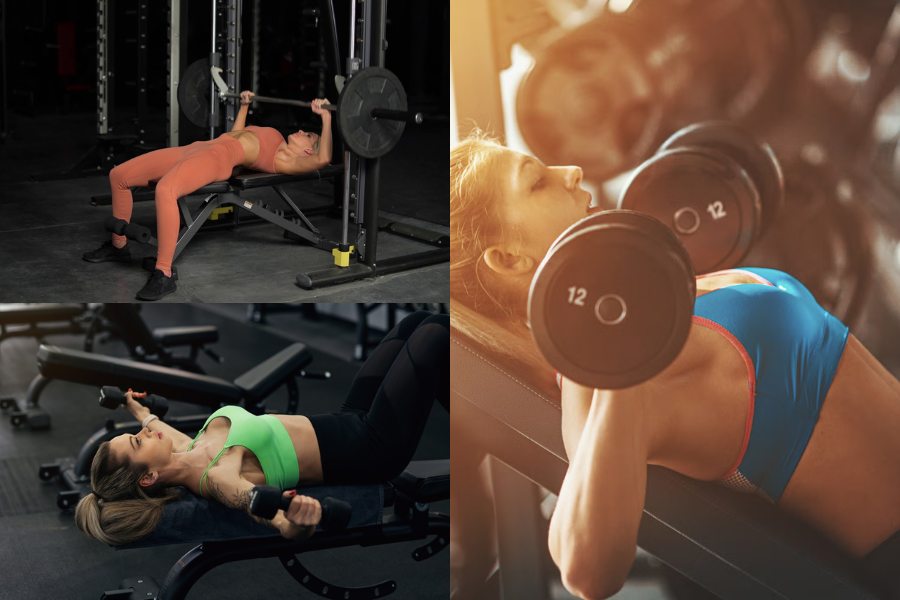
The dumbbell chest press is a classic chest exercise for female lifters who want to develop strength and definition. You can perform it on a bench or on the floor.
Lie on your back with a dumbbell in each hand, elbows bent at about 90 degrees and wrists stacked over elbows. Press the weights upward until your arms are straight but not locked, then lower slowly. Lighter weights with higher reps focus on endurance and tone, while heavier weights with fewer reps build more strength.
Incline chest press
Adjusting the bench to an incline shifts more emphasis to your upper chest and shoulders. This can help you build balanced chest development and support better posture.
Begin with a moderate incline so you feel your upper chest working without straining your shoulders. As with the flat press, press the weights up under control and lower them slowly.
Dumbbell floor press and variations
If you do not have a bench, the dumbbell floor press is an excellent alternative. Lying on the floor limits your range of motion slightly, which can be easier on your shoulders while still providing a strong challenge for your chest and triceps.
You can experiment with:
- Alternating floor press, pressing one arm at a time while the other holds steady
- Single arm floor press, which helps you identify and correct side to side imbalances in strength
Both variations demand more core stability, which improves your overall upper body control.
Chest flys with dumbbells or cables
Chest flys isolate your chest more than presses do. Lying on a bench or the floor, hold dumbbells above your chest with a slight bend in your elbows, then slowly open your arms into a wide arc until you feel a gentle stretch through your chest. Bring them back together under control.
Cable chest flys use the same motion from a standing position with a cable machine. Both versions help improve flexibility and create more sculpted definition through the chest.
Close grip bench press
A close grip bench press, with your hands positioned narrower than shoulder width, shifts more emphasis to your triceps while still training your chest. This is a useful variation if you want to build stronger arms along with a defined chest. You can do it with a barbell or dumbbells, on a bench or on the floor.
Sample 20 minute chest workout for confidence
Here is how you might combine these movements into a short, effective chest workout. Adjust exercises to match the equipment you have.
- Incline push ups or standard push ups, 10 to 12 reps
- Dumbbell chest press or floor press, 10 to 12 reps
- Hand release push ups, 8 to 10 reps
- Dumbbell chest flys, 10 to 12 reps
- Push up hold, 5 slow reps with a pause near the bottom
- Optional finisher, Uneven push ups, 8 reps per side
Move through each exercise with about 15 seconds of rest between them, then rest for 1 minute after the full circuit. Repeat the circuit 2 more times for a total of 3 rounds. This format fits into roughly 20 to 25 minutes and trains your chest, shoulders, triceps, and core efficiently.
Tip: If you are new to strength training, start with 1 to 2 rounds instead of 3, and keep at least one rest day between chest focused sessions.
How to progress safely and stay consistent
Strong results come from small, consistent steps rather than drastic changes. You can make steady progress by adjusting just one variable at a time.
Increase difficulty by:
- Adding 1 or 2 reps per set
- Slowing down the lowering phase of each movement
- Reducing incline height on push ups until you are ready for the floor
- Gradually increasing dumbbell weight while keeping good form
Watch for warning signs like sharp pain in your shoulders or wrists. If something feels off, reduce the range of motion, modify the exercise, or consult a qualified trainer or health professional.
With each week of practice, you are teaching your body to push with more power, stabilize with more control, and carry yourself with more confidence. Your chest workouts become less about chasing perfection and more about noticing how strong and capable you feel, one rep at a time.
About The Author