Step Up Your Fitness with Calf Raises and Dumbbells
A pair of dumbbells and a few feet of floor space are all you need to build stronger, more defined calves. Calf raises with dumbbells fit easily into your existing routine, help protect your ankles and Achilles, and improve how you move in everyday life. Whether you walk, run, hike, or simply want more lower leg strength, this simple exercise pays off quickly when you do it with good form.
Below, you will learn exactly how to perform calf raises with dumbbells, how to progress them, and how to avoid common mistakes that slow your results.
Why calf raises with dumbbells are worth your time
Your calves do much more than shape how your lower legs look. The main calf muscles, the gastrocnemius and soleus, support ankle extension, help stabilize your feet, and even assist with knee flexion. Stronger calves make it easier to walk up stairs, push off when you run, and maintain balance on uneven ground.
According to Edward R. Laskowski, M.D., from the Mayo Clinic, the calf raise exercise with dumbbells strengthens the muscles at the back of your lower legs and helps protect your Achilles tendon from injury. If you already do squats and lunges, adding dumbbell calf raises is a simple way to round out your lower body training and reduce weak links.
Calf raises with dumbbells are also easy to adjust. You can do them double leg or single leg, standing or seated, on flat ground or on a small step. That flexibility makes them suitable whether you are a beginner or an experienced lifter.
How to do standing calf raises with dumbbells
Nicole L. Campbell from the Mayo Clinic explains a straightforward version of the standing dumbbell calf raise. You can use this as your base technique.
Step by step form
- Stand tall with your feet shoulder width apart.
- Hold a dumbbell in each hand with your arms relaxed at your sides.
- Keep your back straight, your chest open, and your knees softly straight, not locked.
- Press through the balls of your feet and slowly rise up onto your toes.
- At the top, pause briefly and feel your calves contract.
- Lower your heels back down in a controlled way until they reach the floor.
You should feel tension in the muscles at the back of your lower legs, not in your lower back or knees. The Mayo Clinic recommends one set of 12 to 15 repetitions for most people, although you can add more sets as you become comfortable.
If you struggle with balance, use a chair, wall, or pole with one hand for support while you hold a single dumbbell in the other hand.
Using an elevated surface for more range of motion
You can make calf raises with dumbbells more effective by increasing the range of motion. In the popular Frankoman dumbbell workout, lifters place the balls of their feet on a stand so that their heels hang off. This allows the heel to drop below the level of the toes at the bottom of each rep, which increases the stretch in the calf muscles.
You do not need a tall platform. Community discussions around this method suggest that only a few inches of elevation is enough to feel the difference. A sturdy step, a thick weight plate, or a simple homemade block can all work, as long as it is stable and does not shift when you put weight on it. Some lifters have even built simple and affordable wooden steps after finding basic plans online, just to have a dedicated surface for calf work.
To try this version, set up as you would for a standard calf raise, but place the front of your feet on the step with your heels hanging off the edge. From there, lower your heels toward the floor until you feel a stretch, then rise up as high as you can onto your toes. Compared with flat footed raises, this style usually provides a stronger stimulus because you move through a fuller range.
Standing vs seated dumbbell calf raises
Calf raises with dumbbells are not limited to one position. Standing and seated variations emphasize different parts of your calves, so it helps to understand what each one does for you.
Standing dumbbell calf raises
Standing calf raises mainly target the gastrocnemius, the larger, more visible muscle that gives your calves their rounded shape. The standard version is performed by standing upright while holding two dumbbells by your sides. For an even better stretch, place the balls of your feet on an exercise step or weight plate so your heels can move up and down freely.
This version also challenges your balance and ankle stability because your entire body weight is supported on your feet as you move.
Seated dumbbell calf raises
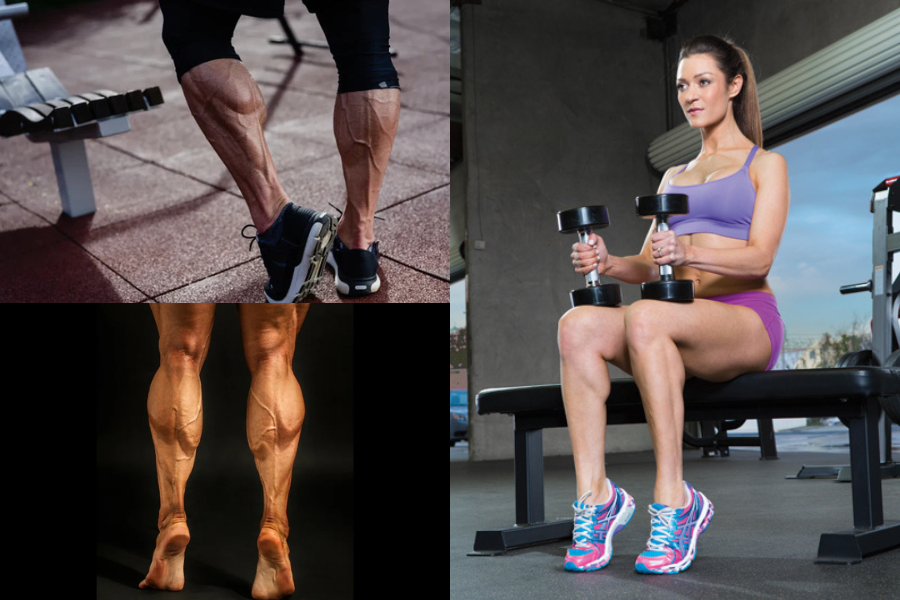
The seated dumbbell calf raise targets the soleus, a deeper calf muscle that is especially important for activities like walking and running. To perform it, sit on a bench with your feet flat on the floor. Place a dumbbell across your thighs close to your knees. Then raise your heels off the ground, pause at the top, and lower them back down again.
You can place the balls of your feet on a low weight plate to increase the range of motion and intensity. Be sure to maintain proper back support, either by sitting upright with your core engaged or by using the bench for support. This reduces strain on your lower back.
In a well rounded calf routine, both standing and seated dumbbell raises have a place, since together they strengthen the full calf complex.
Single leg calf raises with dumbbells
Once you feel confident with double leg calf raises, you can progress to single leg variations. The single leg standing calf raise with a dumbbell is especially effective at targeting each calf separately and addressing side to side imbalances.
To perform it, stand on one leg with the ball of that foot on the floor or an elevated surface. Hold a dumbbell in the hand on the same side, and lightly support yourself with the other hand on a wall or rail if needed. Lower your heel as far as you comfortably can, then press up strongly through the entire width of your foot to rise onto your toes.
Research on calf muscle function shows that the soleus is primarily composed of slow twitch fibers, which respond well to higher repetition work. The gastrocnemius has fewer slow twitch fibers and responds better to moderate and heavy loads. That means it is helpful to vary the load and repetition range when you use single leg dumbbell calf raises, so you challenge both muscles.
Common mistakes to avoid
Calf raises with dumbbells look simple, but a few small errors can reduce their benefits or increase strain on your joints. When you train, watch out for these frequent issues.
One common mistake is rushing through the movement. If you bounce at the bottom and spring up using momentum, the force shifts toward the Achilles tendon instead of the calf muscles. This not only reduces muscle activation but can irritate the tendon over time. Aim for slow, deliberate repetitions with a clear pause at the top.
Another mistake is shortening the range of motion, usually because the weight is too heavy or you are losing balance. When you cut off the bottom stretch or do not rise fully onto your toes, you rob your calves of a complete contraction. Choose a weight that lets you lower your heel as much as possible and lift it as high as you can with full control.
Finally, avoid letting your ankles roll outward or inward. Keep your weight spread across the ball of the foot and big toe, small toe, and center. This helps you push through the entire width of your foot and keeps your ankles aligned.
If you have a history of Achilles, ankle, or knee problems, consider speaking with a healthcare or fitness professional before increasing load or range of motion in your calf training.
Helpful variations for every level
You can adjust calf raises with dumbbells to match your experience and goals. A few simple variations cover most needs.
If you are new to calf training, start with bodyweight single leg standing calf raises. These help you learn the pattern and build balance without worrying about extra load. Focus on a slow tempo and full range of motion from the very beginning.
For more advanced lifters, slow calf raises increase time under tension. Count 3 seconds up, pause for 1 second at the top, and then take 3 seconds to lower back down. This slower style improves muscle activation and can make even light weights feel challenging.
If you struggle with balance on one leg, double leg standing calf raises are a useful compromise. You still use resistance but have more stability. Over time, you can transition from two legs to one leg by gradually shifting more weight onto a single side as you raise and lower.
You can also slightly change your foot position to emphasize different parts of the gastrocnemius. For example, toes pointing inward tend to stress the outer head more, while toes pointing slightly outward emphasize the inner head. These are subtle shifts, so use them only after you have mastered the neutral position.
How much weight should you use?
The right loading for calf raises with dumbbells depends on your current strength. Strength Level data collected in 2026 offers a useful reference for one rep max performances in the dumbbell calf raise.
For male lifters, the average one rep max is about 85 pounds, which falls in the Intermediate strength category and is considered a very impressive lift at that level. Male beginners are encouraged to start around 17 pounds for a one rep max, which is still strong compared with the general population.
For female lifters, the average one rep max is around 48 pounds, also in the Intermediate category. Female beginners might start with roughly 16 pounds for a one rep max, which again is impressive compared with the broader population.
You do not need to test a one rep max to train effectively. Instead, pick a weight that feels challenging but allows you to complete your planned repetitions with control, full range of motion, and good posture. When a set of 12 to 15 reps feels too easy, increase the weight slightly or move to a more difficult variation such as single leg or elevated raises.
How often to train your calves
To see noticeable improvements in strength and size, you can incorporate dumbbell calf exercises 2 to 3 times per week. This schedule gives your muscles time to recover between sessions while still offering consistent stimulus.
On each training day, choose one or two variations, such as standing dumbbell calf raises and seated dumbbell calf raises. Perform 2 to 3 sets of 12 to 20 repetitions, depending on your goal and the load you use. Higher repetitions with lighter weights tend to work well for the soleus, while moderate repetitions with moderate to heavier weights suit the gastrocnemius.
Proper technique matters more than how heavy you go. Engage your core gently for stability, keep your back and knees straight but not locked, and move your heels up and down in a smooth, controlled way. Over time, this combination of consistent practice and progressive overload can significantly improve calf strength, size, and performance in everyday activities like walking, running, and jumping.
Start with one simple change today. Pick a version of calf raises with dumbbells that feels approachable, add it to the end of your next workout, and notice how quickly your lower legs respond when you train them with attention and intent.
About The Author