Get Fit Fast with the Best Exercise Bike Workouts You Need
A stationary bike can be one of the fastest, simplest ways to get fit. The best exercise bike workouts help you burn calories, build stamina, and protect your joints, all without leaving your living room or gym. With the right mix of intervals, steady rides, and smart progression, you can use your bike to lose weight and improve your overall health.
Below, you will find practical, science-backed workouts you can start today, even if you are a beginner. You will also see how to structure your week so you keep making progress without burning out.
Understand why exercise bike workouts work
Indoor cycling is more than pedaling in place. When you use resistance and speed strategically, you train your heart, lungs, and muscles in a very efficient way.
Researchers and coaches highlight a few key benefits:
- Stationary bike workouts build cardiovascular endurance and leg strength for all fitness levels, and are ideal if you need low impact because of joint issues or injury recovery, as indoor cycling instructor Jennifer Tallman explains (SELF).
- Interval training on a bike, where you alternate short bursts of hard work with easier pedaling, helps you burn more calories in less time and improves cardiovascular fitness (Healthline).
- Moderate intensity indoor cycling can burn roughly 210 to 294 calories in just 30 minutes, depending on your body weight. Vigorous cycling can burn 315 to 441 calories over the same time, which is comparable to running or elliptical sessions (NordicTrack).
If your main goal is weight loss, these numbers matter. A well designed routine lets you hit the recommended 150 minutes of moderate activity per week that the CDC suggests, for example 30 minutes of cycling, five days a week, to support heart health and fat loss (NordicTrack).
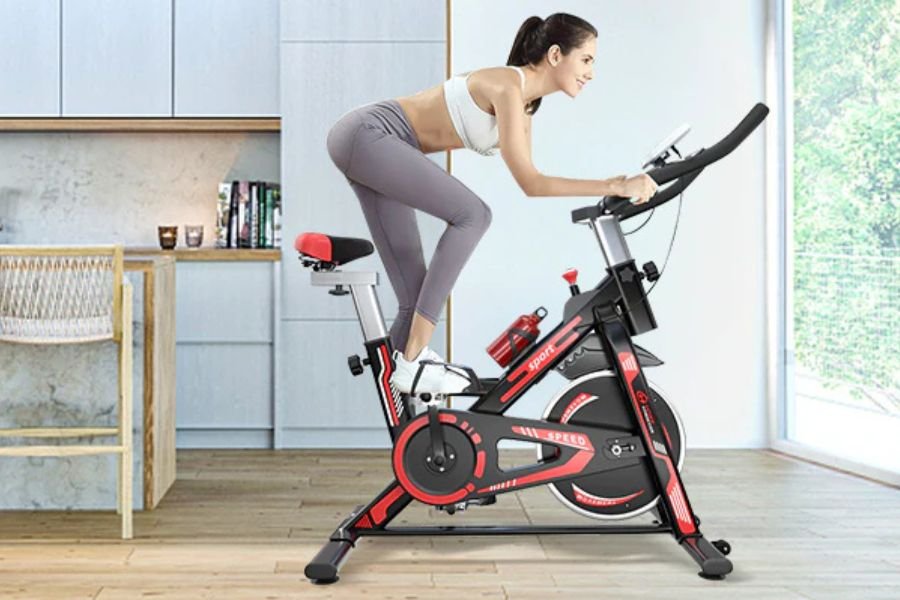
Set up your bike for comfort and safety
You will get more from the best exercise bike workouts if your bike is comfortable and properly adjusted. A poor setup can cause knee, hip, or back pain and may stop you from training consistently.
Start with these basics, especially if you are new to your bike model:
- Adjust the seat height so your knee has a slight bend at the bottom of the pedal stroke, never locked out.
- Move the seat forward or back until your knee is roughly over the center of the pedal when the crank is horizontal.
- If you have a handlebar adjustment, set it so your back feels neutral and your shoulders are relaxed.
Fitness experts recommend that beginners get an orientation if they are at a gym or using a new machine, to learn proper setup and reduce injury risk (Verywell Fit). At home, it can be worth watching a short setup video from your bike manufacturer.
Comfort during indoor cycling also matters for staying consistent. Wearing breathable clothing, keeping a towel nearby, and using a fan or air conditioning can make it easier to push yourself and want to come back for the next ride (Powertrain).
Use intensity levels instead of numbers
You can get a great workout even if your bike does not show power, heart rate, or advanced stats. A simple scale of how hard you feel you are working is enough.
Indoor cycling coaches often use a rate of perceived exertion (RPE) scale from 1 to 10:
- 1 to 2: Very easy, gentle pedaling
- 3 to 4: Easy to moderate, you can talk in full sentences
- 5 to 6: Moderate, your breathing is deeper but you can still talk
- 7 to 8: Hard, you can only speak a few words
- 9 to 10: Very hard to all out, talking is almost impossible
Jennifer Tallman recommends using four general effort levels, easy, moderate, hard, and all out, defined by your breathing and the resistance on the bike (SELF). For each workout below, you will see how to apply these levels so you always know what “hard” should feel like.
Start with a beginner friendly workout
If you are new to exercise or coming back after a break, your main focus should be building a base of consistency. The good news is that you do not need long rides to start seeing benefits.
Verywell Fit suggests starting with just a few minutes of cycling, then adding time gradually as your endurance improves (Verywell Fit). Here is a simple 25 minute workout to get you going:
- Warmup, 5 minutes at easy effort (RPE 3 to 4). Spin the legs, keep resistance low, and let your breathing slowly deepen.
- Baseline block, 3 minutes at moderate effort (RPE 5). Increase resistance slightly until you feel like you are working, but can still talk.
- Push block, 2 minutes at harder effort (RPE 6 to 7). Add a bit more resistance or speed. You should feel challenged, but not breathless.
- Repeat steps 2 and 3 three more times, for a total of 20 minutes of work.
- Cool down, 5 minutes back at easy effort (RPE 3). Gradually reduce resistance and slow your legs.
This structure matches what many coaches recommend: after you can ride for about 20 minutes, you slowly add 5 minute segments, usually three minutes at baseline and two minutes a little harder, until you comfortably reach 30 minutes, which meets minimum daily exercise goals (Verywell Fit).
If 25 minutes feels like too much at first, start with 10 to 15 minutes and add two or three minutes every few sessions.
Try a quick 10 minute HIIT routine
When you are short on time, a short high intensity interval training (HIIT) session can deliver a surprising fitness boost. Interval workouts that use 20 to 30 second intense efforts have been shown to increase VO2 max, improve endurance, and support fat loss in a short time frame (Bicycling).
One popular 10 minute stationary bike HIIT workout, shared by riders on Reddit, looks like this (Reddit r/Fitness):
- Warmup, 2 minutes easy pedaling, RPE 3.
- Sprint, 20 seconds all out at very hard resistance, RPE 9 to 10.
- Recover, 2 minutes very easy, RPE 2 to 3.
- Repeat steps 2 and 3 two more times, for three total sprints.
- Cool down, 3 minutes easy pedaling.
Because the intense parts are so short, you can push close to your max effort, then recover fully. This type of session is demanding, so use it 1 or 2 times per week, not every day, and skip it if you feel very tired or sore.
Use Tabata intervals for a serious challenge
If you are comfortable with harder efforts and want a tough workout that takes only a few minutes, Tabata intervals are one of the best exercise bike workouts for advanced riders.
Tabata training uses 20 seconds of very intense work followed by 10 seconds of rest, repeated for 4 minutes. This protocol was developed by scientist Izumi Tabata, and has been shown to increase muscular power and the intensity you can sustain over a long time trial, which is related to improved lactate threshold (Bicycling).
Exercise physiologist Jacqueline Crockford recommends a similar structure on a stationary bike, working at 80 to 100 percent effort during the 20 second bursts and then dropping resistance very low to recover (SELF).
Here is how you can structure a Tabata style ride:
- Warmup, 5 to 8 minutes building from easy to moderate.
- Tabata round, 8 cycles of:
- 20 seconds at RPE 9 to 10, very high resistance and speed
- 10 seconds very light pedaling at RPE 1 to 2
- Rest, 3 to 5 minutes at easy effort.
- Optional second Tabata round if you are more advanced.
- Cool down, 5 minutes very easy.
Because this is so intense, it is important that you already have a base of regular riding, and that you listen to your body. If you have any cardiovascular or health concerns, check with a medical professional before trying Tabata intervals.
Build stamina with longer steady rides
While HIIT is great for time efficiency and calorie burn, steady moderate rides are the foundation that lets you handle tougher workouts and longer sessions.
Beginners are often better served by building this aerobic base first. Many experienced riders recommend spending a lot of time in Zone 2, or low intensity, before layering in harder intervals. On a perceived effort scale, this feels like RPE 4 to 5, where you can talk in short sentences and your breathing is steady (Reddit r/Fitness).
You can structure a simple stamina workout like this:
- Warmup, 5 minutes at easy effort.
- Main set, 20 to 40 minutes at a steady moderate pace, RPE 4 to 5. Every 5 minutes, check your posture, relax your shoulders, and adjust resistance if needed.
- Cool down, 5 minutes easy.
Over several weeks, you can increase the main set by about 5 minutes at a time. Powertrain suggests starting as low as 3 to 5 minutes for complete beginners, then building to 7 to 10 minutes and beyond as your body adapts (Powertrain).
Mix in fun interval variations
Once you have a bit of base fitness and can ride for 20 to 30 minutes, you can experiment with different interval formats. Variety keeps your workouts mentally engaging and trains your body in new ways.
A few evidence based options include:
- 10 20 30 intervals. Jessica Matthews describes this method as 1 minute blocks on a constant resistance. You ride 30 seconds easy, 20 seconds moderate, and 10 seconds very hard. You repeat these blocks to create a short, time efficient workout that works well on bikes and other cardio machines (SELF).
- Hill charges. By increasing resistance to simulate a climb for short bursts, then recovering with easier pedaling, you improve your climbing strength and teach your body to handle repeated efforts, which is especially useful if you also ride outside (Bicycling).
- Speed intervals. Short 10 second speed bursts with light to moderate resistance train a smooth, quick pedal stroke and can improve your cycling technique and efficiency (Bicycling).
You do not need to use all of these in one week. Rotate them over time so you always feel challenged but not overwhelmed.
A good rule of thumb is to keep most of your rides at easy to moderate intensity, and use only one or two hard interval sessions per week.
Plan a weekly routine for fat loss and fitness
To get the most from the best exercise bike workouts, it helps to see how they can fit into a realistic week. You do not need to train like an athlete to see real change in your health and body composition.
Experts often suggest at least three cardio workouts per week to build endurance and burn calories effectively (Verywell Fit). Andrew Kalley, a triathlon coach, recommends combining interval days with longer moderate rides on a stationary bike at least three times per week for effective fat burning (SELF).
Here is a sample week you can adjust to your schedule:
- Day 1, Beginner or stamina ride, 25 to 30 minutes at easy to moderate intensity.
- Day 2, Rest or light movement, such as walking or stretching.
- Day 3, Interval day. Try the 10 minute HIIT workout or a 10 20 30 session inside a 20 to 25 minute ride.
- Day 4, Rest or easy ride, 15 to 20 minutes at RPE 3 to 4.
- Day 5, Longer steady ride, 30 to 40 minutes at RPE 4 to 5.
- Day 6 and 7, Optional extra easy ride, strength training, or rest.
As your fitness improves, you can lengthen your steady rides or gradually increase the number and length of intervals. Powertrain suggests being consistent at least five days a week for stamina gains, but you should increase volume slowly and allow your body to recover to avoid overtraining (Powertrain).
Stay consistent and keep it enjoyable
The best exercise bike workouts only work if you do them regularly. Many riders find that enjoyment is one of the biggest predictors of long term success.
Community feedback from cyclists suggests that:
- Consistent shorter rides beat sporadic long sessions. For example, riding most days of the week at an easy pace can build more fitness than a single very long weekend ride (Reddit r/Fitness).
- Mixing different workouts, such as classes, virtual races on platforms like Zwift, or guided plans on apps like TrainerRoad or Peloton, can make indoor riding feel more like a game and less like a chore (Reddit r/Fitness).
- Listening to your body, adjusting intensity on days you feel tired, and starting with fun routines keeps motivation higher over the long term (Reddit r/Fitness).
If your main goal is weight loss, remember that nutrition plays a major role alongside your workouts. Healthline notes that combining high intensity indoor cycling with a lower calorie diet in one study, for example 45 minute sessions three times a week plus a 1,200 calorie per day plan, led to significant reductions in body weight, body fat, cholesterol, and triglycerides (Healthline).
You do not have to follow that exact protocol, but pairing regular riding with thoughtful eating will move you toward your goals faster.
Putting it all together
You can use your exercise bike to:
- Burn hundreds of calories in a focused session
- Build strong legs and a healthy heart with low joint impact
- Improve stamina with longer moderate rides
- Boost speed and power with short HIIT and Tabata intervals
Start with the beginner workout, add a short interval session once or twice a week, and gradually build your longer rides. Adjust the resistance and intensity using how you feel, not just the bike display, and keep your setup comfortable so you look forward to each ride.
Pick one workout from this guide to try in your next session. Once that feels manageable, you can layer in the others and create a routine that keeps you motivated, fit, and feeling stronger week after week.
About The Author