Strengthen Your Back with This Friendly Dumbbell Workout
A strong, stable back supports almost everything you do, from carrying groceries to sitting comfortably at your desk. A simple back workout with dumbbells can help you build strength, improve posture, and reduce your risk of pain or injury, all without needing a full gym.
Below, you will find a friendly, beginner‑friendly routine plus clear form cues so you can feel your back working instead of your joints.
Why train your back with dumbbells
A dumbbell back workout does more than build visible muscle. It helps you stabilize your spine, balance your body, and move with more confidence in daily life.
With dumbbells you can:
- Train each side of your body independently to uncover and correct muscle imbalances.
- Move through a greater range of motion than many machines or barbells allow.
- Recruit stabilizer muscles in your shoulders and core for better overall control.
Physical therapists Jaime Aparicio and Amber Lowe note that dumbbell back exercises are especially useful for home workouts because they challenge stabilizer muscles and allow a versatile range of movements without bulky equipment (February 2024).
A strong back also supports a strong core and can improve your posture and balance, which helps reduce your risk of everyday aches and sports injuries, as trainer Austin Cagley explains (February 2024).
Warm up before your dumbbell workout
Treat your warm up as part of the workout, not an optional extra. A good warm up raises your heart rate, wakes up your back muscles, and reduces your chance of pulling something when you start lifting.
Spend 5 to 8 minutes on:
- Light cardio such as brisk walking, easy cycling, or marching in place.
- Dynamic movements like arm circles, torso twists, and bodyweight squats, focusing on keeping your back long and active.
Cagley recommends this style of warm up to help activate your back so it is ready to handle dumbbell rows, deadlifts, and carries safely.
Once you feel slightly warm and loose, you are ready for your first exercise.
Key form tips for all back exercises
You will see these cues repeated. Keeping them in mind during every dumbbell back exercise helps you stay safe and get the most from your workout.
Focus on three big points:
-
Neutral spine
Think of a straight line from the back of your head to your tailbone. Avoid rounding or over‑arching your lower back. If you feel your low back pinching, reset. -
Brace your core
Gently tighten your abs as if you are preparing for a cough. This supports your spine while you hinge, row, and carry. -
Pull with your elbows, not your hands
When you row, imagine your elbows driving back toward your hips. This helps your lats and mid‑back work harder and keeps your biceps from taking over.
If you feel an exercise in your joints instead of your muscles, or you need momentum to swing the weights up, the dumbbells are probably too heavy. Lighten the load so you can move slowly and with control.
The core back workout with dumbbells
You can do this back workout 2 to 3 times per week, leaving at least one rest day between sessions. Start with one or two sets of each exercise and build up as you get comfortable.
Here is a simple structure:
Aim for 3 sets of 8 to 12 controlled reps for most exercises, and 3 to 4 rounds of 30 seconds for carries, using weights that feel challenging by the last few reps but never painful.
1. Dumbbell bent‑over row
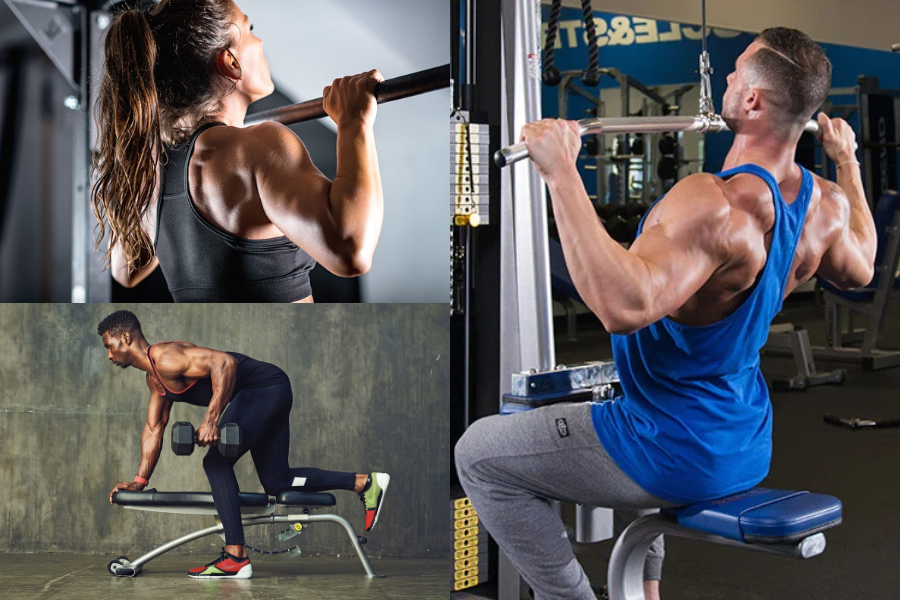
The dumbbell row is one of the best back exercises you can do. It targets the lats and rhomboids and it also makes your core work hard to keep you stable.
How to do it
- Stand with your feet hip‑width apart, dumbbells in your hands.
- Hinge at your hips until your torso is close to parallel with the floor. Keep a soft bend in your knees.
- Let the dumbbells hang under your shoulders with your palms facing each other.
- Brace your core and squeeze your shoulder blades slightly together.
- Pull the dumbbells toward your hip crease, leading with your elbows.
- Pause at the top, then slowly lower the weights until your arms are straight again.
Try 3 sets of 8 to 12 reps. Focus on keeping your torso still instead of rocking to move the weights. If you have to swing, lower the weight.
2. Single‑arm incline dumbbell row
An incline row variation lets you support your chest on a bench so you can focus on your lower lats with less chance of cheating the movement.
How to do it
- Set a bench at roughly a 30 to 45 degree angle.
- Lie face down with your chest glued to the pad and feet planted on the floor.
- Hold a dumbbell in one hand with your arm straight and palm facing in.
- Pull your elbow back toward your hip, keeping your chest on the bench.
- Squeeze your back at the top, then lower the weight with control.
Do 3 sets of 8 to 12 reps per side. Because your torso is supported and cannot rock, this becomes a strict and often humbling back exercise.
If you do not have an incline bench, you can hinge at the hips and support your non‑working hand on a sturdy surface for a similar effect.
3. Renegade row
Renegade rows combine a plank hold with a row. This means you train your mid back and lats while your core, shoulders, and hips work to keep you from twisting.
How to do it
- Start in a high plank position with a dumbbell in each hand, hands under shoulders, feet slightly wider than hip‑width.
- Brace your core and squeeze your glutes so your body forms a straight line.
- Shift your weight slightly to one side and row the opposite dumbbell up toward your ribs.
- Keep your hips as level as you can, avoid letting them roll open.
- Lower the dumbbell back to the floor and repeat on the other side.
Work for 3 sets of 8 to 12 total reps, counting each row separately. To make it easier, widen your feet. To make it harder, bring them closer together.
4. Dumbbell Romanian deadlift (RDL)
Dumbbell RDLs are a powerful way to train your lower back, glutes, and hamstrings. They strengthen the erector spinae that run along your spine and support better posture.
How to do it
- Stand tall with feet hip‑width apart, dumbbells in front of your thighs, palms facing your legs.
- Soften your knees, then hinge at your hips, sending your hips back while the dumbbells slide down your thighs.
- Keep your back flat and your core braced. The dumbbells should stay close to your body.
- Lower until you feel a strong stretch in your hamstrings but no rounding in your lower back.
- Drive through your heels and squeeze your glutes to stand up tall again.
Aim for 3 sets of 8 to 12 reps. Avoid turning this into a squat with lots of knee bend. Too much knee bend or a rounded back shifts stress away from your glutes and hamstrings and onto your spine, which raises injury risk.
5. Kelso shrug
The Kelso shrug targets your upper back, especially the traps and rhomboids, which help you retract your shoulder blades and stand taller.
How to do it on a bench
- Set a bench to around a 45 degree incline and lie face down with your chest supported.
- Hold a dumbbell in each hand with arms straight and palms facing each other.
- Without bending your elbows much, pull your shoulder blades back and slightly down, as if you are trying to pinch them together.
- Pause for a moment, then slowly relax your shoulders forward again.
Do 3 sets of 10 to 15 smaller, controlled reps. Focus on the squeeze between your shoulder blades.
If you do not have a bench, you can hinge at the hips and perform the same motion in a bent‑over position.
6. Farmer’s carry
Farmer’s carries look simple, but they are one of the most effective dumbbell back exercises you can do. Heavy carries encourage scapular retraction and a tight core, which builds resilience through your entire upper body.
How to do it
- Stand tall with a heavy dumbbell in each hand, arms by your sides.
- Pull your shoulder blades slightly back and down. Imagine you are tall and proud, not hunched.
- Brace your core and walk forward with controlled, steady steps.
- Keep your gaze forward and your ribs stacked over your hips.
Perform 3 to 4 rounds of 30 seconds of walking. Rest for 30 to 60 seconds between rounds. Choose a weight that feels challenging but still allows you to maintain good posture.
Sample 30‑minute back workout with dumbbells
Here is how you can put everything together into one balanced session.
- Warm up, 5 to 8 minutes of light cardio plus dynamic stretches.
- Dumbbell bent‑over row, 3 sets of 8 to 12 reps.
- Single‑arm incline row, 3 sets of 8 to 12 reps per side.
- Renegade row, 3 sets of 8 to 12 total reps.
- Dumbbell Romanian deadlift, 3 sets of 8 to 12 reps.
- Kelso shrug, 3 sets of 10 to 15 reps.
- Farmer’s carry, 3 to 4 rounds of 30 seconds walking.
Rest 45 to 90 seconds between sets, or longer if you need it to keep your form sharp.
How to progress your dumbbell back workout
You do not need to overhaul your routine every week. Instead, pick one way to make your back workout with dumbbells slightly more challenging over time.
You can:
- Add a small amount of weight while keeping your reps and form the same.
- Add 1 or 2 reps per set until you reach the top of the suggested range.
- Add one extra set to your main exercises once they feel comfortable.
Start with weights that feel manageable, especially if you are new to these moves. Cagley recommends beginning with lighter loads and gradually increasing as your technique improves so you can build strength safely.
If you ever notice pain in your lower back, shoulders, or joints, pause and reassess your form. Signs that your technique might be off include using momentum to swing the weights, waking up sore in unexpected areas, or not feeling the target muscles working. Slowing down and using a lighter weight often solves these issues.
Bringing it all together
A consistent back workout with dumbbells can help you stand taller, move more easily, and feel stronger in everyday life. You do not need advanced equipment or an hour‑long program, only a few pairs of dumbbells, focused form, and a routine that you repeat regularly.
Pick two or three exercises from this guide and try them in your next workout, then build toward the full routine. With each session, pay attention to how your posture and strength change. Your back will thank you every time you carry something, reach overhead, or sit through a long day without aching.
About The Author