Avoid Injuries with the Best Hamstring Exercises for You
A strong set of hamstrings does much more than power you through deadlifts. When you focus on the best hamstring exercises for your body and your sport, you help protect your knees, support your hips, and significantly cut your risk of muscle strains and tears. With the right mix of strength, control, and flexibility, your hamstrings become far more resilient to everyday demands and high intensity workouts.
Below, you will learn how your hamstrings work, how to choose the best exercises for your goals, and how to build them into a simple plan that supports performance and injury prevention.
Understand what your hamstrings actually do
Your hamstrings are a group of three muscles on the back of your thigh: the semitendinosus, semimembranosus, and biceps femoris. They run from your pelvis down across the back of your knee, and they handle two key jobs: extending your hip and bending your knee. You use them when you walk, run, squat, climb stairs, or hinge forward to pick something up.
In daily life and in many workouts, your quadriceps tend to dominate. Over time this can leave your hamstrings relatively weak. This imbalance is linked to knee pain, poor running form, and a greater risk of pulled or torn hamstrings, especially in activities that involve sprinting or kicking. Strengthening your hamstrings helps restore better balance across your legs and pelvis so your joints are not overloaded on one side.
Hamstring injuries also have a high re‑injury rate, with many recurring in the first few weeks after you return to your usual sport. That is one reason long term hamstring strength work and gradual progress matter so much for staying healthy rather than bouncing from one strain to the next.
Know what makes a hamstring exercise “the best”
There is no single best hamstring exercise that suits everyone. Your ideal choices depend on a few practical questions.
Consider these factors as you decide what belongs in your routine:
- Your main activity: sprinting, field or court sports, distance running, general fitness, or strength training
- Your current level: beginner, intermediate, or advanced
- Any history of hamstring or knee injuries
- The equipment you have access to
- How many days per week you can consistently train
Research on hamstring training points to a simple pattern. The most effective programs for injury prevention and strength include eccentric work, where the muscle is working as it lengthens. Nordic hamstring curls, certain bridge variations, and Romanian deadlifts are great examples of this type of loading.
Volume also matters. A 2024 analysis found that doing roughly 10 to 16 total sets of hamstring work per week, spread over 1 to 3 sessions, both improves muscle size and cuts injury risk. You do not have to do everything at once, but a small, consistent dose of targeted work goes a long way.
Start with beginner friendly hamstring exercises
If you are new to strength training, coming back from time off, or feeling generally tight through your hips and thighs, begin with simpler movements that teach you how to hinge at your hips and contract your hamstrings without straining your back.
Good mornings and bodyweight Romanian deadlifts
Both of these teach you to push your hips back while keeping your spine neutral. For a bodyweight Romanian deadlift, stand tall, soften your knees, then hinge at your hips so your torso leans forward as your hips travel backward. You should feel a stretch in the back of your thighs, then squeeze your glutes and hamstrings to come back up.
Keep your range of motion comfortable and slow, especially on the way down. This slow eccentric phase builds strength and awareness so heavier deadlifts and single leg variations feel safer later.
Glute bridges and basic leg curls
Glute bridges are often thought of as a glute exercise, but if you walk your heels slightly farther from your hips, you will feel your hamstrings engage more. Lying on your back with your feet on the floor, press through your heels to lift your hips and hold a brief pause at the top without arching your lower back.
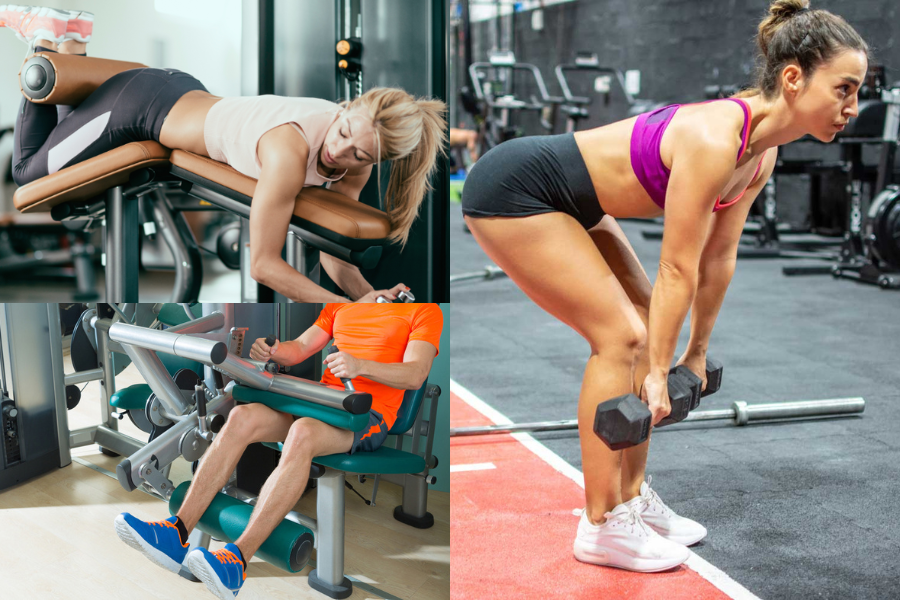
For a more direct hamstring challenge without equipment, try prone leg curls. Lie on your stomach and bend your knees to bring your heels toward your glutes, then slowly lower them back down. You can add a light resistance band or ankle weights later for more load.
Standing leg curls and band curls
Standing leg curls are a simple option if you have no equipment. Stand tall while holding a wall or chair for balance, bend one knee to bring your heel toward your glute, then lower with control. Focus on not letting your knee drift forward and avoid swinging your leg. When that feels easy, loop a small resistance band around your ankles or behind your knees to add tension.
These beginner exercises teach you how to feel your hamstrings working and build basic endurance. Aim for sets of 10 to 20 slow repetitions per leg, twice per week.
Progress to intermediate hamstring strength moves
Once you are comfortable hinging at the hips and feeling your hamstrings work without discomfort, you can move to single leg and slightly heavier variations. These challenge your balance and coordination along with strength.
Reverse lunges and single leg deadlifts
Reverse lunges shift more emphasis to your glutes and hamstrings compared with forward lunges. Step one foot back, lower your back knee toward the floor, and push through the front heel to come up. Keep your front shin fairly vertical so your hamstrings and glutes carry more of the load.
Single leg Romanian deadlifts build on the same hip hinge pattern you used earlier, but now on one leg. Stand on one foot, keep a slight bend in your knee, and hinge at your hips as your free leg extends behind you. The goal is to feel a strong but controlled stretch along the back of your standing leg, then return to standing by driving your hips forward. This move is excellent both for hamstring strength and for testing your flexibility and balance.
Single leg bridges and reverse hypers
Straight single leg bridges are a natural step up from basic bridges. With one foot on the floor and the other leg extended, push your hips up while keeping them level. These demand more from your hamstrings and glutes and help you spot side to side differences.
Reverse hypers, done by lying face down on a bench with your legs hanging off, allow you to lift your legs behind you using your glutes and hamstrings. Done with control and not excessive arching through your lower back, they can build strength for running and lifting without needing heavy weight.
At this stage, you can work in the 8 to 15 rep range for 2 to 3 sets per exercise, still focusing on smooth control rather than speed.
Use advanced hamstring exercises for maximum strength
If you already lift regularly or play a sport that demands explosive power, you will benefit from heavier, more complex hamstring exercises that emphasize both strength and eccentric control.
Romanian deadlifts and single leg Romanian deadlifts
Romanian deadlifts with a barbell or dumbbells are a staple in nearly every strong hamstring program. Start from a standing position, hinge at your hips while keeping the weights close to your thighs, then lower them to around mid‑shin or wherever your hamstring flexibility comfortably allows. Your back should stay neutral, and you should feel most of the effort in your hamstrings and glutes, not your lower back.
Single arm or single leg Romanian deadlifts are also very effective. A 2018 study from the American Council on Exercise found that kettlebell swings, single arm and single leg Romanian deadlifts, and traditional Romanian deadlifts were among the most effective options for quickly activating and strengthening the hamstrings in young adults. If you enjoy kettlebells, swings can be a powerful addition once you have a solid hip hinge pattern.
Nordic hamstring curls and eccentric bridges
Nordic hamstring curls are one of the most researched exercises for preventing hamstring injuries, especially in runners and field sport athletes. You kneel with your feet anchored under a partner or sturdy object, then slowly lean your body forward from the knees while trying to resist the fall with your hamstrings. Take about five seconds to lower, then catch yourself with your hands and push back up.
Because they load the hamstring as it lengthens, Nordic curls build exactly the kind of eccentric strength you need for fast running and sudden decelerations. They are very challenging and often cause soreness at first, so begin with only a few slow reps and progress gradually.
Eccentric bridge variations, such as sliding your heels out slowly on a slick floor from a bridge position, also emphasize the lengthening phase. These are helpful on their own or as preparation for more demanding Nordic curls.
Sprinting, bounds, and plyometric work
If your body tolerates impact, well planned sprint work might be the most powerful hamstring training you can do. High speed running places enormous demands on the hamstrings, especially as they work eccentrically to control your leg at the end of the swing phase. That is why you often hear of strains during maximal sprints or kicks.
Straight leg bounds, jump squats, and other plyometric drills sit slightly lower on most hamstring exercise tier lists than sprinting or Romanian deadlifts, but they still offer valuable stimulus for contact athletes and anyone who needs explosive leg power. Use them sparingly and always after a thorough warm up.
Balance strength with flexibility and recovery
Strong hamstrings still need to move well. Tight hip flexors can leave your hamstrings long and weak, which can feel like constant tightness even if stretching does not seem to help. The solution is usually a mix of strength work and sensible flexibility training rather than stretching alone.
Helpful hamstring stretches include:
- A standing straight leg hamstring stretch, often done as a forward fold
- Downward Dog
- A half kneeling hamstring stretch with your front leg extended
- A supine hamstring stretch using a strap or towel
Foam rolling your hamstrings can also help ease muscle spasms and improve flexibility in a way similar to massage. Work slowly along the back of your thigh for short bouts, such as 20 seconds per area, and repeat as needed.
Think of these recovery tools as support for your strength work. They help you tolerate training volume, move through better ranges of motion, and may reduce post workout soreness.
A practical weekly target is 10 to 16 sets of hamstring exercises spread across 1 to 3 sessions. This gives you enough stimulus for strength and injury prevention without overwhelming your recovery.
Put it together in a simple weekly plan
To make this easy to apply, here is a sample structure you can adapt to your level and equipment.
On 2 days each week, choose:
- 1 hip hinge movement, such as Romanian deadlifts or good mornings
- 1 single leg or unilateral exercise, such as single leg deadlifts or reverse lunges
- 1 hamstring isolation exercise, such as curls, bridges, or Nordic curls
- Optional, 1 short hamstring stretch or mobility block at the end
For example, a beginner day might be: bodyweight Romanian deadlifts, reverse lunges, prone leg curls, and a brief forward fold stretch. A more advanced day could be: Romanian deadlifts, single leg Romanian deadlifts, Nordic curls, and eccentric bridges.
Rotate variations every 4 to 6 weeks, track your sets and reps, and gradually increase difficulty by adding weight, slowing the eccentric phase, or progressing to more challenging versions.
When to be cautious or seek help
If you are recovering from a recent hamstring tear or you have persistent pain that does not settle after rest, it is worth seeing a medical or sports professional for a personalized plan. They can guide you on when to introduce eccentric work like Nordic curls and how fast to progress, which is especially important given the high re‑injury rate within the first month of returning to sport.
Listen to how your body responds. A bit of muscle ache 24 to 48 hours later is normal when you introduce these exercises, especially the eccentric focused ones. Sharp pain, sudden pulling, or swelling are signs to back off and get assessed.
When you choose the best hamstring exercises for your current level, apply them consistently, and respect recovery, your legs become far more resilient. You will likely notice fewer twinges, stronger strides, and more confidence in everything from daily walks to heavy lifts and fast runs.
About The Author