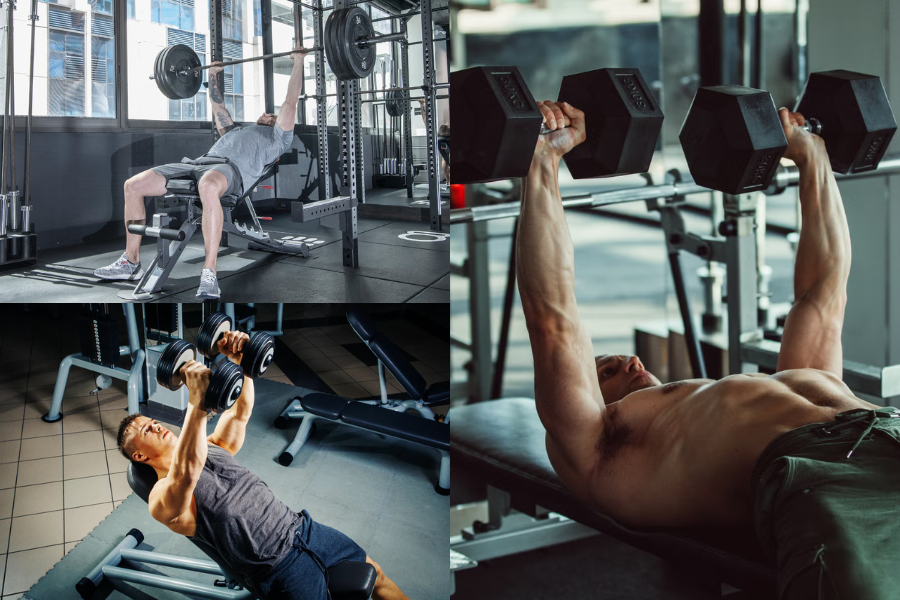
Get Strong Fast with These Good Chest Exercises for Men
A strong chest makes almost every upper body movement feel easier. When you focus on good chest exercises for men, you build power for pressing, improve your posture, and add visible size through your whole torso. You do not need an advanced program to see results. You just need the right mix of exercises, smart form, and consistent effort.
Below, you will find a clear guide to the best chest exercises for men, whether you train in a gym or at home with just bodyweight.
Understand how your chest muscles work
Before you load up a bar, it helps to know what you are actually trying to train. Your chest is mostly the pectoralis major, a large fan-shaped muscle that has two main regions:
- The upper chest, often called the clavicular head
- The middle and lower chest, often called the sternal head
Different angles hit different areas more intensely. Flat pressing tends to work the mid chest. Incline positions shift more tension to your upper chest. Decline positions and dips drive more stress into the lower chest.
You also use your shoulders and triceps heavily in most good chest exercises for men. That is why compound moves like the bench press are so useful for building overall upper body strength and size.
Build your base with the bench press
If you want bigger, stronger pecs, the bench press deserves a place in your routine. The barbell bench press is one of the best chest exercises for men because it recruits muscle fibers across your entire chest, plus your anterior deltoids and triceps. It is also great for building raw pressing power and long-term strength.
For beginners and intermediates, a solid starting point is 3 sets of 6 to 12 repetitions. Focus on control and consistent bar path. Many lifters find that 3 to 4 sets of 8 to 10 reps work well for both strength and muscle growth.
You can also switch to dumbbells. A dumbbell bench press increases stabilization demands and can help correct side to side imbalances. Because each arm moves independently, your muscles have to work harder to keep the weights steady, which often means more activation.
Bench press form checkpoints
Set up with your eyes under the bar. Plant your feet solidly on the floor and lightly arch your back so your chest is high. Grip the bar slightly wider than shoulder width so that your forearms are vertical at the bottom.
Lower the bar under control to your mid chest. Keep your elbows at about a 45 degree angle to your torso to protect your shoulders. Press the bar back up by driving it slightly toward your face, not straight up and down. This creates a strong, efficient bar path and helps you keep your shoulders packed and safe.
Target your upper chest with incline pressing
A well developed upper chest gives your torso that lifted, full look. Many men struggle to grow this area. That is where incline pressing comes in. Both the barbell incline bench press and the dumbbell incline bench press are excellent options for shifting more tension to the upper chest.
Many lifters even favor the barbell incline bench press over flat bench when their main goal is upper chest growth. Reddit users have highlighted this since at least 2013, noting better development when they prioritize incline work.
The incline dumbbell bench press gives you an even deeper stretch and can be easier on your shoulders. Because the dumbbells allow a more natural arm path and greater range of motion, you get a strong stretch at the bottom and a powerful squeeze at the top. Some lifters rely on incline dumbbell work almost exclusively for chest growth and report great results.
A good starting range is 3 to 4 sets of 8 to 10 reps. Choose an incline of roughly 30 to 45 degrees. Too steep and the move turns into more of a shoulder press and you lose some chest emphasis.
Shape and define with fly variations
Once you have your big presses in place, fly movements help you pile on extra tension and stretch. Dumbbell flies and cable flyes are two of the most popular isolation chest exercises.
Dumbbell chest flies are essential for creating that deep stretch across the chest and practicing a strong squeeze at the top. You will usually use lighter weights here since the goal is muscular tension, not moving maximum load. Try 3 sets of 10 to 12 reps and think about pulling your upper arms together in a wide arc instead of just bending and extending your elbows.
Cable flyes keep constant tension on your pecs from start to finish. Many lifters credit cable flyes as the move that gave them the most chest definition. Because the cable line of pull does not change, your muscles never really get to relax during a set, which is very useful for hypertrophy.
You can also experiment with band chest flies, or variations like the T bench glute bridge fly. These shoulder friendly options are often used at the end of a workout for 3 to 4 sets of 12 to 15 reps to finish the chest completely.
For muscle growth, isolation movements like flies are most effective after your main compound presses, when your chest is already warm and somewhat fatigued.
Use bodyweight push ups for strength and size
Push ups are more than a basic warm up. They are one of the most effective bodyweight chest exercises you can do. Research on young men with resistance training experience shows that push ups can provide comparable muscle activation and strength gains to the bench press when programmed correctly.
Standard push ups work your pectoralis major and minor, triceps, and anterior deltoids. They also train your core for stabilization which improves overall athleticism. To grow, aim for 3 to 4 sets of 12 to 15 reps with strict form. Keep a straight line from your head to your heels and maintain a locked, braced core.
There are many push up variations that help you target different parts of the chest and adjust the difficulty:
- Incline push ups are easier and perfect if you are just starting out. Place your hands on a bench or sturdy chair and perform 8 to 15 repetitions for 3 to 4 sets. This reduces the load on your chest and shoulders while still building strength.
- Decline push ups emphasize the upper pectoral muscles and front shoulder area. Elevate your feet on a chair or bench and perform 5 to 15 repetitions for 3 to 4 sets, keeping your hips from sagging.
- Diamond push ups hit the inner chest and triceps hard. Form a diamond with your thumbs and index fingers under your chest and perform 8 to 15 repetitions for 3 to 4 sets, resting 30 to 60 seconds between sets.
- Deficit push ups are done with your hands on handles or blocks so you can drop your chest lower. This increases the range of motion at the shoulders and elbows and can improve chest hypertrophy by recruiting more motor units. Use caution and avoid excessive shoulder stress, especially if you have a history of shoulder pain.
You can also explore offset push ups, one leg push ups, wide grip, plyometric, and decline or incline versions to keep your training fresh. These variations demand more core stability, unilateral strength, and balance which makes them very effective for long term progress.
Add dips and lower chest work
If you have access to parallel bars, dips are a powerful tool for chest development. Bodyweight dips, especially when performed leaning forward with a slight elbow flare, strongly target the lower chest while still training your triceps and shoulders.
Start with assisted dips or band support if you cannot do full bodyweight yet. Once you can handle sets of 8 to 10 clean reps, you can gradually add load with a belt or holding a dumbbell between your feet. These weighted dips significantly increase chest activation without necessarily over fatiguing your triceps.
For more inner and lower chest focus, the single arm cable crossover is an excellent option. This move works in the transverse plane and incorporates rotational movement, which enhances muscle fiber recruitment and reinforces a strong mind muscle connection. It is also a functional and athletic pattern that carries over well to sports and everyday activities.
Train effectively at home without equipment
No gym memberships or machines are required to build a strong chest. With creativity, you can get a serious workout using bodyweight and household items.
Standard push ups and their variations are your foundation. Regular, decline, incline, offset, one leg, diamond, plyometric, wide, seal, and deficit push ups all provide slightly different challenges. Studies on men with training experience show that these variations can match many of the benefits of the bench press when programmed with enough total volume.
You can also perform bench press style movements at home with dumbbells or even filled water bottles. Lying on a flat bench or the floor, press the weights for 2 to 4 sets of 8 to 15 reps. Floor presses work especially well if you do not have a bench because they reduce shoulder strain by limiting the range of motion at the bottom.
Isometric push ups are another great at home tool. Lower yourself to the bottom of a push up with your elbows at 90 degrees, then hold for about 15 seconds. Aim for 3 to 4 repetitions with 45 to 60 seconds of rest. This increases time under tension, which is a key driver of muscle growth.
Plan your weekly chest workouts
To see noticeable progress, you need enough weekly volume. A good rule of thumb for men is to perform at least 10 sets of direct chest work per week. If you are more advanced, you may gradually increase that number, but it is smart to start around 10 and assess your recovery.
Compound lifts like the bench press should appear early in your workout when you are fresh. After that, add incline pressing, dips, and fly variations. Finish with higher rep isolation or bodyweight work to fully fatigue the muscles.
Rep ranges should match your goals:
- 1 to 6 reps for strength, usually on heavy presses
- 6 to 12 reps for hypertrophy, the main target for most chest exercises
- 12 to 20 or more reps for muscular endurance and finishers
Training techniques such as progressive overload, where you steadily increase weight or reps over time, are essential. Equally important is maintaining a strong mind muscle connection. Focus on feeling your chest stretch and contract on every rep, rather than just moving the weight from point A to point B.
Put it all together
Good chest exercises for men revolve around a mix of heavy presses, targeted incline work, deep stretch flyes, and smart push up or dip variations. You do not need to do every exercise in a single session. Instead, pick a few staples, commit to proper form, and gradually push your volume and load.
If you are just getting started, choose one flat press, one incline press, one fly variation, and one push up or dip option. Train your chest one to two times per week, hit at least 10 total sets, and track your progress.
Stay consistent for a few months and you will feel the difference every time you push, pull, or pick something up.
About The Author


