Best Chest Exercises for Men to Build Strength Fast
A strong, well built chest is about more than looks. The right chest exercises for men improve posture, pressing strength, and shoulder health, whether you want to fill out a T shirt or simply feel stronger in everyday life. With a smart plan, you can build your chest at home or in the gym without wasting time on random workouts.
Below, you will learn how your chest muscles work, the best exercises for each area, and how to build an effective routine to gain size and strength fast while staying safe.
Understand your chest muscles
If you want a bigger, stronger chest, it helps to know what you are actually training.
Your main chest muscle is the pectoralis major. It has three key regions: the upper chest, also called the clavicular head near your collarbone, the mid chest or sternal head across the middle of your chest, and the lower chest or abdominal head closer to your ribcage. The fibers in each region run in slightly different directions. That is why some chest exercises for men hit your upper chest harder, while others load the mid or lower areas more.
You get the best growth when you train all three regions, use enough resistance, and move your arms across the midline of your body. That full sweep across your chest is where the muscle works hardest, especially during fly and crossover movements.
Best compound chest exercises for men
Compound exercises move more than one joint at a time and let you lift heavier weights. These should form the base of your chest workouts.
Barbell bench press
The barbell bench press is a classic for a reason. It heavily trains your mid chest and lets you handle serious weight.
Lie on a flat bench with your eyes under the bar. Plant your feet, squeeze your glutes, and brace your abs. Grip the bar slightly wider than shoulder width, pull your shoulder blades back into the bench, and keep your upper arms at about a 45 degree angle from your torso. Lower the bar to the lower part of your chest with control, then press back up while driving your feet into the floor.
Keeping your arms at 45 degrees instead of flared out protects your shoulders and helps you feel your chest more, a point highlighted by Men’s Health fitness director Ebenezer Samuel in 2023. Flaring to a full 90 degrees often leads to shoulder irritation and less chest engagement.
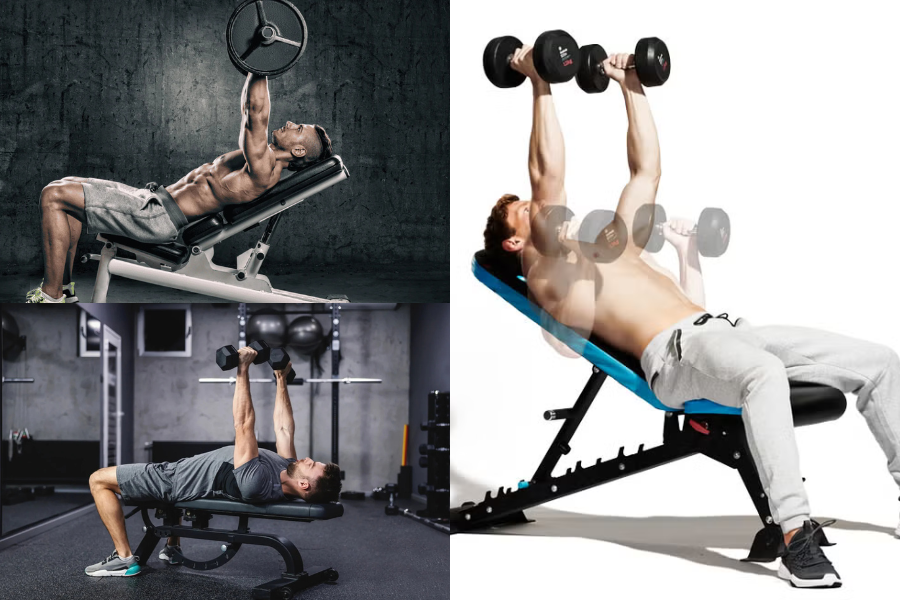
Incline bench press
If you want a fuller upper chest that looks square and lifted from the side, you need incline work. Setting the bench at about 30 to 45 degrees shifts more load to the clavicular head near your collarbone, which helps give your chest that high, shelf like look, as explained in a Gymshark article from August 2025.
You can use a barbell or dumbbells. Keep your forearms vertical at the bottom of the rep, regardless of the bench angle. Many beginners push at a steep angle that lines the bar up almost over the face, which stresses the shoulders. Focus on pressing the weight up in line with your upper chest instead.
Weighted dips
Weighted dips are powerful for your lower chest and triceps. Use parallel bars, lean your torso slightly forward, and let your elbows track at a comfortable angle. The deeper you go, the more stretch you place on the lower portion of your pecs, so stay within a pain free range.
If bodyweight dips are already challenging, you do not need to add weight yet. Just focus on slow, controlled reps. When they feel easy, add a dip belt or hold a dumbbell between your feet.
Best dumbbell chest exercises for men
Dumbbells are joint friendly and excellent for evening out strength imbalances. Each arm works independently, you can fine tune your grip, and you can move through a larger range of motion than with a bar.
Flat dumbbell bench press
The dumbbell bench press is one of the best all around chest exercises for men to build size and strength. You can perform it on a flat bench or even on the floor if you train at home.
Start with the dumbbells on your thighs, lean back, and kick them into position above your chest with straight arms. Retract your shoulder blades, keep your wrists stacked over your elbows, and lower the weights until your elbows are just below the bench. Press up and lightly touch the dumbbells at the top, then repeat. Aim for 3 to 4 sets of 6 to 8 reps with a weight that challenges you.
Engage your glutes and abs throughout to create a stable base, and consciously squeeze your chest at the top of each rep to maximize activation.
Incline dumbbell press
Incline dumbbell presses are ideal for upper chest development because the angle changes where the tension is highest. Research shows that an incline around 30 to 45 degrees increases activation of the upper chest compared with flat variations, while the greater range of motion helps correct muscle imbalances.
You will usually be able to lift slightly less weight than on the flat press, so check your ego and choose a load that allows clean technique. A common target is 3 to 4 sets of 8 to 10 reps.
Decline dumbbell press
Decline presses place more stress on the lower chest fibers. Even a small decline is enough. Secure your feet, lie back carefully, and keep the same 45 degree arm angle relative to your torso that you use on flat benching to protect your shoulders.
Mixing flat, incline, and decline dumbbell presses through your training week is a simple way to ensure every chest region gets attention.
Isolation moves to sculpt your chest
Once your main heavy sets are done, isolation exercises let you directly target the pecs without being limited by your triceps or shoulders.
Dumbbell chest fly
Dumbbell chest flyes emphasize adduction, or bringing your arms toward the midline of your body, which is a primary function of the pecs. Lie on a bench, hold the dumbbells above your chest with a slight bend in your elbows, and slowly arc your arms out to the sides. Stop when you feel a deep stretch across your chest but before your shoulders complain. Bring the weights back together over your chest in the same arc.
Because flyes put your shoulder joint in a stretched position, form matters more than load here. A common guideline is 3 sets of 10 to 12 smooth reps with moderate weight.
Cable crossovers and low to high flyes
Cable crossover variations keep tension on your chest throughout the entire movement, which is great for muscle growth. Setting the pulleys low and pulling up and across your body, often called low to high flyes, is particularly effective for your upper chest.
Recent biomechanics research from 2022 shows that low to high cable flyes create greater shoulder joint movement and constant tension. That mechanical tension is a major driver of hypertrophy. Focus on crossing your hands slightly in front of your chest to squeeze through the midline, then control the return.
Effective chest workouts at home
You do not need a full gym to build an impressive chest. With some dumbbells, resistance bands, or even just your bodyweight, you can create effective chest workouts for men in a small space.
Bodyweight push up variations
Push ups remain one of the most accessible chest exercises for men, and you can progress them further than you might think.
- Standard push ups build general strength and endurance.
- Incline push ups, with your hands on a bench or chair, are easier and ideal for beginners. They slightly bias the lower chest.
- Decline push ups, with your feet elevated, load the upper chest more and are more demanding.
- Diamond push ups bring your hands close together under your chest, increasing triceps and inner chest involvement.
You can also experiment with isometric push ups, where you lower halfway and hold with your elbows at 90 degrees for about 15 seconds. Performing 3 to 4 of these long holds with 45 to 60 seconds of rest can dramatically increase chest tension.
Some trainees on Reddit report noticeable pec development doing very high daily push up volumes, such as 300 to 400 per day over many months. You probably do not need that extreme approach, but it shows how powerful simple movements can be when you are consistent.
Simple at home pressing
If you have dumbbells or even filled water bottles, you can bench at home by lying on a flat bench or on the floor. Pressing this way still strengthens and defines your pecs, front delts, and triceps. Aim for 2 to 4 sets of 8 to 15 reps depending on your current strength.
How often to train your chest
To grow your chest as quickly as your body allows, you need enough weekly work and enough rest to recover.
For most men, training chest 2 times per week is a sweet spot for growth and recovery. Current expert guides on dumbbell chest training suggest this schedule, with the option to increase to 3 times per week later if progress stalls and your joints feel good.
You can think in terms of sets and reps as well as days:
- For strength, use heavier weights for 2 to 5 sets of 5 to 10 reps per exercise.
- For muscle growth, use moderate weights for 2 to 5 sets of 10 to 20 reps, or even 20 to 30 reps on lighter isolation work.
Whichever rep range you choose, take your sets close to failure while keeping your form tight. That effort is what signals your chest to grow.
Common chest training mistakes to avoid
Small technique errors and programming mistakes can limit your results and increase your injury risk. You can sidestep many of the common pitfalls by paying attention to a few details.
Skipping a proper warm up
Going straight to heavy benching with cold muscles increases your risk of strains and reduces your range of motion. Instead, spend 5 to 10 minutes raising your body temperature with light cardio, then do a couple of easy warm up sets of push ups or light presses before your working sets.
Losing shoulder position
During presses, protracting or rounding your shoulder blades causes your shoulders to dominate the lift instead of your chest. Retract and gently pin your shoulder blades into the bench or pull them back while doing push ups. This posture helps recruit your outer, upper, and inner chest more effectively and keeps your shoulders healthier.
Flaring your elbows
As mentioned earlier, flaring your elbows to a 90 degree angle from your torso often causes shoulder discomfort and shifts work away from your chest. Keeping your upper arms around 45 degrees relative to your torso activates your lats, allows more stable pressing, and lets you handle more productive volume.
Ignoring your back
Chest exercises tend to pull your shoulders forward. If you never train your back, you can develop rounded shoulders, nagging pain, and a physique that looks unbalanced. Include rowing variations, such as barbell or dumbbell rows, to maintain shoulder health and posture. A strong back supports a strong chest.
Lifting too heavy too soon
Ego lifting by loading the bar beyond your capacity usually leads to sloppy form, less time under tension on your pecs, and a higher risk of injury. Choose a weight that lets you control the lowering phase, press without bouncing, and keep tension on your chest instead of relying on momentum.
You can add advanced techniques like drop sets, partial reps, and paused reps once your form is solid. These methods increase intensity and stimulate more hypertrophy, but they work best on top of, not instead of, good fundamentals.
Putting it all together
You now understand how your chest is built, which chest exercises for men target each region, and how to structure your training for fast, sustainable progress.
To recap in a simple checklist you can use today:
- Pick 2 compound presses for each workout, such as a flat bench and an incline press.
- Add 1 to 2 isolation moves, like dumbbell flyes or cable crossovers, to hit the chest across the midline.
- Train your chest 2 times per week with 2 to 5 hard sets per exercise in your chosen rep range.
- Warm up thoroughly, retract your shoulder blades, and keep your elbows at about 45 degrees.
- Balance your chest work with regular back training to protect your shoulders and posture.
Start with the setup that fits what you have, whether that is a full gym, a basic pair of dumbbells, or just floor space for push ups. Focus on consistent effort, clean form, and gradually challenging weights, and you will see and feel your chest get stronger in the weeks ahead.
About The Author