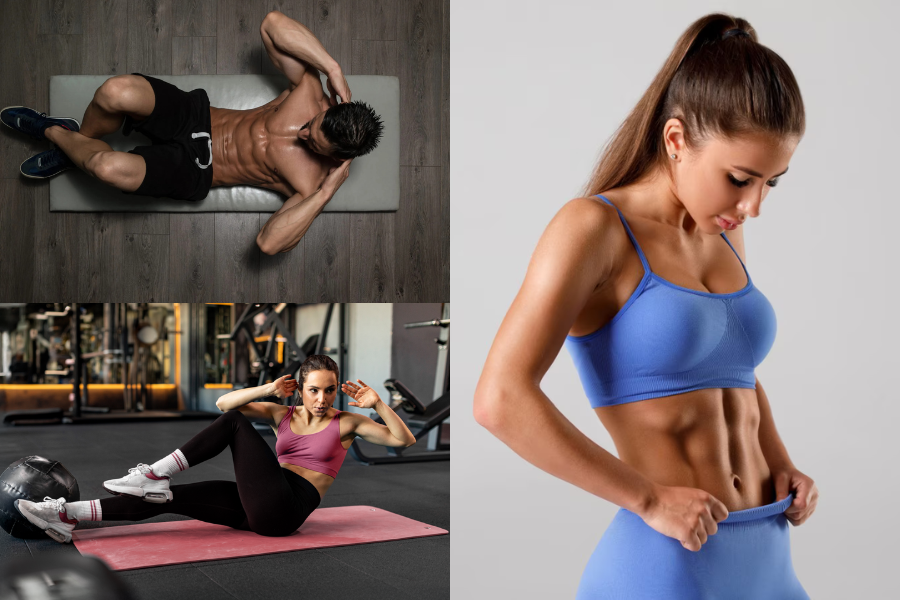
Unlock Your Strength with an Ab Workout for Athletes
Why athletes need specific ab training
An ab workout for athletes is about much more than a six pack. Your core is the link between your upper and lower body, so every sprint, jump, swing, or tackle passes through it. When it is strong and stable, you transfer power more efficiently, perform better, and reduce your risk of injury.
Your abdominal core includes more than just the visible rectus abdominis. It also includes your internal and external obliques, transverse abdominis, quadratus lumborum, and hip flexors like the psoas major. Training all of these muscles in a balanced way supports posture, protects your lower back, and helps you handle heavy lifts like squats, deadlifts, and presses with more confidence.
Core strength versus visible abs
You can build a powerful core without seeing a single ab. Visible definition mainly depends on your body fat percentage. For many people, that means roughly 6 to 15 percent body fat for men and 10 to 22 percent for women, alongside solid ab training and smart nutrition.
If you are focused on performance, your priority is function. A strong core helps you stabilize your spine and pelvis, maintain good positions under fatigue, and absorb contact or abrupt changes of direction. If you also want visual definition, you will combine this type of ab workout with overall fat loss strategies, including nutrition and full body strength and conditioning.
Think of your abs as your performance belt. When they are strong and engaged, everything you do in sport feels more controlled and powerful.
How an athletic core actually works
A complete ab workout for athletes trains your core in all the ways it has to work on the field or in the gym. That includes producing movement, but just as importantly, resisting it.
Key movement and anti movement patterns
Your trunk is challenged in three planes of motion:
- Sagittal plane: flexion and extension, like bending forward or arching backward
- Frontal plane: lateral flexion and extension, like leaning to the side
- Transverse plane: rotation, like twisting to throw or hit
According to strength coach Brandon Robb, many athletes rely too heavily on sit ups and crunches, which focus on flexion in the sagittal plane and mainly hit the rectus abdominis. This can lead to imbalances and a higher risk of low back pain if you ignore lateral and rotational patterns, as well as anti movement work.
Anti movement patterns train your core to resist motion and keep your spine in a safe, neutral position. These include anti flexion, anti lateral flexion, anti rotation, and anti compression, and they are especially important if you accelerate, decelerate, or change direction quickly in your sport.
Why anti movement matters for you
Coaches like Mike Boyle and others popularized the idea that athletes benefit most from stability focused core work, where your job is to keep your trunk still while your limbs move or external forces try to pull you out of alignment. This type of training supports better force transfer from your legs through your torso to your arms, which is essential in sprints, throws, tackles, and swings.
Exercises like Pallof presses, side planks, and certain lunge rotations are designed to challenge your ability to resist unwanted motion. Over time, you feel more solid in contact, more balanced in cuts, and more controlled under heavy loads.
Core training phases for athletes
You can think of your ab and core work in three progressive phases. You might cycle through these phases during the year, or even touch all three in a single week, depending on your schedule and level.
Stability phase
Here you focus on motor control and learning to hold a neutral spine and pelvis. The goal is to activate the right muscles in the right sequence and build endurance at lower intensities. Exercises like deadbugs, bird dogs, and basic planks are perfect here.
Strengthening phase
Once you can hold good positions, you start adding load, longer levers, or slower tempos. You increase eccentric control and may introduce isometric pauses. This might mean weighted carries, longer plank holds, and more demanding variations of leg raises or rotational work.
Chaos phase
Finally, you train your core to stay braced in unpredictable, sport like situations. This could include reactive drills, partner perturbations, or dynamically loaded exercises. The goal is not circus tricks, but learning to keep your trunk stable while the environment changes quickly, like it does in real play.
Best ab exercises for athletes
Below are some of the most effective movements supported by coaches and research. They target multiple muscles at once and help you develop a strong, functional core rather than isolated show muscles.
Bicycle crunches
The American Council on Exercise (ACE) ranks bicycle crunches as one of the most effective ab moves for activating your rectus abdominis and obliques. You lie on your back, lift your shoulders, and alternate bringing opposite elbow to knee with a pedaling motion. This incorporates rotation and challenges your transverse abdominis without any equipment, so it works well as part of a quick home or field workout.
Planks and side planks
Standard planks teach you to brace your entire abdominal wall and glutes while keeping your spine neutral. When you do them correctly and gradually progress your hold from about 10 seconds toward 30 seconds or more, you improve both core and upper body strength.
Side planks are especially valuable for athletes because they target your obliques and deep stabilizers in an anti lateral flexion pattern. That means your core learns to resist bending sideways, which supports posture, reduces back strain, and helps you stay aligned during cuts, landing, and heavy squats.
Leg raises
Leg raises are a staple for targeting your lower abs and hip flexors. Strong hip flexors and lower abs support better running mechanics, jumping, and squatting. You can start with lying leg raises and progress to hanging leg raises as your control improves.
Focus on keeping your lower back gently pressed into the floor or keeping your ribs down if you are hanging. You want your abs, not your lower back, to do the work.
Bird dogs and deadbugs
Bird dog exercises are especially helpful if you tend to feel ab work in your lower back. On all fours, you extend opposite arm and leg while keeping your trunk stable. This builds core and back strength together and has been recommended as a way to improve lower back function and reduce pain.
Deadbugs flip the position. You lie on your back with arms and legs in the air and then slowly extend opposite arm and leg while maintaining a neutral spine. Coaches often program deadbugs two to three times per week to teach athletes how to brace their core while their limbs move, which carries over to running, lifting, and change of direction.
Supermans and back extensions
You cannot have strong, healthy abs without a strong posterior chain. Supermans, where you lie face down and gently lift your arms and legs, train trunk extension and your lower back muscles. They help balance all the flexion based work and support better posture.
Use controlled reps and avoid overextending your spine. The goal is smooth, steady activation rather than big, jerky movements.
Rotational and weighted core work
For sports involving twisting, like tennis, golf, baseball, or many field sports, you need rotational strength and control. Russian twists and cable woodchoppers are excellent for building your obliques and transverse abdominis with load. By holding a weight or cable and rotating your torso with control, you can progressively overload these patterns to match your sport demands.
Isometric lunge banded rotations are another powerful option. You hold a lunge position and resist or control band-driven rotation. This mimics catching or swinging in a staggered stance, so it closely reflects the stress you deal with in competition.
Sample ab workout for athletes
You can build an effective ab workout for athletes in as little as 15 minutes, using bodyweight only. Aim to do this two to three times per week after your main training. Adjust sets and reps to your level and sport schedule.
15 minute functional core circuit
Perform 3 rounds. Rest 30 to 45 seconds between exercises and 1 minute between rounds.
- Deadbug: 8 to 10 reps per side
- Side plank: 20 to 30 seconds per side
- Bicycle crunches: 12 to 15 reps per side
- Bird dog: 8 to 10 reps per side
- Lying leg raises: 10 to 12 reps
On another training day, you might swap in rotational or weighted work, such as Russian twists or banded rotations, to cover transverse plane demands. Over time, you can rotate through stability, strengthening, and chaos variations of these base moves, so your core is prepared for predictable and unpredictable situations alike.
Integrating core work into your training week
You do not need to spend endless time doing abs. In fact, a focused ab workout for athletes two to three times weekly is usually enough when combined with compound lifts and sport practice.
Place your core work:
- After your main strength session, especially on lower body or full body days
- On lighter conditioning days, as part of a short finisher
- In warm ups, using low intensity drills like deadbugs and bird dogs to groove bracing patterns
If your sport or position involves lots of rotation, lateral contact, or overhead work, you can bias your exercise selection toward anti rotation and anti lateral flexion patterns. For example, a rugby forward might spend more time with anti compression and anti rotation work, while a rotational athlete adds more loaded twists and woodchoppers.
Do not forget recovery and nutrition
Your abs respond to training just like any other muscle group. They need progressive overload, but also rest, sleep, and solid nutrition to adapt and grow stronger.
Nutrients like protein, magnesium, calcium, and potassium support muscle function and recovery. Minimizing heavily processed and high sugar foods helps you manage body composition, which matters if you are also aiming for visible definition alongside performance.
Key takeaways
- A strong, stable core is essential for transferring force between your upper and lower body, protecting your spine, and boosting performance in every sport.
- The best ab workout for athletes trains all planes of motion and emphasizes anti movement patterns, not only basic sit ups.
- Exercises like planks, side planks, deadbugs, bird dogs, leg raises, bicycle crunches, and rotational drills form a solid foundation.
- Two to three focused core sessions per week, often around 15 minutes, are enough to make a real impact when you are consistent.
- Pair your training with good recovery and nutrition, and you will not just see stronger abs, you will feel more powerful and controlled in every practice and game.
About The Author





