Effective Women Workout Chest Routines You’ll Love
A strong chest is about much more than upper body definition. When you focus on a women workout chest routine, you build support for your shoulders, improve posture, and make everyday tasks like carrying groceries or pushing a heavy door feel easier.
Below, you will learn how your chest muscles work, why they matter for you, and how to structure simple, effective chest workouts you can actually stick with.
Understand your chest muscles
When you train chest, you mostly target the pectoral muscles or “pecs.” These are the large muscles that cover the front of your upper body, from your collarbone to your upper ribs, and across toward your shoulders.
Your chest training also involves supporting muscles, including:
- Pectoralis major and minor, which are responsible for most pushing motions
- Serratus anterior, which helps move and stabilize your shoulder blades
- Deltoids in your shoulders
- Triceps on the back of your upper arms
When these muscles work together, they stabilize your shoulder joint and support your clavicle and shoulder blades. This helps lower your risk of strains and sprains during everyday life and workouts, as many trainers note in recent strength training guidance for women.
Why chest workouts matter for women
It is common for women to focus on lower body workouts and skip chest day. That can leave you with strong legs but undertrained upper body muscles and rounded shoulders.
Regular chest training gives you several benefits:
You support better posture
Stronger pecs help pull your shoulders into a more neutral position. That support can reduce slouching, ease tension in your neck and upper back, and make it easier to stand tall.
You move more comfortably in daily life
Pushing a stroller, shoving open a heavy door, lifting a suitcase into an overhead bin, or carrying multiple grocery bags all rely on chest, shoulder, and triceps strength. When you train these muscles, those tasks feel less draining.
You reduce your risk of injury
Your chest muscles work with your rotator cuff and upper back to stabilize the shoulder joint. When that area is stronger, you are less likely to experience nagging shoulder issues that can interrupt your workouts.
You breathe more efficiently
Chest workouts help strengthen muscles around your ribcage, including the pectorals and intercostals. Stronger muscles here can support better breathing mechanics and make sustained activity feel easier.
You increase overall calorie burn
Muscle tissue uses energy even when you are not moving. By adding lean muscle to your upper body, you gently raise your metabolism, which supports weight management as part of a balanced strength routine.
Key principles for women chest training
Before you dive into specific exercises, it helps to understand a few basics that will make any women workout chest routine more effective and safer.
Focus on pressing and flying motions
Chest exercises generally fall into two categories:
- Pressing movements, such as pushups and bench or floor presses, which are compound moves that also target your shoulders, back, core, and triceps
- Fly movements, such as dumbbell or cable chest flys, which place more emphasis on the inner chest and require more control
Both types have a place in your routine.
Choose smart frequency and recovery
For most women, training chest 1 to 3 times per week is a solid starting point. Keep at least 24 to 48 hours between sessions that heavily work the same muscles so your pecs and shoulders can recover and grow.
You can pair chest with:
- Shoulders and triceps on upper body days
- Full body workouts that mix chest with legs and back
Prioritize form over load
Ego lifting, which means using more weight than you can control, often shifts the work from your chest to your shoulders and triceps. That slows your progress and raises your injury risk.
Instead, focus on:
- Controlled lowering and lifting
- A full but comfortable range of motion
- Slightly slower tempos on the way down, especially on flys
If your shoulders hurt more than your chest, reduce the weight, check your elbow angle, and shorten the range until you feel the exercise in your pecs again.
Set up your shoulders correctly
For presses and many fly variations, think about gently pinching your shoulder blades together and down toward your back pockets. This position stabilizes your upper back, helps you better engage your chest, and reduces strain at the front of your shoulders.
Best chest exercises for women
You can build an effective women workout chest routine with a mix of these beginner friendly and intermediate moves. Use dumbbells, a barbell, resistance bands, or even household items like filled water bottles if you train at home.
Pushup variations
Pushups are one of the most efficient chest exercises because they also work your triceps, shoulders, core, and back.
You can scale them to your current strength level:
- Incline pushups: Place your hands on a bench, sturdy table, or staircase. The higher your hands, the easier the move. Incline press ups are especially helpful if you are new to chest training and want a joint friendly entry point.
- Modified pushups: Keep your knees on the floor, but maintain a straight line from knees to shoulders and avoid letting your hips sag.
- Eccentric pushups: Lower slowly from the top of a pushup to the floor, then reset back to the top on your knees or by stepping back into position. This builds strength in the hardest portion of the movement.
- Hand release or medicine ball pushups: Once you are comfortable with standard pushups, you can add hand releases at the bottom or place one hand on a medicine ball for a greater challenge and added stability work.
Aim to keep your elbows about 45 degrees out from your ribs, not flared straight to the side, to protect your shoulders.
Dumbbell or barbell chest press
Chest presses are one of the most effective ways to strengthen both your upper and lower chest while also training your triceps and front deltoids.
You can perform them:
- On a flat bench with dumbbells or a barbell
- On the floor, which limits the range slightly and is easier on your shoulders
- With weighted household items if you do not have equipment yet
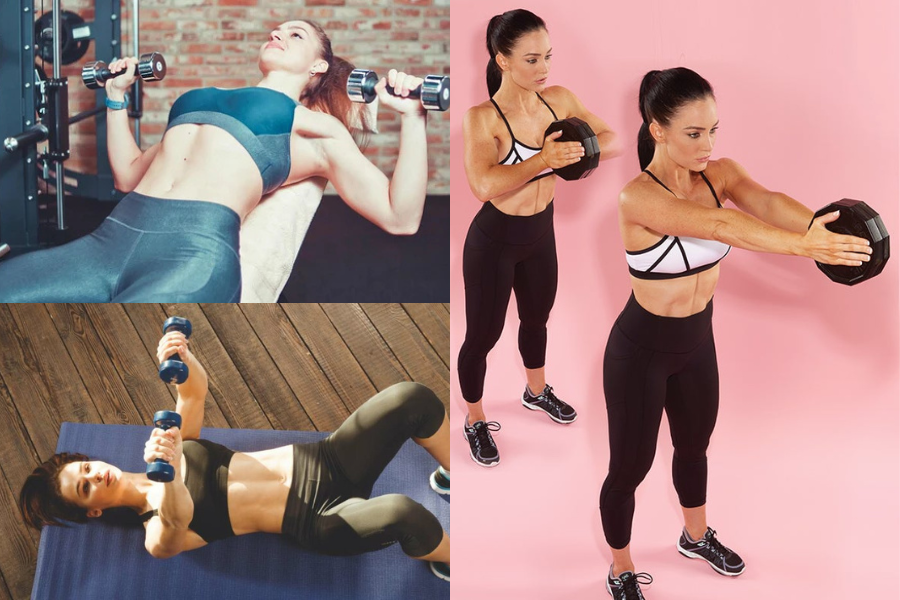
Lie on your back, feet planted, and shoulder blades gently pulled together. Press the weights up over your chest, not directly over your face, then lower with control until your upper arms are in line with your torso or just below, depending on comfort.
A close grip bench press, where your hands are slightly closer than shoulder width, shifts more emphasis to your triceps while still working your chest. This is a useful variation if you want both stronger arms and a toned upper body.
Chest fly movements
Chest flys target the inner chest and help you feel a strong squeeze across the front of your body.
Common options include:
- Dumbbell chest fly: Lie on a bench or the floor, hold a dumbbell in each hand with a slight bend in your elbows, then open your arms wide and slowly lower the weights out to the sides. Bring the weights back over your chest by imagining you are hugging a large tree.
- Cable chest fly: Stand in the middle of a cable machine with the handles at chest height. Step forward for tension, then bring your hands together in front of your chest or slightly upward for an incline emphasis.
Move slowly on the way down to avoid overstretching the front of your shoulders. You can also use resistance bands to mimic the cable fly pattern at home and maintain constant tension.
Overhead presses and support work
While not strictly chest exercises, some moves build muscles that assist every chest press and pushup you do.
These include:
- Overhead presses: Performed seated or standing with dumbbells or a barbell. A seated position is often best for beginners since it minimizes the urge to use momentum from your legs or arch your back.
- Lateral raises: These target the lateral deltoids on the sides of your shoulders, which support pressing motions.
- Triceps kickbacks: These help strengthen the back of your arms so you can lock out presses and pushups more confidently.
When you develop these supporting muscles along with your chest, your upper body stays balanced and stable.
Sample women chest workout routines
You can plug the exercises above into simple workouts that fit your schedule and current fitness level.
Beginner dumbbell chest workout
Try this routine 1 to 2 times per week. Warm up first with 5 to 10 minutes of light movement and some arm circles to prepare your shoulders.
- Incline pushups
- 3 sets of 8 to 10 reps
- Dumbbell floor press
- 3 sets of 10 to 12 reps
- Dumbbell chest fly on the floor or bench
- 3 sets of 8 to 10 reps
- Seated overhead press
- 2 to 3 sets of 10 reps
- Triceps kickbacks
- 2 sets of 12 reps per arm
Rest 45 to 60 seconds between sets. Choose a weight that makes the last 2 reps challenging but still allows you to maintain good form.
20 to 25 minute chest focused circuit
If you prefer a fast paced, full body style, try this circuit format that many trainers recommend for women building upper body strength:
Pick 5 to 8 moves, for example:
- Bear plank shoulder taps
- Dumbbell floor or bench press
- Pushup to renegade row
- Incline pushups
- Single arm chest press
- Dumbbell chest fly
- Bodyweight squats or lunges
- Glute bridges
Perform 10 to 12 reps of each exercise, or work for up to 50 seconds with controlled form. Rest 15 to 30 seconds between movements and 1 to 2 minutes between rounds. Complete 3 rounds total.
This layout trains your chest along with your core and lower body, which is helpful if you are short on time and want total body results.
Safety tips and form reminders
A thoughtful women workout chest routine should keep you strong and safe, not sore and sidelined. As you train, keep these guidelines in mind:
- Warm up properly: Cold muscles have less range of motion and are more prone to sprains and tears. Start every session with light cardio and dynamic movements for your shoulders and arms.
- Adjust for your joints: If an exercise bothers your shoulders, shorten the range of motion, reduce the weight, or swap it for a similar move that feels better.
- Watch your elbow angle: For most presses and pushups, elbows at roughly 45 degrees from your torso are a good balance between chest engagement and shoulder protection.
- Progress gradually: When a weight feels easy and your form is solid, increase the load slightly or add a few reps. Avoid jumping up too quickly, especially on fly movements.
If you are unsure about your technique, consider filming a short clip of your set so you can check your form, or ask a certified trainer at your gym to watch a few reps.
Putting it all together
A strong, sculpted chest is not reserved for bodybuilders. With a consistent women workout chest routine, you can improve posture, support your shoulders, and feel more capable in every push, lift, and carry you do throughout the day.
Start with one or two of the exercises in this guide, add them to your next workout, and notice how even small changes in your upper body strength can shift how you move and feel. Over time, as those pushups get smoother and those presses feel stronger, your confidence will grow right along with your muscles.
About The Author