Effective Rowing Workouts for Beginners to Boost Your Health
You might be surprised by how much a rowing workout can do for your overall health and fitness. Whether you want to lose weight, strengthen your muscles, or improve your endurance, rowing provides a low-impact, full-body workout that can fit into almost any schedule. It’s also a great choice if you’re just starting your fitness journey, since you can adjust the intensity to your comfort level.
Explore the benefits of rowing
Rowing engages nearly every major muscle group in your body. Your legs drive the stroke, your core stabilizes your posture, and your arms help pull the handle for that finishing power. Because the movement is smooth and rhythmic, rowing reduces stress on your joints while raising your heart rate.
When you row regularly, you can improve cardiovascular health as well as build lean muscle. Rowing also helps you burn a significant number of calories, which supports weight loss goals when paired with a balanced diet. In addition, you’ll find that consistent rowing workouts for beginners are easy to modify, so you can increase the challenge as you grow stronger and more confident.
Gather your gear and space
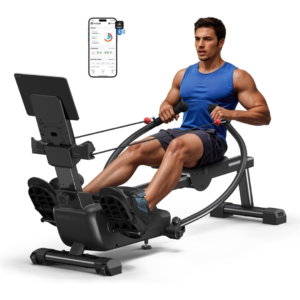
A reliable rowing machine is your best friend when just getting started. Consider a model that fits your living area and has adjustable resistance so that you can tailor the intensity. Wooden or metal-framed machines both have their pros and cons but focus on how comfortable the seat and handle feel, since you’ll spend most of your time there.
Make sure you have enough clearance behind you to fully extend your legs, and leave extra room so you don’t feel cramped while rowing. Wear clothing that won’t get caught in the seat track, such as fitted shorts or leggings, and keep a water bottle nearby to stay hydrated. A friend or family member who’s familiar with rowing can help check your technique if you need a second set of eyes.
Machine considerations
- Check the seat height if you have limited mobility.
- Look for a monitor displaying stroke rate and time.
- Choose a resistance type (air, magnetic, or water) that feels smooth to you.
Master the basic technique
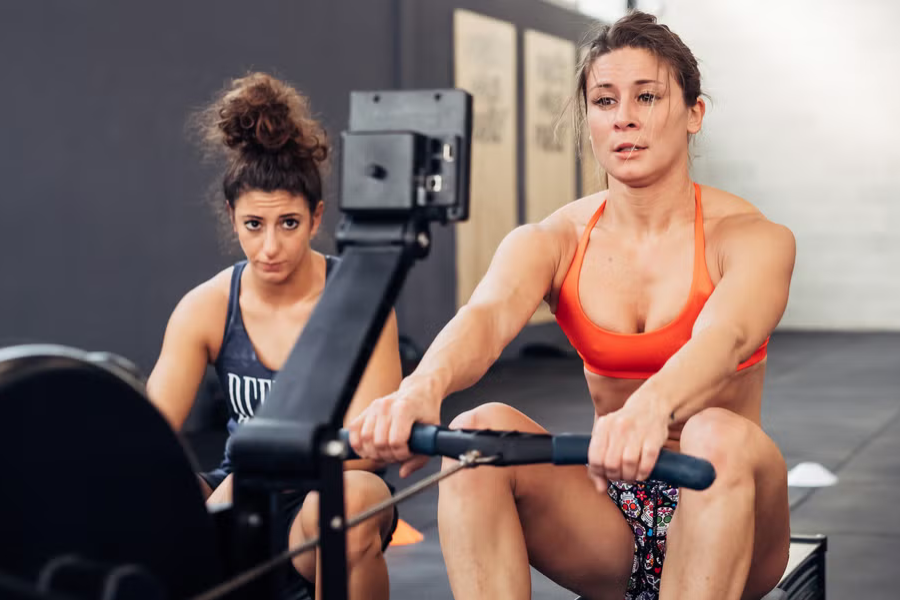
Good form starts with a stable core, a relaxed grip, and a smooth flow between each part of the row. If you’re new, focus first on learning the sequence of movements: legs, body, then arms on the drive, and arms, body, then legs on the recovery. Keeping the handle close to your body will help you maintain proper alignment.
Try to keep your back straight by hinging forward at the hips instead of slouching. Resist the urge to hunch your shoulders. If you’re feeling too much strain, ease your stroke rate or lower the resistance. As you become more comfortable, you can gradually increase the intensity, but always keep your form and safety at the forefront of every stroke.
Breaking down the stroke
• Start in the catch position with knees bent, back upright, and arms extended.
• Drive through your legs, shift your torso slightly backward, then pull the handle to your chest.
• Reverse the motion in a controlled manner to return to the catch.
Craft your beginner rowing routine
There’s no need to overcomplicate your sessions when you’re starting out. Aim for shorter workouts around 10 to 15 minutes, focusing on correct technique and steady effort rather than speed. Keep your strokes per minute at a moderate rate, often referred to as your “stroke rate,” to make sure you’re not rushing.
Gradually add a few more minutes each week. If you prefer to measure in distance, you could try for 1,000 to 2,000 meters to begin with. Once you’re comfortable completing that distance without excessive fatigue, you can either lengthen the distance or row at a slightly higher stroke rate. Pay attention to how your body feels and regulate your intensity so that you finish each session feeling satisfied, not exhausted.
Sample beginner routine
• Warm up with light rowing for 3 minutes, keeping the rate around 20 strokes per minute.
• Row at a comfortable but steady pace for 5 minutes, focusing on form.
• Take a 1-minute break (easy rowing or rest).
• Row for another 5 minutes, slightly increasing your effort.
• Cool down with 2 minutes of easy rowing or gentle stretching.
Progress with interval training
When you’re ready for a new challenge, intervals are a terrific way to amplify calorie burn and boost cardiovascular fitness. Interval workouts alternate between periods of higher intensity rowing and lower intensity recovery. For instance, row hard for 30 seconds, then row gently for 60 seconds. Repeat the cycle for several rounds, adjusting time ratios as you get stronger.
This type of training helps you push your limits in a manageable way, because you’re allowing your body to rest briefly in between hard efforts. Intervals also break up the monotony of a continuous pace. Before you jump in, be sure you’re comfortable with moderate rowing first. If your form breaks down at high intensity, scale back until you’ve built more stamina.
Maintain safety and motivation
As with any exercise routine, prioritize safety by listening to your body and knowing your limits. If you experience sharp pain in your back, arms, or knees, stop and evaluate your form. When in doubt, consult a fitness professional or physician to ensure you’re protecting your joints and muscles.
Staying motivated can be as simple as setting a personal rowing goal each month. Aim to row at least three days a week, fitting your sessions around other commitments. Tracking your progress on a fitness app, a notebook, or a spreadsheet can keep you focused. If you prefer group energy, some gyms offer rowing classes where you can share the experience with others and feed off the excitement in the room.
Embrace consistent progress
Rowing can quickly become a highlight of your fitness routine once you catch the rhythm and start noticing improvements in body composition and energy levels. This is especially true if you introduce minor challenges over time, like rowing a bit farther or trying new interval patterns. Keep each workout feeling purposeful by reflecting on what’s working and where you can improve.
Your success with rowing workouts for beginners hinges on balancing steady progress with proper technique. As you become stronger and more confident, remember that the journey doesn’t end when you can row effortlessly for 20 minutes. There are always new paces, intervals, and advanced drills to experiment with. Before long, you may find you’re rowing longer, rowing faster, and enjoying every stroke.
About The Author