Your Guide to Fun Quadricep Exercises at Home
A strong set of quadriceps does more than power your workouts. Your quads support your knees, help you walk and climb stairs comfortably, and make everyday movements feel easier. The best part is that you can build and tone them without setting foot in a gym. With the right quadricep exercises at home, you can get an effective leg workout using only your body weight and a few household items.
Below, you will find simple moves for beginners, more challenging variations for when you are ready, and a sample routine you can follow. You will also learn how to use form, tempo, and range of motion to get more from every rep.
Understand your quadriceps
Your quadriceps are the large muscles on the front of your thighs. They straighten your knees and play a big role every time you stand up, squat down, or walk uphill. Strong quads help stabilize your knees, which can reduce your risk of injury over time.
Because your quads are involved in so many daily activities, training them at home is both practical and time saving. Most quadricep exercises can be performed at home without any special equipment, so you can build strength and endurance even in a small space.
Set up for safe at-home quad workouts
Before you start any quadricep exercises at home, give your body a quick warm up. Five to ten minutes is enough for most people. You might march in place, do gentle leg swings while holding on to a chair, or walk up and down a hallway at a brisk pace.
If you have any existing knee, hip, or back issues, it is a good idea to talk with your doctor or a physical therapist before you begin. They can help you adjust movements so they feel comfortable and safe. As you move through the exercises, listen to your body and stop if you feel sharp pain, pinching, or instability.
Master beginner-friendly quad exercises
You can build a surprisingly strong foundation with basic bodyweight movements. These exercises are friendly to beginners, yet effective enough to stay in your routine long term.
Bodyweight squats
Bodyweight squats are one of the best at-home exercises for strengthening your quadriceps. They also involve your core, hamstrings, glutes, and the muscles along your spine for full lower body engagement.
To perform a solid squat at home:
- Stand with your feet about hip to shoulder width apart.
- Keep your chest lifted and your eyes forward.
- Sit your hips down while bending your knees, as if you are aiming for a chair.
- Lower until your thighs are at least parallel to the floor, or as low as your mobility comfortably allows.
- Press through your whole foot to return to standing.
If you are just starting, you can reduce squat depth so the movement feels stable. Over time, work toward a deeper range of motion. Proper squat form is essential for targeting the quadriceps. Try to avoid leaning too far forward or pushing your hips excessively back. That posture shifts the work into your back and glutes instead of your quads and can increase strain on your spine.
Chair or box squats
If full bodyweight squats feel unsteady, use a sturdy chair.
- Stand in front of the chair with your legs hip width apart.
- Reach your hips back and slowly sit down.
- Lightly touch the chair, then stand back up without fully relaxing.
This variation helps you learn the movement pattern while keeping you supported. You can gradually lower the chair height or move to regular squats as you gain confidence.
Walking lunges
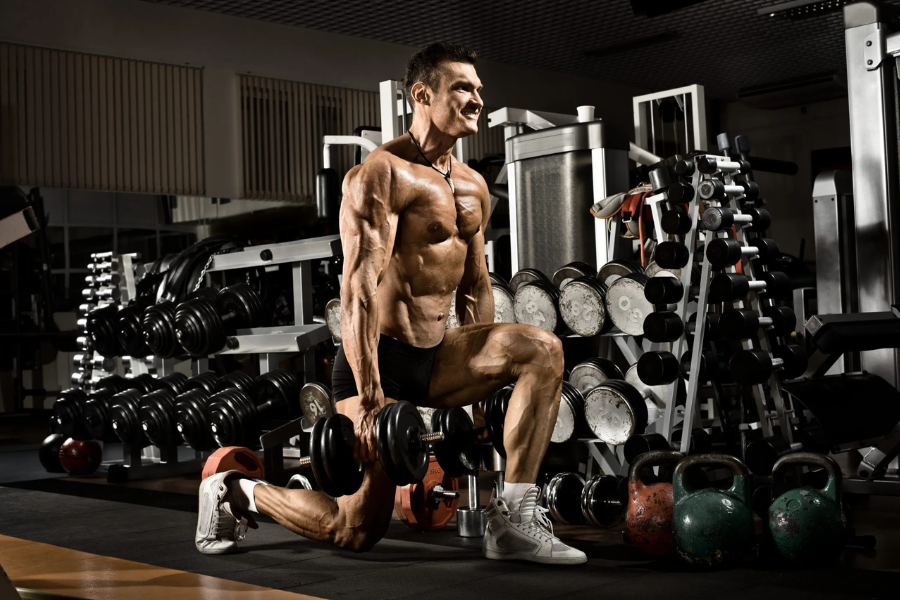
Walking lunges are effective quad exercises that also train your hamstrings, glutes, and core. You can perform them in a hallway or living room.
- Stand tall with your feet together.
- Step one foot forward and bend both knees so your back knee moves toward the floor.
- Keep your front knee stacked above your ankle, then push through your front foot to bring your back leg forward into the next lunge.
You can hold light dumbbells or water bottles to add resistance. If you prefer to stay in one place, try alternating forward lunges instead.
Step-ups
Step-ups bring the feeling of a gym box right into your home using stairs or a sturdy low bench. This move strengthens your quads and glutes while challenging your balance.
- Place one foot on a step.
- Press through that foot to lift your body up, bringing the other foot to meet it.
- Step back down with control and repeat.
To make step-ups easier, use a lower step height. To make them harder, add weight or pause briefly at the top of the movement.
Level up with more advanced quad exercises
Once the basics feel comfortable, you can introduce more demanding movements that challenge your strength and stability.
Bulgarian split squats
Bulgarian split squats are a powerful single leg exercise that targets your quads and also recruits stabilizing muscles around your knees and hips. You will need a couch, chair, or low bench.
- Stand about two feet in front of your support with your back turned to it.
- Place the top of one foot behind you on the edge of the support.
- Keep your torso fairly upright and bend your front knee to lower your hips.
- Push through your front foot to stand tall again.
You can adjust the exercise to focus more on your quadriceps by taking a slightly shorter stance, keeping your torso upright, and letting your front knee travel over your toes. At home, you can even elevate your front heel on a book or plate to increase the knee bend and quad engagement. If balance is a challenge, lightly touch a wall or countertop for support.
Pistol squats and assisted variations
Pistol squats are a very advanced bodyweight squat performed on one leg. They build strength, balance, and control in your quads and surrounding muscles but require practice.
If a full pistol squat is out of reach, that is perfectly normal. You can start with easier variations:
- Hold a countertop or doorframe while you lower and stand.
- Sit down to a chair on one leg and stand back up, using your hands for light support.
- Try a partial range of motion and only go as low as you can control.
These progressions allow you to work toward the full movement without straining your knees or back.
Sissy squats for focused quad work
Classic squats and leg presses do not fully target one of your key quad muscles, the rectus femoris, because they involve both the hip and knee at the same time. Research summarized by BuiltWithScience.com notes that isolating knee extension with movements like leg extensions or sissy squats is helpful for fully training this muscle.
At home, you can perform a supported sissy squat:
- Stand tall and hold on to a stable surface like a counter or railing.
- Rise onto your tiptoes.
- Let your knees travel forward over your toes as you lean your torso slightly back.
- Lower only as far as you can maintain control, then return to standing.
This position removes some of the hip involvement and places more tension on your quads. If you are new to the move, use a resistance band or extra support to stay stable. Because sissy squats are demanding, you can start with very small ranges of motion and low reps.
Use smart technique for better quad gains
How you perform quadricep exercises at home matters just as much as which ones you choose. Small tweaks can turn a basic move into a serious muscle builder.
Focus on full range of motion
To effectively train your quads at home, aim for a full range of motion in your reps. In squats and similar movements, that usually means your thighs reach at least parallel to the floor or perpendicular to your calves. Partial reps can have a place in training, but if they are all you do, they limit quad development.
If mobility or knee comfort stops you from going deeper, you can:
- Warm up with gentle mobility drills.
- Gradually increase your depth over time.
- Use support, like a chair or countertop, while you explore a slightly larger range.
Control the tempo
You do not need heavy weights to make your quads work hard. A slower, controlled tempo is a powerful tool. According to analysis from BuiltWithScience.com, spending 2 to 3 seconds on the lowering portion of each rep can increase quadriceps muscle growth, even with lighter loads. This is especially useful when you are limited to bodyweight training at home.
Try counting “one, two, three” as you lower into a squat or lunge, then stand up more quickly. You will feel your quads working harder to stabilize and control the movement.
Adjust your stance and foot position
You might have heard that a wide stance targets your outer quads or a narrow stance isolates your inner thighs. The research discussed by BuiltWithScience.com points out that these simple rules are not accurate. Foot positioning does matter, but not in such a black and white way.
A practical way to think about stance is:
- Choose a width where your knees track comfortably over your toes.
- Experiment gently with slightly narrower or wider positions to find where you feel your quads most.
- Avoid letting your knees collapse inward as you bend.
For more quad emphasis in squats, lunges, and Bulgarian split squats, you can elevate your heels on a small plate or wedge if you have limited ankle mobility. This creates a more forward shin angle that places more load through your quadriceps and less through your hips, a strategy highlighted in an October 2023 article from BuiltWithScience.com.
Balance weight and effort
When you exercise at home, it may be tempting to hold the heaviest weights you can find. However, going too heavy often leads to shallow, truncated reps and rushed form. Lighter loads combined with full range of motion and good technique are more effective for quad growth than heavy partial reps.
You will get the most out of your sets if you push close to muscular failure. That means stopping when you feel you could only manage one or two more quality reps. The same BuiltWithScience.com article emphasizes that cutting sets short at the first sign of discomfort reduces your progress. Use the burn as a guide, not a signal to quit immediately.
Try this simple at-home quad routine
You can structure your at-home quad training around two focused days per week. Allow at least 48 hours of rest between sessions for recovery.
Here is a sample routine you can follow or adapt:
Start with a 5 to 10 minute warm up, then move through each exercise with control. Rest 60 to 90 seconds between sets.
-
Bodyweight squats or chair squats
3 sets of 10 to 12 reps -
Walking lunges or stationary lunges
3 sets of 8 to 10 steps per leg -
Bulgarian split squats
2 to 3 sets of 8 to 10 reps per leg -
Step-ups
2 to 3 sets of 10 reps per leg -
Optional: Supported sissy squats (for more advanced exercisers)
2 sets of 6 to 8 slow reps
For most people, this adds up to at least 5 challenging sets per workout that focus on the quadriceps, which aligns with recommendations outlined by BuiltWithScience.com. You can increase sets or reps gradually as your strength improves.
Build a consistent quad habit
Small, steady efforts go a long way. Most quadricep exercises at home can be done in a few square feet of space with little or no equipment. If an entire workout feels overwhelming, start by adding one exercise to the end of your usual routine. For example, you might begin with two sets of bodyweight squats and lunges twice a week.
As your quads get stronger, you will likely notice stairs, hills, and long walks feeling easier. Your legs will also feel more stable when you bend, lift, or carry items in daily life. Pick one exercise from this guide to try today and focus on slow, controlled form. From there, you can build a simple routine that fits your schedule and supports stronger, more reliable legs.
About The Author





