The Best Quad Workout With Dumbbells You Can Try Today
A quad workout with dumbbells is one of the simplest ways to build stronger legs, support your knees, and boost overall athletic performance without a full gym setup. With a single pair of dumbbells and a bit of floor space, you can target all four heads of your quadriceps femoris and feel a serious burn in under 30 minutes.
Below, you will learn how your quads work, the best quad exercises with dumbbells, and a complete workout you can try today, whether you are a beginner or more advanced.
Understand your quad muscles
Your quadriceps femoris is the large four headed muscle at the front of your thigh. All four heads work together to extend your leg at the knee and help stabilize your kneecap while you move, jump, and land. According to Iron Bull Strength, the quad consists of four muscles, each with a slightly different role and ideal exercise focus:
- Vastus lateralis, the outer thigh muscle that gives your legs that sweep from the front
- Rectus femoris, the central quad muscle that also crosses the hip and helps with hip flexion
- Vastus medialis, the inner thigh teardrop muscle that is important for knee stability
- Vastus intermedius, which sits underneath the rectus femoris and supports overall quad strength
A good quad workout with dumbbells will hit each of these heads through different angles, stances, and ranges of motion so you build balanced, strong, and stable legs.
Why train quads with dumbbells
If you are used to thinking of squats as a barbell exercise, it might surprise you how much you can gain from dumbbells alone. A 2024 guide on dumbbell quad workouts highlights several key benefits of using dumbbells for squats, lunges, and step ups.
You hold a weight in each hand, which means each leg has to pull its own weight. This helps correct muscle imbalances, improves stability, and reduces the chance that your stronger side will quietly take over. A Steel Supplements article also notes that dumbbell quad exercises like Bulgarian split squats demand more balance and control than many barbell movements, which can drive better muscle activation and control across your whole lower body.
Training quads with dumbbells can help you:
- Build overall leg strength for squats, jumps, and sprints
- Improve knee stability through stronger inner and outer quads
- Enhance daily movement, such as standing up from a chair or climbing stairs
- Challenge your core and grip strength, since you must stabilize the weights independently
Because you can easily adjust weight and stance, dumbbell workouts also suit all fitness levels, from beginners to seasoned lifters.
Key quad exercises with dumbbells
In this section, you will find the main dumbbell moves that target each part of your quads. You can plug these into the full workouts later or pick a few as accessories in your current routine.
Tip: Choose a weight that lets you move with control through the full range of motion, especially at the bottom of each squat or lunge.
Close stance dumbbell front squat (outer and central quads)
This variation places extra emphasis on the vastus lateralis on the outside of your thigh and the rectus femoris in the center.
- Hold a dumbbell in each hand and clean them up to your shoulders so they rest just in front of your collarbones.
- Stand with your feet about hip width, slightly closer than a normal squat stance.
- Brace your core, keep your chest up, and sit your hips down and back until your thighs reach at least parallel.
- Drive through the middle of your foot to stand back up, squeezing your quads at the top.
Keeping the stance closer and the weights in front increases knee flexion and quad demand. Iron Bull Strength highlights close stance dumbbell front squats as one of the most effective ways to train the outer quad head using only dumbbells.
Dumbbell hack squat (outer quads focus)
You can mimic a hack squat with dumbbells to target the outer quads without a machine.
- Stand with your feet shoulder width apart and hold a dumbbell in each hand behind your legs, arms straight.
- Lean slightly forward at the hips but keep your back flat and core tight.
- Bend your knees and lower your body as if sitting straight down, letting the dumbbells travel close to your calves.
- Push through your heels and mid foot to return to standing, keeping your torso angle consistent.
The dumbbells behind you shift more load toward your quads, particularly the vastus lateralis, while still training your glutes and core.
Dumbbell squat (central quad builder)
The basic dumbbell squat remains one of your best tools for building overall quad size and strength, especially in the rectus femoris.
- Hold a pair of dumbbells at your sides or racked on your shoulders.
- Stand shoulder width, toes slightly turned out.
- Sit your hips down and back while bending your knees, aiming to keep your knees tracking in line with your toes.
- Drive back to standing without letting your knees cave inward.
As Iron Bull Strength notes, squats and lunges are two of the most direct ways to load the rectus femoris and improve central thigh strength.
Dumbbell lunges and reverse lunges (central and inner quads)
Lunges light up your entire quad, but specific variations can shift emphasis to the inner vastus medialis.
To do a standard forward lunge:
- Hold dumbbells at your sides.
- Step forward with one leg, lowering until both knees are bent about 90 degrees and your back knee is close to the floor.
- Push through the front foot to step back to the start, then switch legs.
Reverse lunges work similarly but you step backward instead of forward. Iron Bull Strength highlights reverse lunges and dumbbell split squats as powerful ways to hit the vastus medialis and support better knee stability.
Dumbbell split squats and Bulgarian split squats (inner quads and balance)
Split squats put you in a staggered stance, which challenges balance and deeply engages the inner quad.
- Stand tall holding dumbbells at your sides.
- Step one foot forward and the other back as if you are mid lunge.
- Drop your back knee toward the floor, staying tall through your torso.
- Push through the front foot to rise, keeping most of your weight in that front leg.
Elevate your rear foot on a bench or step to turn this into a Bulgarian split squat for an even deeper stretch and more intensity on the front leg. Steel Supplements notes that these dumbbell single leg variations help correct strength imbalances and demand more stabilizer engagement than many bilateral barbell exercises.
Dumbbell side lunges (inner quad emphasis)
Side lunges hit your quads from a lateral angle and are especially good for the vastus medialis and general hip health.
- Stand with feet together, holding a dumbbell at your chest or one in each hand.
- Take a wide step to the side and bend that knee while keeping the other leg straight.
- Sit your hips back as you lower, then push off the bent leg to return to the center.
Moving sideways trains muscles that support your knees during cuts, turns, and uneven terrain.
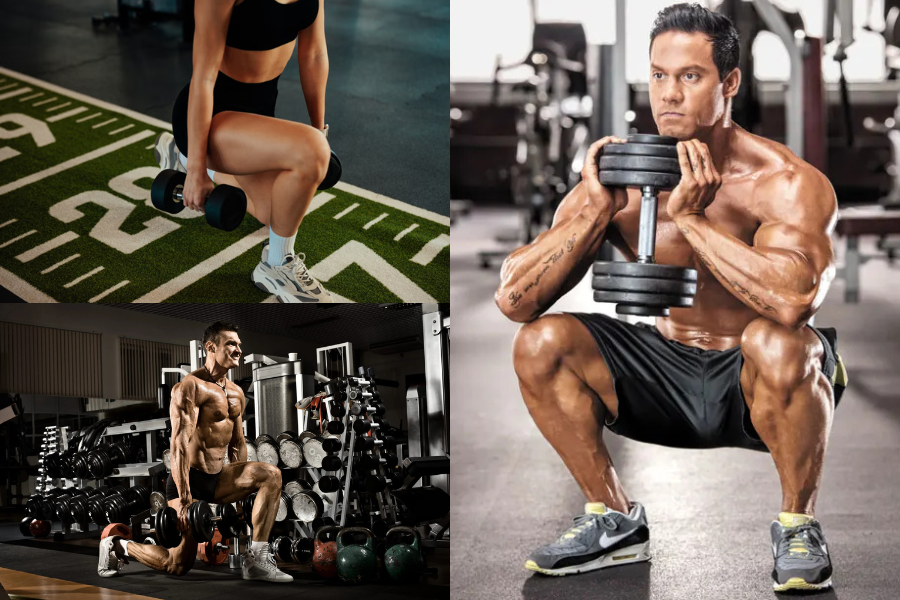
Goblet squats and step ups (deep quad strength)
The vastus intermedius, located beneath the rectus femoris, is harder to feel directly, but it works hard whenever you perform deep knee bending movements like goblet squats and step ups.
To do a goblet squat:
- Hold a single dumbbell vertically at your chest, elbows pointing down.
- Take a shoulder width stance and sit into a deep squat while keeping your chest up.
- Drive up through your whole foot, pushing the floor away.
For step ups:
- Stand facing a stable bench or box with dumbbells at your sides.
- Place one foot on the step and push through the heel to bring your body up.
- Control the descent and repeat, then switch legs.
Iron Bull Strength recommends both step ups and goblet squats to effectively engage the vastus intermedius and build base strength and endurance across the entire quad group.
Dumbbell lunge pulses (burnout for quad endurance)
Lunge pulses are a small range of motion finisher that will make your quads heat up quickly.
- Step into a forward lunge with dumbbells at your sides.
- Instead of standing all the way up, pulse up and down about 3 inches, staying in the bottom half of the lunge.
- Maintain tension for the full time or rep count, then switch legs.
Research on dumbbell quad workouts describes lunge pulses as a powerful way to create continuous tension and target the vastus intermedius and surrounding quad tissue for endurance and hypertrophy.
Sample quad workout with dumbbells for every level
You can tailor your quad workout with dumbbells to your experience and current strength. The Iron Bull Strength guide outlines how beginners, intermediate lifters, and advanced athletes can all use similar movements with different structures, such as supersets and focused inner or outer quad sessions.
Below is a simple structure you can try. Rest 45 to 75 seconds between sets unless noted.
Beginner friendly quad workout
If you are newer to strength training, focus on learning solid technique and controlling your range of motion.
- Goblet squat: 3 sets of 10 to 12 reps
- Reverse lunge: 3 sets of 8 reps per leg
- Step up: 2 sets of 10 reps per leg
- Bodyweight lunge pulses: 2 sets of 15 seconds per leg
Use light dumbbells for the squats, lunges, and step ups. You can do the pulses without weights until you feel more confident with balance.
Intermediate quad workout with supersets
Once you are comfortable with the basics, you can increase intensity by pairing exercises back to back. This is known as a superset.
- Superset A (3 rounds)
- Close stance dumbbell front squat: 8 to 10 reps
- Dumbbell reverse lunge: 8 reps per leg
- Superset B (3 rounds)
- Dumbbell hack squat: 10 reps
- Dumbbell side lunge: 8 reps per side
- Finisher
- Lunge pulses with dumbbells: 2 sets of 20 seconds per leg
This structure raises your heart rate and volume without adding a lot of extra time.
Advanced quad focus routine
If you have been lifting for a while and want to push your quads harder, you can use more volume and focused inner and outer quad emphasis two times per week as suggested by Iron Bull Strength.
Day 1, outer and central quads:
- Close stance dumbbell front squat: 4 sets of 6 to 8 reps
- Dumbbell hack squat: 4 sets of 8 to 10 reps
- Bulgarian split squat: 3 sets of 8 reps per leg
Day 2, inner and deep quads:
- Goblet squat (deep): 4 sets of 8 to 10 reps
- Dumbbell split squat: 3 sets of 10 reps per leg
- Dumbbell side lunge: 3 sets of 10 reps per side
- Lunge pulses: 2 sets of 30 seconds per leg
Keep at least 48 hours between these two sessions to let your quads and connective tissue recover.
Safety, recovery, and progression tips
Quad training can transform your strength and confidence, but only if you respect your joints and recovery.
Pay attention to your knees. Your knees should track roughly over your middle toes during squats and lunges. If they cave inward, lighten the weight and concentrate on alignment. Strong inner quads help protect your knee joint, which is one reason exercises like split squats and side lunges are so valuable.
Increase load gradually. Dumbbell training makes it tempting to jump to the next pair as soon as a set feels easy, but try adding reps or slowing the tempo first. For example, take three seconds to lower into each squat before you move up in weight.
Do not neglect recovery. Large muscle groups like your quads can handle hard work, but they still need rest. Iron Bull Strength notes that adequate recovery, including nutrition and, for some lifters, supplementation to support muscle repair, can help you keep making progress in leg strength over time.
Finally, listen to your body. Mild muscle soreness after a new quad workout with dumbbells is normal. Sharp pain in your knees or hips is not. If something feels off, reduce the range of motion or consult a professional before continuing.
Putting your new quad workout into action
You do not need a gym membership or a squat rack to build powerful legs. With a thoughtful quad workout with dumbbells, you can train every head of your quadriceps femoris, support your knees, and improve how you move through daily life.
Choose the beginner, intermediate, or advanced routine above and commit to doing it once or twice this week. As you get more comfortable, swap in variations like hack squats, Bulgarian split squats, or lunge pulses to keep challenging your quads from new angles.
Your legs carry you everywhere. A few focused dumbbell sessions are a straightforward way to make them stronger, more stable, and ready for whatever you ask of them.
About The Author