How to Build Calf Muscles Without Wasting Time
A lot of people train hard and still feel stuck with small calves. If you want to learn how to build calf muscles without wasting time, it helps to understand how these muscles work and what actually makes them grow. With a few focused changes to your workouts and habits, you can finally give your calves the attention they need.
Understand your calf muscles
Your calves are not just one muscle. You mainly work three areas, and each one responds slightly differently to training.
The gastrocnemius is the big, diamond shaped muscle you see when you flex your calves. It helps you point your toes (plantar flexion) and bend your knee. The soleus sits underneath the gastrocnemius and plays a big role in stabilizing your ankle and foot. The tibialis anterior runs along the front of your shin and helps lift your toes, which balances out your calves and reduces the risk of shin splints.
You build better calves when you train both the gastrocnemius and soleus, and you do not ignore the muscles in the front of your lower leg. Movements with a straight knee hit the gastrocnemius more, while bent knee exercises emphasize the soleus. This is why mixing standing and seated variations matters.
Fuel your calves with the right foods
You cannot train your way out of poor recovery. To build calf muscles, you need nutrient dense foods that support muscle repair after your workouts.
Eggs are often called a gold standard for protein. Each egg gives you about 7 grams of high quality protein plus vitamins and minerals that support muscle growth, making them a simple option to include in breakfast or snacks. Wild salmon offers around 20 grams of protein per 100 gram serving and includes omega 3 fatty acids that help support muscle health and recovery. Spinach supplies iron and nitrates that can promote muscle growth and support cell metabolism, so it works well in salads, omelets, or smoothies. Chicken breast is another staple, with roughly 31 grams of protein and only about 4 grams of fat per 100 gram serving, which makes it an efficient way to meet your daily protein needs for building muscle.
Think of your meals as part of your training plan. Aim for a source of protein at each meal, pair it with whole carbohydrates like rice or potatoes, and add vegetables for micronutrients. Even if your calf workouts are perfect, growth will be limited if you consistently under eat or miss out on protein.
Set realistic expectations about calf genetics
Some people seem to have big calves without trying, while others train for years and see slow changes. Genetics play a real role in calf size, especially the structure of the gastrocnemius muscle, where it attaches, and the ratio of tendon to muscle belly.
You cannot change your genetics, but you can control how much effective work you put in. Calves are used constantly when you walk three thousand to ten thousand steps or more per day, so they are adapted to low intensity, short range movements. To make them grow, you have to train them with a new stimulus: more range of motion, more tension, and more volume than they are used to.
It helps to judge progress by strength, endurance, and how your calves look over months, not weeks. Taking monthly photos from the same angle and tracking your working weights is a better way to see change than checking the mirror every day.
Use exercises that actually build calves
You do not need dozens of fancy moves to build calf muscles. A small group of exercises done well will give you most of your results.
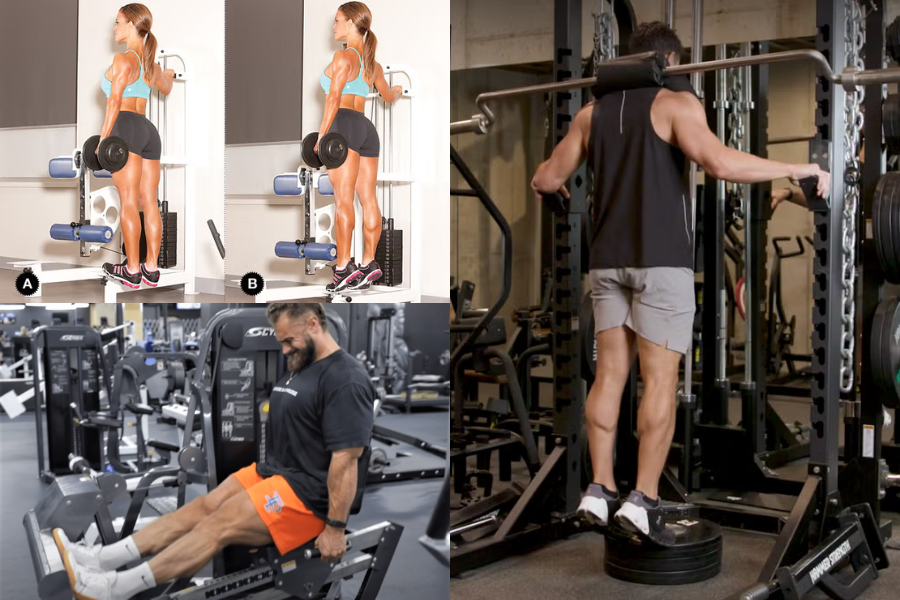
Standing calf raises target the gastrocnemius with straight knees. You can do them on a machine, holding dumbbells, or using your body weight on a step. Seated calf raises focus more on the soleus because your knees are bent. If you do not have a machine, you can sit on a bench, place your toes on a block and a weight on your thighs, then raise and lower your heels.
Eccentric calf raises are useful when one side is weaker or you want extra growth. For example, you can rise up on both feet and then lower slowly on one foot, which increases tension during the lowering phase. Tip toe farmer’s carries combine strength and balance. You walk on your toes while holding weights at your sides, which challenges your calves and ankles in a functional way. Squats into calf raises let you pair a big lower body move with a focused calf contraction. You squat down, stand up, then rise onto your toes at the top for a strong squeeze.
These five exercises, done two to three times per week with effort, can form the backbone of your calf routine. You can rotate them across workouts or combine two or three in the same session.
A focused routine with a few proven exercises, done consistently, builds better calves than a random mix of movements you change every week.
Train with the right sets, reps, and frequency
Calves are different from some other muscles because they are built to handle a lot of daily work. They respond well to higher training volume and not just heavy low rep sets.
For general calf hypertrophy, a good starting point is 4 to 5 sets of 6 to 12 or more repetitions per exercise. Training your calves at least twice per week, and often two to four times per week, gives you enough stimulus to grow without overdoing a single session. Aim for 2 to 3 calf exercises per workout so you can hit the muscles from a few angles.
Research suggests that calf muscles contain a high percentage of slow twitch fibers. That means they often respond best to high volume, lower loads, and a high level of effort, instead of only relying on very heavy weights for a few reps. One effective approach is to use different rep ranges within the week. For example, you can do standing calf raises in the 8 to 12 rep range with heavier weight to target the gastrocnemius, and seated calf raises in the 15 to 30 rep range with moderate weight to challenge the slow twitch driven soleus.
The key is to reach close to muscular fatigue in each working set. Your last few reps should feel challenging while still being controlled.
Use full range of motion and proper technique
If you want your calf training to count, how you move matters as much as how much weight you use. Calf growth is optimized when you use a full range of motion at the ankle. That means lowering your heel so it moves below the level of a raised surface like a step, and then rising all the way up onto your toes.
Your ankle can typically move into dorsiflexion up to around 20 degrees and plantarflexion up to around 50 degrees. When you work through as much of that range as you comfortably can, you place your calf muscles under more stretch and create a stronger contraction. This deeper stretch is one reason step or block variations are usually more effective than doing raises on a flat floor.
Avoid bouncing or jerking the weight. Instead, lower your heels in a controlled way, pause briefly at the bottom if needed, then drive up smoothly. You can also add partial repetitions at the end of a set once you can no longer complete full reps. This extra time under tension helps you reach total fatigue.
Adjust foot and knee position to hit all angles
Small changes in form can shift where you feel the exercise and which fibers work hardest.
Knee angle is the first variable to consider. Exercises with straight legs, such as standing calf raises, emphasize the gastrocnemius. Movements with bent knees, like seated calf raises or squatting calf raises, focus more on the soleus. A 2014 study by Suzuki and colleagues showed that knee position affects which calf muscles are activated more during different exercises, so including both styles in your week gives you better coverage.
Foot angle is the second variable. When your toes point outward, you tend to hit the medial (inner) head of the gastrocnemius more. When your toes point inward, the lateral (outer) head works a bit harder. Keeping your feet straight forward engages both heads in a more balanced way. A 2020 study by Nunes and colleagues recommends performing sets with different foot positions to maximize overall hypertrophy across the muscle.
You do not need to overcomplicate things. You might do one set with toes forward, one set slightly out, and one set slightly in, while keeping the same basic movement pattern.
Add plyometrics and shin work for complete lower legs
Traditional strength training is key, but adding some explosive work and front of the leg training can round out your results and improve performance.
Plyometric exercises like lunge jumps and jump rope challenge your calves during fast, repeated toe off and landing. Focus on pushing off aggressively through the balls of your feet and landing softly with control. These movements help improve calf strength, power, and muscle definition when you pair them with your regular calf raises.
Do not forget your tibialis anterior. Working the shin muscles improves ankle stability and can reduce the chance of shin splints. Simple options include toe raises while standing with your heels on the ground and pulling your toes up, or using a light band to pull your toes toward you against resistance. Including a few sets of these in your week improves the overall look and function of your lower legs.
Progress your workload without guessing
To keep building calf muscles over time, you need to gradually increase the challenge. You can do this by adding weight, increasing reps, or adding sets, but it helps to have a simple plan.
A practical approach is to start with a load around 5 to 10 percent of your body weight for weighted calf raises and then increase the weight by about 5 to 10 percent per week as long as your form stays solid. You can also keep the weight the same and add a few reps each session until you reach the top of your target rep range, then bump the weight slightly and drop the reps back down.
Because calves adapt quickly to repeated patterns, varying your exercise selection and workload over time is useful. You might focus more on standing and eccentric raises for a few weeks, then shift toward more seated and single leg work. This variety challenges both the slow and fast twitch fibers and helps you avoid plateaus.
Stretch and recover for better growth
Your calves work hard outside the gym, so recovery matters if you want them to grow. Stretching fully between sets and after your workout can help improve mobility, support fascia expansion, and enhance the muscle pump, which may support long term growth.
Between sets, you can step onto a raised surface with one foot, drop your heel until you feel a comfortable stretch, and hold for 15 to 30 seconds. After training, spend a few minutes stretching each calf with both bent and straight knees. This simple habit can also reduce tightness and improve how your ankles feel during other lifts.
Good sleep, overall hydration, and spacing your calf sessions across the week will also help. Since calves have low androgen receptor levels, they benefit from focused sessions instead of just tacking on a few rushed sets after upper body workouts.
Put it all together
To build calf muscles without wasting time, you need three things: smart exercise choices, enough training volume with full range of motion, and consistent progression supported by good nutrition and recovery.
If you are not sure where to start, pick two or three of the exercises described above, train them two or three times per week, use a mix of straight and bent knee moves, and focus on slow, controlled reps through a full stretch. Combine that with protein rich meals and patient tracking, and your calves will finally get the stimulus they need to grow.
About The Author