The Best Hamstring Workout Routine to Strengthen Your Back Legs
A smart hamstring workout routine does much more than build the back of your legs. Strong hamstrings support your hips and knees, protect you from injury, and power movements like walking, running, and jumping. When you train them with the right mix of exercises, sets, and reps, you get stronger, more athletic, and more stable in everyday life.
Below, you will find a clear, beginner friendly guide to building a balanced hamstring workout routine you can actually stick with.
Understand what your hamstrings do
Your hamstrings are a group of three muscles on the back of your thigh, the biceps femoris, semitendinosus, and semimembranosus. They cross both your hip and knee joints and are responsible for two main actions: hip extension and knee flexion.
That means your hamstring workout routine needs to cover both of these movement patterns. You do this by including hip hinge exercises, such as Romanian deadlifts or good mornings, and knee flexion exercises, such as leg curls. When you train both, you develop complete strength and muscle along the entire back of your legs.
Key principles for hamstring training
Before you jump into a plan, it helps to know how often and how hard to train your hamstrings.
How often to train
Most people do well training hamstrings 2 times per week. This gives you enough total work to build strength and muscle, while still leaving room for recovery. Some lifters can handle 3 sessions per week, especially if one day is lighter or more focused on mobility.
If your legs are very sore for several days or your performance drops, you can scale back the volume or frequency.
How much volume to use
Coaches often talk about training volume using four landmarks:
- Maintenance Volume (MV): the minimum work you need to maintain what you have
- Minimum Effective Volume (MEV): the lowest amount of work that still produces progress
- Maximum Adaptive Volume (MAV): the range where you grow the fastest
- Maximum Recoverable Volume (MRV): the upper limit of what you can recover from
You do not need exact numbers to get results. As a rule of thumb, aim for about 6 to 12 hard sets per week for hamstrings, split over 2 sessions. Start on the lower end if you are newer to lifting, and add sets slowly if you feel you are recovering well and want more growth.
Rep ranges that work best
Different hamstring movements respond well to different rep ranges:
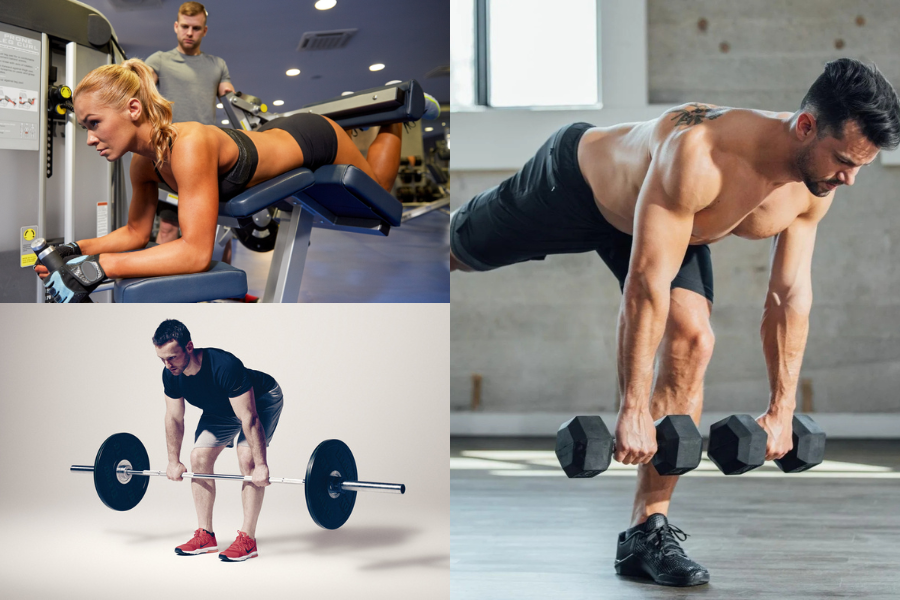
- Hip hinge exercises like stiff leg deadlifts and Romanian deadlifts work best in the 5 to 10 rep range. Heavy loads here are effective, but your posture and lower back fatigue will usually limit how many reps you can do safely.
- Leg curl exercises respond well to 10 to 30 reps per set. The lighter to moderate loads let you focus on a full range of motion and deep contraction without straining your joints.
Using this variety across your hamstring workout routine gives you a broader muscle building stimulus.
Learn proper hamstring exercise technique
Good technique protects you from injury and keeps the work where you want it, in your hamstrings instead of your lower back.
Hip hinge form basics
For hip hinge exercises like Romanian deadlifts or good mornings, focus on:
- A deep bend at the hips while keeping a neutral spine
- Pushing your hips back, rather than just reaching the weight toward the floor
- A slight bend in your knees, not locked but not squatting
- Lowering the weight until you feel a strong stretch in your hamstrings, without rounding your back
According to the RP Strength hamstring guide, you should move in a controlled way through a full range of motion so you load the hamstrings safely and completely.
Leg curl form basics
For machine or ball leg curls, think about:
- Starting from a fully extended knee, not a half bent position
- Curling your heels toward your glutes smoothly, without swinging
- Pausing briefly at the top to squeeze your hamstrings
- Controlling the return to full extension, instead of letting the weight drop
That simple focus on full range and control is one of the safest ways to overload the hamstrings.
If you ever feel sharp pain in your lower back or behind your knee, stop the set, rest, and adjust your form or load before continuing.
Sample weekly hamstring workout routine
Here is a simple 2 to 3 day structure you can plug into your week. You can run this on its own or inside a full leg or lower body day.
Option 1: Three focused hamstring sessions
This template comes from RP Strength and balances hip hinge and leg curl work across the week:
-
Monday
-
Barbell stiff leg deadlift: 3 sets of 5 to 10 reps
-
Wednesday
-
Lying leg curl: 3 sets of 10 to 30 reps
-
Friday
-
Seated leg curl: 3 sets of 20 to 30 reps
You can add a light glute bridge or hip thrust variation after the main exercise if you want a bit more posterior chain work.
Option 2: Two day hamstring split
If you only want to train hamstrings twice per week, try this structure:
-
Day 1, heavy hinge focus
-
Conventional or hex bar deadlift: 3 sets of 6 to 8 reps
-
Romanian deadlift: 3 sets of 6 to 10 reps
-
Day 2, curl and accessory focus
-
Seated or lying leg curl: 3 sets of 10 to 20 reps
-
Single leg Romanian deadlift: 2 to 3 sets of 8 to 12 reps per leg
Hex bar deadlifts let you use a neutral grip and often feel easier on your upper body and lower back while still challenging your legs and hamstrings effectively.
Effective hamstring exercises to include
You do not have to perform every exercise you see online. If you cover the key categories below, your hamstring workout routine will be solid.
Big compound lifts
Compound movements train your hamstrings along with your glutes, back, and core. Good options include:
- Deadlifts (conventional, sumo, or Romanian)
- Single leg deadlifts
- Good mornings
- Hip thrusts or glute bridges with your feet slightly forward for more hamstring tension
Romanian deadlifts are especially useful because they keep most of the work on your hamstrings while putting less stress on your lower back compared to some heavier deadlift variations.
Kettlebell swings and single leg Romanian deadlifts are also great for activating the biceps femoris portion of your hamstrings, which is heavily involved in sprinting and explosive hip extension.
Isolation and knee flexion moves
To directly target knee flexion, include at least one of the following:
- Seated hamstring curl machine
- Prone (lying) hamstring curl machine
- Nordic hamstring curls
- Physio ball leg curls
Nordic curls are challenging but excellent for hypertrophy and injury prevention because they overload the hamstrings as they lengthen. You just need something or someone to anchor your feet, then you slowly lower your body forward and use your hamstrings to resist the fall.
Dumbbell friendly options
If you train at home or with limited equipment, dumbbells can still give you a complete hamstring workout routine. Useful movements include:
- Dumbbell deadlifts and Romanian deadlifts
- Single leg dumbbell deadlifts
- Weighted glute bridges and hip thrusts
- Dumbbell good mornings
- Reverse dumbbell lunges and dumbbell step ups
When you are new to dumbbell training, use light weights and smooth, controlled motion. You can always increase the load once you feel your form is solid.
Warm up, mobility, and recovery
Strong hamstrings are not just about lifting heavy. Flexibility, mobility, and core stability all help keep you injury free.
Warm up and activation
Before you load your hamstrings, spend about 10 minutes getting warm. You can use light cardio like walking, jogging, or cycling, followed by three rounds of bodyweight activation drills, for example:
- Knee hugs
- Glute bridges
- Lunges with elbow to instep
- Hip flexion or leg swings
This type of warm up prepares your hips and knees, wakes up your glutes, and lets your hamstrings work in a safer position.
Mobility and stretching
Hamstring tightness is often linked to tight hip flexors and poor pelvis control, especially if you sit for long periods during the day. When your hip flexors are tight, your glutes may not activate well, and your hamstrings have to work harder to stabilize your hips. That can increase the risk of strains.
Useful mobility and rehab style drills include:
- Hamstring scoops and flossing
- Assisted sitting hamstring stretches
- Handwalks, which lengthen the hamstrings and lower back while building shoulder and core stability
- Physio ball bridges and leg curls for hamstring strength and pelvic control
Foam rolling your hamstrings for a couple of 20 second passes can also help ease muscle tension and improve flexibility at a very low cost.
Core and pelvis stability
Building lumbo pelvic control, in other words, stability around your lower back and hips, is critical for keeping your hamstrings safe. Simple progressions like double leg bridges with your feet elevated on a chair, then single leg bridges, then ball curls, all train your hamstrings while also teaching your pelvis to stay stable.
Keeping your core braced and your pelvis in a neutral position during your main lifts reduces unnecessary strain on the hamstrings and lower back.
Preventing hamstring injuries
Hamstring strains are common in sprinting and kicking sports where the muscle has to contract forcefully while lengthened. You lower your risk by combining strength, flexibility, and good movement patterns.
Key points to keep in mind:
- Train hamstrings at least twice per week with a mix of hip hinges and knee flexion
- Use full range of motion and controlled reps, especially in lengthened positions
- Include flexibility work for your hip flexors, glutes, lower back, and hamstrings, not just one area
- Gradually progress your volume and intensity instead of jumping too fast
If you have a history of hamstring injuries or you are working around pain, it is wise to consult a physical therapist or sports medicine professional for a tailored plan.
Putting it all together
A good hamstring workout routine does not need to be complicated. If you:
- Train 2 to 3 times per week
- Combine at least one hip hinge and one curl style movement
- Use appropriate rep ranges for each exercise
- Warm up properly and work on hip and core stability
you will build stronger, more resilient hamstrings that support everything you do, in and out of the gym. Start by adding just one or two of the exercises above to your next leg day, pay attention to your form, and build from there as you feel more confident.
About The Author