Build Your Best Body with This Glute and Hamstring Workout
A strong, well shaped backside is about much more than how your jeans fit. When you follow a smart glute and hamstring workout, you build the muscles that help you walk, climb stairs, carry groceries, and protect your knees and lower back every day. Training these muscles on purpose can also boost your athletic performance, metabolism, and overall confidence.
Below, you will learn what your glutes and hamstrings actually do, how often to train them, and a complete beginner friendly workout you can start this week.
Understand your glutes and hamstrings
Your glutes and hamstrings work together as the engine of your lower body. They extend your hips, bend your knees, and stabilize your pelvis when you walk, run, jump, or simply stand up.
What your glutes do
Your glutes are a group of three muscles on each side of your hips:
- Gluteus maximus
- Gluteus medius
- Gluteus minimus
The gluteus maximus is the largest and most powerful. It creates hip extension, which means driving your hips forward. This is what happens when you stand up from a chair, sprint, or jump. Research from Nutrisense notes that the gluteus maximus is critical for hip extension and stability, and it supports your lower back as you stand and climb stairs, while the gluteus medius and minimus help stabilize the hip and thigh during single leg activities and reduce injury risk.
When you train your glutes properly, you are not just working on aesthetics. You are also helping your hips and lower back handle the demands of daily life with less strain.
What your hamstrings do
Your hamstrings are the large muscles at the back of your thighs. They are made up of four main parts: the semitendinosus, semimembranosus, and the long and short heads of the biceps femoris. These muscles originate from your sit bones and attach to the bones of your lower leg, allowing both hip extension and knee flexion.
Strong hamstrings help you:
- Bend your knees and extend your hips when you walk or run
- Control your body when you slow down or change direction
- Support your back when you bend forward to pick something up
A report in Current Sports Medicine Reports highlights that strength based hamstring training reduces injury risk, which is especially important for athletes in sports like soccer and football. Nutrisense also points out that your hamstrings help decelerate the body during running and can prevent many common running and jumping injuries.
Why a glute and hamstring workout matters
If you sit often, your glutes and hamstrings likely spend a lot of time in a stretched, inactive position. Over time, that can leave them weak and tight, which may shift extra stress to your knees and lower back.
By training this area with a targeted glute and hamstring workout, you support your whole body. According to Nutrisense, building muscle in your glutes and hamstrings can:
- Increase your metabolic rate
- Improve insulin sensitivity
- Support healthy blood pressure and bone density
- Strengthen ligaments and reduce injury risk
- Improve how you feel about your body and may even benefit mental health
You do not need hours in the gym to get these benefits. A focused routine performed a few times per week can make a real difference.
How often to train glutes and hamstrings
Glute training expert Bret Contreras suggests that training your glutes about three times per week is a solid guideline for most people. He also notes that you can get good results anywhere from two to six weekly sessions, depending on your genetics, exercise selection, and how much volume and effort you use.
For your hamstrings, you can usually pair them with your glute sessions. A practical starting point is:
- Two to three glute and hamstring workouts per week
- At least one rest day between sessions to let your muscles recover
If you are new to strength training or returning after a break, begin with two sessions weekly. Once that feels manageable, you can add a third day if you want faster progress.
Key principles for effective training
You can do a lot of popular lower body exercises and still not feel your glutes. Coaches like Jeremy Ethier have pointed out that many people pick the wrong movements or use form that shifts the work to their quads or lower back instead.
Keep these principles in mind so your glute and hamstring workout actually targets the muscles you want.
Prioritize hip extension, not just abduction
Many trendy exercises focus on hip abduction, like endless side leg lifts. Your glutes do help with abduction, but their primary job is hip extension. That is why exercises such as squats, deadlifts, Bulgarian split squats, leg presses, and hip thrusts are so valuable.
Ethier recommends emphasizing these hip extension based moves if your goal is glute growth, and then using abduction work as a supplement, not the main event.
Use proper form and muscle focus
To truly strengthen your hamstrings and glutes, you need to feel them working. That means:
- Engaging your core so you do not overuse your lower back
- Driving through your heels rather than your toes
- Squeezing your glutes at the top of each hip extension movement
For hamstring exercises like deadlifts and curls, you should feel the back of your thigh engage. You might not be able to move through a full range of motion right away, and that is fine. Stay in a range where you feel the muscle work without pain, and let your mobility improve over time.
Balance compound and isolation exercises
An effective glute and hamstring workout includes:
- Compound movements that involve multiple joints, like barbell hip thrusts, squats, and sumo or conventional deadlifts
- Isolation moves that zero in on specific areas, like banded clamshells, single leg Romanian deadlifts, and hamstring curls
Research and practical experience show that using a variety of exercises, ranges of motion, and rep schemes leads to more complete muscle development. High muscle activation in a lab does not always guarantee better growth, so do not rely on just one or two exercises.
Warm up for better performance
Before you pick up any weights, give your muscles and joints a chance to wake up. Nutrisense recommends a simple warm up that you can follow:
- Do 10 minutes of light cardio, like brisk walking or easy cycling, to raise your heart rate.
- Perform activation drills that prepare the hips and hamstrings, such as:
- Knee hugs
- Glute bridges
- Lunges with elbow to instep
- Hip flexion swings or marches
This type of warm up improves blood flow, increases your range of motion, and helps your glutes and hamstrings fire properly once you start the main workout.
Your complete glute and hamstring workout
Use this workout two or three times per week. Rest one to two minutes between sets. If you are brand new, start with one or two sets per exercise and lighter weights. Over time, build up to the full set and rep ranges listed.
1. Conventional or sumo deadlift
Deadlifts are one of the best tools for hamstring growth and overall posterior chain strength. The movement loads your hips heavily and requires strong hip extension.
- Do 3 sets of 6 to 8 reps
- Keep your spine neutral and push the floor away as you stand
- Focus on driving your hips forward and squeezing your glutes at the top
Because the deadlift involves heavy weights and multiple joints, it is smart to place it near the beginning of your workout when you are fresh.
2. Romanian deadlift
Romanian deadlifts shift more of the work directly into your hamstrings by emphasizing the eccentric or lowering phase with only a soft bend in the knees.
- Do 3 sets of 6 to 8 reps
- Start from the top, hinge at your hips, and slide the bar or dumbbells down your thighs
- Stop when you feel a strong stretch in your hamstrings, then return to standing
This movement isolates the posterior chain without extra knee action, and it has great carryover to your conventional deadlift strength.
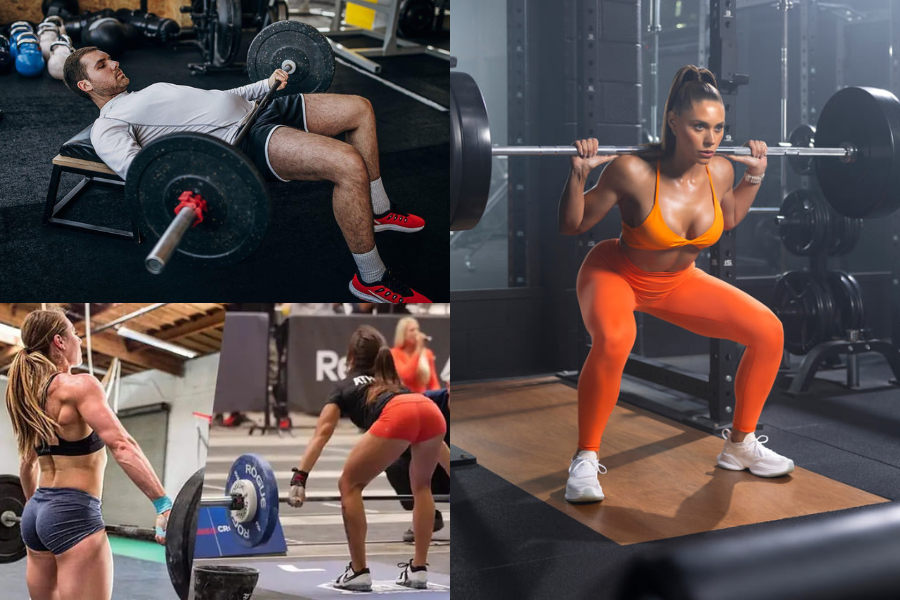
3. Hip thrusts or glute bridges
Hip thrusts place your gluteus maximus in a strong position to generate force, and they are especially helpful if your lower back does not like heavy squats.
- For hip thrusts, aim for 3 sets of 8 to 10 reps
- For bodyweight glute bridges, try 3 sets of 10 to 12 reps
Set your upper back on a bench, plant your feet firmly, and drive through your heels. At the top, form a straight line from your shoulders to your knees and pause for a strong glute squeeze.
4. Hamstring curls
Leg curls target the area of your hamstrings closer to the knee. You can use a machine at the gym, a stability ball, or a slider.
- Do 3 sets of 10 to 15 reps
- Move with control, and avoid swinging the weight up
- Focus on feeling the muscle at the back of your knee contract
On a stability ball, lie on your back with your heels on the ball, lift your hips into a bridge, then curl the ball toward you and slowly extend again. This variation also challenges your glutes and core.
5. Lunges or split squats
Single leg work challenges your glutes and hamstrings while also training balance and hip stability. Exercises like reverse lunges or Bulgarian split squats are especially effective.
- Do 3 sets of 8 to 10 reps per leg
- Keep most of your weight in the front heel, and avoid collapsing at the waist
- Lower under control, then push through the front leg to return to the start
Because your glute medius and minimus help stabilize your hip during single leg tasks, you will feel a lot of work on the side of your hips with these movements.
6. Optional kettlebell swings
If you want to add a power and conditioning element to your glute and hamstring workout, finish with kettlebell swings.
- Do 3 sets of 12 to 15 reps
- Use your hips to swing the bell, not your arms
- Hinge back, then snap your hips forward to drive the bell up
This ballistic hip hinge loads your hamstrings and glutes quickly. It can improve power, athleticism, and metabolic conditioning when done correctly.
If an exercise causes sharp pain or discomfort that does not feel like normal muscle work, stop and adjust your form, reduce the load, or replace that move with a more comfortable variation.
Stretch and recover for better results
Strength training is only part of the equation. To keep your muscles healthy and flexible, fit in some stretching and recovery work.
Simple hamstring stretches
Two to three times per week, spend a few minutes on hamstring flexibility:
- Standing hamstring stretch: Place one heel on a low surface, keep your back flat, and gently lean forward until you feel a stretch in the back of your thigh.
- Seated forward bend: Sit with your legs straight, hinge at the hips, and reach toward your feet without rounding your back.
Hold each stretch for 15 to 30 seconds. You should feel tension but not pain. Start gently, especially if your hamstrings are tight from sitting or past injuries.
Build in rest days
Your muscles grow and adapt between workouts, not during them. Include at least one rest or light movement day between intense leg sessions. Walking, easy cycling, or gentle yoga can help blood flow and reduce soreness without overtaxing your glutes and hamstrings.
Nutrisense also recommends working with a personal trainer or physical therapist if you are unsure about your form, and consulting a sports nutritionist if you want to optimize your diet for muscle recovery and metabolic health.
Putting it all together
You do not need a complicated routine to build strong, powerful glutes and hamstrings. Focus on a few proven exercises, perform them with good form, and stay consistent.
Over the next month, aim to:
- Warm up with 10 minutes of cardio and a few activation drills
- Complete the main glute and hamstring workout two or three times per week
- Stretch your hamstrings two or three times weekly
- Allow at least one rest day between tough lower body sessions
Start with weights that feel manageable and add a little more only when you can perform all your reps with steady control. With each week, you will likely notice everyday tasks feeling easier, your posture improving, and your lower body looking and feeling stronger.
About The Author