Boost Your Fitness with Easy Exercise Bike Workouts for Beginners
A stationary bike is one of the simplest ways to start moving more, especially if you are new to exercise or getting back into a routine. An exercise bike workout for beginners can help you burn calories, improve your heart health, and build leg strength, all without pounding your joints like running often does (Verywell Fit). With the right setup and a realistic plan, you can build fitness in short, manageable sessions.
Below, you will learn how to set up your bike, structure beginner workouts, and progress safely as you get stronger and more confident.
Understand why an exercise bike is great for beginners
A stationary bike gives you many of the same cardiovascular benefits as walking, running, or using a treadmill or elliptical, yet it is easier on your joints (Verywell Fit). If you have knee, hip, or ankle discomfort, or you are simply cautious about impact, this is a major advantage.
Cycling works your quads, hamstrings, glutes, and calves in every pedal stroke, and when you turn up the resistance you challenge those muscles even more, which can support strength and muscle growth over time (Garage Gym Reviews). Some bike styles, such as air bikes, even involve your upper body so you get a fuller body workout.
Regular cycling also raises your heart rate into an aerobic training zone, which is linked with better cardiovascular fitness and a lower risk of heart disease (Garage Gym Reviews). You get similar heart health benefits as you would from running or HIIT, but in a seated and controlled position.
If your goal is weight loss, a 30 minute moderate ride can burn roughly 210 to 294 calories depending on your body weight, and increasing your pace or resistance will raise that number (Garage Gym Reviews). When you combine those rides with a modest calorie deficit through food, your exercise bike can become a reliable tool for fat loss (NordicTrack).
Choose the right bike for your body
You do not need a fancy studio bike to get a good beginner workout. The best choice is the one that feels comfortable, fits your space, and encourages you to ride often.
Upright bikes keep you in a more traditional cycling posture and are a solid pick if you have no major joint or back issues. If you deal with low back pain, limited mobility, or balance concerns, a recumbent bike with a larger seat and backrest can be more forgiving. The reclined position supports your upper body and reduces strain on joints, which is especially helpful for beginners and people with chronic pain (Healthline).
Whatever style you choose, look for simple resistance controls that you can adjust easily mid ride. This lets you scale workouts to your current fitness level and change intensity for intervals or recovery as needed (NordicTrack).
If you have any medical conditions, take medications, or are brand new to exercise, it is smart to check in with your doctor before you start a new cycling program so you know it is safe for you (Healthline).
Set up your bike for comfort and safety
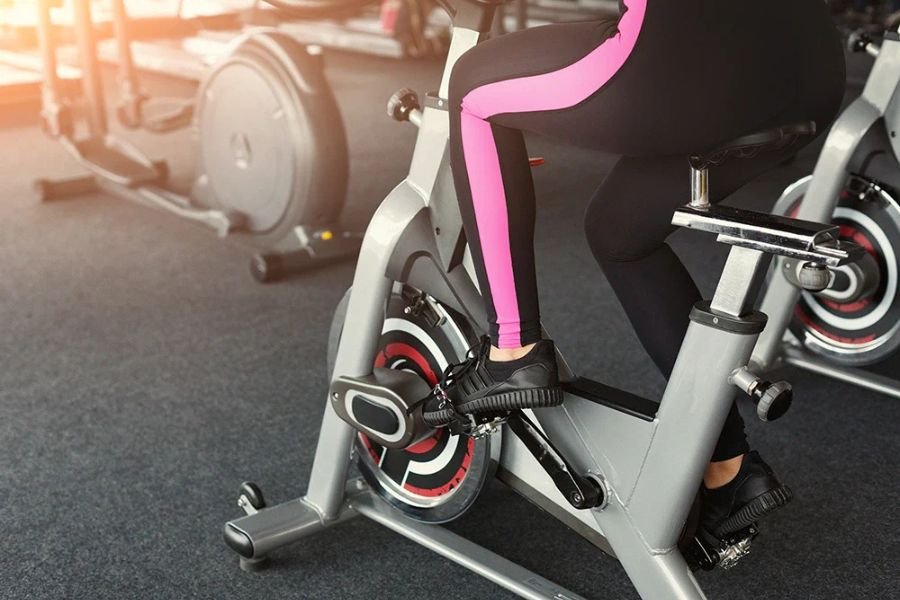
Good bike setup is one of the most important parts of an exercise bike workout for beginners. An improperly adjusted bike can irritate your knees, hips, or back and make riding feel much harder than it needs to be.
Start with the saddle height. A helpful guideline is to adjust the seat so it is roughly level with your hip bone when you stand next to the bike. When you sit on the saddle with your foot on the pedal at the lowest point, your knee should have a slight bend, not be locked straight or overly bent (NordicTrack). This simple change can significantly reduce strain and improve efficiency.
Next, adjust the handlebar height so you can sit upright with your chest open and shoulders relaxed. You want to reach the bars without rounding your back or shrugging your shoulders toward your ears. Both ProForm and NordicTrack recommend sitting with a relaxed posture, slight bend in the knees, hands resting lightly on the handlebars, and neck and arms relaxed to minimize soreness and fatigue (ProForm, NordicTrack).
Finally, resist the urge to crank the resistance too high right away. Extremely heavy resistance makes pedaling choppy, can stress your knees, and is not necessary when you are learning the basics. A moderate resistance that allows smooth circles at your chosen speed is ideal (NordicTrack).
Build your first beginner workout
A good beginner session focuses on time and consistency rather than difficulty. It should feel approachable, leave you slightly out of breath but not wiped out, and make it easy to show up again tomorrow.
Many experts suggest starting with 15 to 20 minutes of cycling three to five days per week and then gradually working up to 30 to 45 minutes on most days as your fitness improves (NordicTrack). Healthline recommends a similar approach, beginning with 25 to 35 minutes and then adding one minute at a time as you feel stronger (Healthline).
Here is a simple 25 minute workout you can try on most upright or recumbent bikes:
-
Warm up, 5 minutes
Pedal at very light resistance. You should be able to hold a conversation with ease. Focus on smooth circles and relaxed posture. -
Easy base riding, 10 minutes
Increase resistance slightly so you feel some effort but can still speak in short sentences. This is your baseline pace where you will spend most of your beginner rides. -
Gentle intervals, 8 minutes
Alternate 1 minute of a somewhat harder effort with 1 minute of easy pedaling. During the harder minute, increase resistance or speed just enough that you are breathing more heavily, then fully back off during the easy minute. -
Cool down, 2 minutes
Return to very light resistance and slow your pedal stroke gradually until your breathing and heart rate begin to come down.
Beginners are often encouraged to focus more on building time in the saddle than complex training plans. Consistent moderate rides build a strong fitness base that you can layer more intense work on later (Reddit Fitness).
Progress safely as you get stronger
Once a 20 minute ride feels comfortable, you can start to extend your sessions. One practical method is to add a five minute block where you alternate 3 minutes at your normal pace with 2 minutes slightly harder, gradually building up to a 30 minute workout (Verywell Fit). When you regularly complete 30 minutes, you are already meeting the minimum daily exercise duration many guidelines recommend.
Another way to progress is to increase duration by small increments. Healthline suggests adding 1 minute at a time as you feel able, which keeps the jump from feeling overwhelming (Healthline). Over a few weeks, those minutes add up.
As your fitness improves, aim for 30 to 45 minute rides on five days per week to notice clear changes in your stamina and mood (NordicTrack). You can maintain some days as easy steady rides and sprinkle in one or two days with intervals where you briefly increase speed or resistance.
At least one day of rest or very light activity each week will help your muscles recover and reduce your risk of overuse injuries, especially if any of your rides include higher intensity efforts (NordicTrack).
Think of your beginner months as “building your base.” Shorter, more regular rides usually do more for your fitness than the occasional long, exhausting session (Reddit Fitness).
Use good form, breathing, and pacing
Good technique makes every minute on the bike more effective and more comfortable. Try to sit with your hips level on the saddle, butt firmly on the seat, knees tracking in line with your feet, and a gentle bend in your elbows. Keeping your core lightly engaged and allowing your hips to move naturally with the pedal stroke helps distribute pressure and may protect your knees and joints from overuse issues (NordicTrack).
Breathing matters too. In lower to moderate intensity rides, inhaling through your nose and exhaling through your mouth can support steady oxygen delivery. During harder efforts, it is fine to breathe more through your mouth so you can get more air in and out quickly. ProForm notes that mindful breathing can improve performance during both gentle rides and high intensity spinning sessions (ProForm).
For cadence, many indoor cycling coaches recommend staying in a smooth range of about 80 to 120 revolutions per minute, especially as you gain confidence. Pedaling extremely fast at very low resistance can feel jerky and may make it harder to control your form, while very slow pedaling against heavy resistance can strain your knees (NordicTrack).
Support your rides with hydration and recovery
Even a short session can feel harder if you start dehydrated. Losing as little as 2 percent of your body weight through sweat and fluid loss can affect performance. The American Council on Exercise recommends specific fluid intake before, during, and after workouts to support temperature regulation, nutrient transport, and joint lubrication (ProForm). For most beginner rides, sipping water before you start and keeping a bottle within reach is enough.
Cool downs also matter. Easing into a lighter pace for a few minutes and then spending time on gentle static stretches for your quads, hamstrings, calves, and hips can reduce muscle stiffness, help blood circulate back toward the heart, and lower your chances of feeling very sore the next day (ProForm).
If weight loss is one of your main goals, pairing your cycling routine with basic strength training and modest nutrition changes can speed up your progress. NordicTrack suggests combining bike workouts with strength sessions and eating in a 300 to 500 calorie daily deficit so you lose fat steadily without feeling overly restricted (NordicTrack).
Put it all together
An exercise bike workout for beginners does not need to be complicated. If you set up your bike correctly, start with short, easy rides, and add time gradually, you will improve your fitness and confidence week by week. Stationary cycling gives you a joint friendly way to burn calories, build leg strength, and support your heart health, whether you ride at home or in the gym.
Choose a day this week, plan a simple 20 to 25 minute ride, and treat it as an experiment. Pay attention to how your body feels during and after, then adjust your next session accordingly. With consistency, your exercise bike can become one of the most approachable and effective tools in your fitness routine.
About The Author