Easy and Effective Elliptical Workouts for Beginners
A beginner friendly elliptical workout can be one of the easiest ways to start moving more, burn calories, and improve your health without beating up your joints. Elliptical workouts for beginners are low impact, simple to learn, and flexible enough to match your current fitness level and schedule.
Below, you will find exactly how to get started, how hard to work, and three simple workout options you can follow on any gym or home machine.
Understand why the elliptical is great for beginners
An elliptical gives you a full body cardio workout with very little stress on your joints. Your feet never leave the pedals, so your hips, knees, ankles, and back take less impact than they would on a treadmill or during outdoor running, which makes this machine especially useful if you are a beginner, returning from a break, or managing joint pain. Garage Gym Reviews notes that this low impact motion suits people with hip, knee, ankle, or foot issues.
You also work many muscles at once. When you use the moving handles, you recruit your upper body along with your legs, which helps you burn more calories in less time and build strength and endurance at the same time (Lose It!). According to the Cleveland Clinic, ellipticals can safely improve cardiovascular fitness and offer a joint friendly option even for people recovering from injuries or surgery (Cleveland Clinic).
Set yourself up before you start
Spending a few minutes on setup will make your first elliptical workouts safer and more comfortable.
Start by checking your shoes. Running shoes or cross trainers with good arch support, stability, and cushioning work best on the flat pedals and help protect your feet and ankles (Lose It!). Avoid old, worn out shoes that feel unstable.
Next, adjust the machine. Step onto the pedals while the machine is still, stand tall, and lightly hold the handles. If your elliptical lets you enter your age, weight, and sometimes height, take the time to do it. This gives you more accurate calorie estimates, since most machines are preset for a 150 pound user (Prevention).
If you have any medical conditions, take medications that affect your heart rate, or are unsure about exercising, check with your doctor before starting. Verywell Fit strongly recommends this step for anyone with illnesses or injuries before beginning an elliptical program (Verywell Fit).
Learn proper form and basic settings
Good form lets you get more out of each workout while protecting your joints and back.
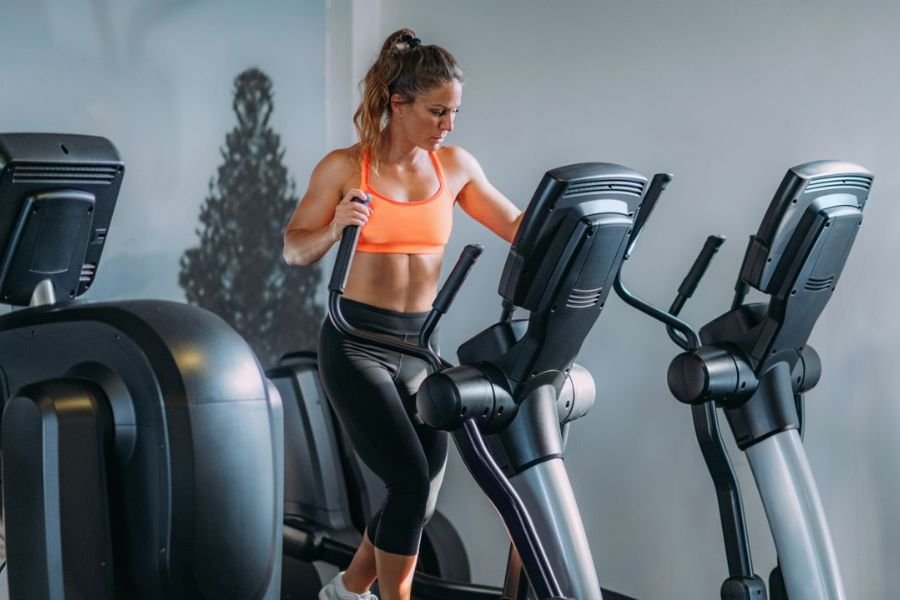
Stand upright with your core gently engaged, shoulders back, and gaze forward, not down at your feet. Slouching or leaning heavily on the handlebars reduces the work your legs and core do and can lead to soreness, so try to keep most of your weight over your legs instead of resting on your arms (ProForm).
As you pedal, focus on a smooth oval motion. Exercise physiologists at the Hospital for Special Surgery suggest actively pushing your legs down and back and then pulling up and forward, rather than letting the machine fling your feet around. This engages your quadriceps and other leg muscles more effectively (Hospital for Special Surgery).
For the first few sessions, you can use the stationary center handles to help with balance. Once your legs feel coordinated, add the moving arm handles so you can involve your upper body. If coordinating arms and legs feels tricky, learn the leg motion first, then slowly bring in the arm swing (Hospital for Special Surgery).
When it comes to settings, start modestly. Many trainers suggest a resistance below level 5 and a low incline between 1 and 8 for beginners, which lets you build confidence without overloading your joints (Garage Gym Reviews). As you get stronger, you can slowly nudge resistance or incline up, as long as your form stays controlled.
Find your ideal beginner intensity
The goal at first is to work hard enough that you feel challenged but not so hard that you want to quit after five minutes.
A simple way to judge this is the perceived exertion scale from 1 to 10, where 1 feels like sitting on the couch and 10 feels like an all out sprint. Verywell Fit recommends that beginners aim for level 4 to 6, which should feel like an easy warm up to just outside your comfort zone (Verywell Fit). You should be breathing heavier but still able to speak in full sentences.
If your machine displays calories burned, do not obsess over the number, but you can use it for rough feedback. Prevention suggests that a target of about 100 calories every 10 minutes is common for many users, as long as the machine has your stats entered correctly (Prevention).
Begin with sessions of 10 to 20 minutes, then build toward 30 minutes as your endurance improves. Both Garage Gym Reviews and Verywell Fit emphasize that gradual progression is key to avoiding excessive soreness and injury in your first weeks (Garage Gym Reviews, Verywell Fit).
Follow a simple warm up and cool down
A short warm up and cool down help your muscles ease into and out of each workout.
For your warm up, start with 5 to 10 minutes at very low resistance, ideally level 3 or below. Focus on smooth movement and posture while your heart rate gradually rises. Garage Gym Reviews recommends this approach to prepare your body and reduce soreness later (Garage Gym Reviews).
During the cool down, drop the resistance back to that easy warm up level and keep moving for another 3 to 5 minutes. This gives your heart rate time to come down and your legs a chance to flush out some of the fatigue.
If you feel steady, you can briefly let go of the handles during your warm up or cool down to challenge your balance and core. Lose It suggests this as a way to engage your midsection more during lower intensity phases (Lose It!).
Try these beginner elliptical workouts
Once you understand the basics, you can rotate among a few beginner friendly workouts. Start with whichever feels least intimidating, and remember that you can always shorten the total time or reduce resistance if needed.
1. Steady state starter workout
Use this when you are brand new or coming back after a long break.
- Warm up: 5 minutes
- Low resistance, low incline
- Effort around level 3 to 4 out of 10
- Main set: 10 to 15 minutes
- Slightly higher resistance, still comfortable
- Aim for level 4 to 5 out of 10, you can talk without gasping
- Maintain a steady pace and smooth breathing
- Cool down: 5 minutes
- Drop back to warm up settings
- Let your heart rate slowly come down
You can start with 15 total minutes and add 2 to 3 minutes each week, working up toward 30 minutes. This steady state style lines up with Verywell Fit’s structured 20 minute beginner workout that gradually builds toward 30 minutes over time (Verywell Fit).
2. Gentle interval workout for fat loss
Intervals alternate short harder efforts with easier recovery periods. They keep your mind engaged and can improve fitness quickly, even in shorter sessions.
-
Warm up: 5 minutes easy
-
Interval block, repeat 6 to 8 times:
- 1 minute at moderate to moderately hard effort, level 6 out of 10
- 1 minute at easy effort, level 3 to 4 out of 10
- Cool down: 5 minutes easy
Start with a total of 20 minutes, including warm up and cool down. Certified trainers often recommend short, higher intensity intervals on the elliptical for beginners because they are time efficient and effective for increasing calorie burn (Garage Gym Reviews, ProForm).
If any interval feels overwhelming, shorten the hard portion to 30 seconds and lengthen the recovery to 90 seconds until your fitness improves.
3. Incline and direction change workout
This workout brings in small changes to incline and movement direction so you work different muscles and avoid boredom.
-
Warm up: 5 minutes, easy pace, low incline
-
Main set, repeat 4 times:
- 3 minutes forward pedaling, moderate incline, medium resistance
- 2 minutes forward pedaling, same incline, slightly higher resistance
- 1 minute backward pedaling at the original resistance
- Cool down: 5 minutes, easy pace, low incline
ProForm and Prevention both highlight that switching directions, like adding backward pedaling, targets your hamstrings and glutes differently than forward pedaling, which mostly hits your quadriceps (ProForm, Prevention). This variety can keep your muscles challenged and help you progress without needing to extend your workouts a lot.
Tip: If your feet ever start to feel numb, shift your weight back into your heels rather than pressing hard into your toes. Prevention notes that this change lets your larger leg muscles work harder and often relieves numbness (Prevention).
Progress safely week by week
You do not need to overhaul your life to benefit from elliptical workouts. A simple plan of 2 to 3 sessions per week is a solid start. Garage Gym Reviews suggests 15 to 30 minute workouts, two or three times weekly, at modest resistance and incline for beginners (Garage Gym Reviews).
As you gain confidence, pick only one variable to increase at a time. You might add 3 to 5 minutes to a workout, slightly raise resistance, or include one extra interval cycle. Avoid raising time, resistance, and intensity all in the same week.
On days when you feel tired or sore, you can use the elliptical as a lighter recovery option between harder sessions. The Hospital for Special Surgery notes that ellipticals are excellent for unloading your joints while still keeping your heart and lungs working (Hospital for Special Surgery).
Finally, remember that nutrition, hydration, and rest all support your results. Staying hydrated is particularly important for joint health and temperature regulation, especially as workouts become more intense (ProForm).
Bring it all together
Elliptical workouts for beginners give you a low impact, full body way to burn calories, strengthen your heart, and build confidence with exercise. With a few simple form cues, realistic intensity targets, and beginner friendly workouts, you can start at your current level and gradually work toward longer, more challenging sessions.
Try choosing one of the three workouts and schedule it twice this week. After a few consistent weeks, you will likely notice easier breathing, stronger legs, and more energy in your everyday life, all from a machine that is kind to your joints and easy to learn.
About The Author