Which Wins in Elliptical vs Treadmill Cardio for Weight Loss
A treadmill and an elliptical can both help you lose weight and improve your cardio health. The debate around elliptical vs treadmill cardio usually comes down to calories burned, joint impact, and what you actually enjoy enough to stick with. The good news is that you do not have to guess. Studies show both machines can be effective for weight loss when you use them correctly and consistently.
Below, you will see how each option affects calorie burn, your joints, and your muscles so you can choose what fits your body and your goals.
Understand how both machines burn calories
For weight loss, you care about how many calories you burn in a workout and how easy it is to keep that routine going week after week.
A 2010 study found that the calories burned, oxygen consumption, and heart rate were nearly identical when exercising on an elliptical compared to a treadmill, which means elliptical workouts are an acceptable alternative to treadmill cardio for improving fitness and burning energy (Healthline). Your effort level matters more than the machine itself.
Harvard Health estimates that a 155 pound person burns about 335 calories in 30 minutes on an elliptical and about 372 calories running on a treadmill at a 10 minute mile pace (Livefit). That is a slight edge for the treadmill, but not a massive one.
Treadmills tend to burn a bit more because you fully support your body weight, especially at faster speeds or on an incline (Livefit, Nike). Ellipticals are lower impact and can feel easier, which sometimes leads people to underestimate how hard they need to work.
If you push yourself to a similar heart rate zone on both, you can expect very similar calorie burn over the same time period (Healthline, Nike).
Compare cardio benefits for fitness and fat loss
For improving your heart health and supporting fat loss, elliptical vs treadmill cardio delivers comparable benefits when intensity and duration match.
Research shows that heart rate and oxygen consumption are nearly the same on both machines at similar effort levels (Healthline, Nike). That means:
- Both can improve your cardiovascular fitness.
- Both can help you reach weekly activity targets.
- Both can be used for steady state or interval training.
Treadmills offer very precise control over speed and incline. This makes them especially well suited for high intensity interval training (HIIT), which is known to burn calories efficiently, reduce body fat, and improve conditioning in less time (Healthline, Livefit).
Ellipticals can also be used for intervals by adjusting resistance and stride speed. Because the movement is lower impact, you might recover faster between hard efforts, which can make interval sessions feel more manageable while still taxing your heart and lungs.
If your main goal is weight loss, what matters is that you get your heart rate up regularly. Both machines can do that well.
Consider joint impact and injury risk
If you have knee, hip, ankle, or low back issues, joint impact will likely be a big part of your elliptical vs treadmill cardio decision.
How the treadmill loads your joints
Treadmills provide a high impact, weight bearing workout that closely mimics outdoor walking or running (Nike). This impact has pros and cons:
- It stresses your bones and joints in a way that can support bone density and help reduce fracture risk over time (Nike).
- It can also increase the risk of shin splints, knee pain, and stress fractures, especially if you ramp up speed or mileage too fast (Healthline).
If you already have musculoskeletal conditions like low back pain, arthritis, or osteoporosis, the repetitive impact of treadmill running or jogging might aggravate symptoms (Healthline).
How the elliptical treats your joints
Ellipticals are designed to be low impact. Your feet stay in contact with the pedals, so there is no pounding with each step. This reduces stress on your knees, hips, and ankles and can feel noticeably gentler if you are returning to exercise, getting older, or managing joint pain (Healthline, Livefit, NordicTrack, Nike).
Guides from Healthline, NordicTrack, and Nike all highlight the elliptical as a safer choice if you have joint problems, are rehabbing an injury, or are a beginner who wants to avoid impact while building cardio fitness (Healthline, NordicTrack, Nike).
A note on joint mechanics and speed
One 2024 study looked closely at joint torques on an elliptical versus a stationary bike. It found that elliptical machines generated higher peak knee joint torque, with peak forces on the knee and ankle increasing as speed went up (Medicina via PMC). The fixed pedal design contributed to delayed, higher force peaks and constrained ankle angles.
The takeaway for you is not to avoid ellipticals entirely, but to be thoughtful about speed and resistance. The study authors recommend choosing appropriate pedaling speeds and using adjustable settings to keep joint stress reasonable and alignment comfortable (Medicina via PMC).
If you feel knee or ankle discomfort on an elliptical, slow your cadence, lower resistance, or adjust your foot position. If symptoms persist, talk with a professional before pushing harder.
Look at muscle engagement and body shaping
Elliptical vs treadmill cardio will feel different in your muscles. While both primarily work your lower body, the way they recruit upper body and core muscles is not the same.
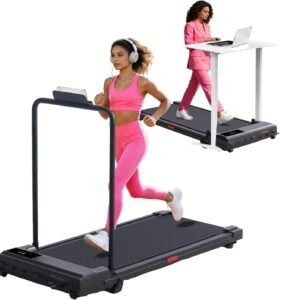
Treadmills mainly target your legs. Walking or running on a flat or inclined belt strengthens your quadriceps, hamstrings, glutes, and calves and is especially useful if you are training for outdoor walking or running since it closely simulates that movement (Healthline, NordicTrack).
Ellipticals, especially those with moving handles, engage both your upper and lower body. You recruit muscles in your arms, shoulders, chest, back, glutes, hip flexors, and quadriceps in a single session (Healthline, NordicTrack). You can also change direction, such as pedaling backward, to emphasize different muscle groups.
If your goal is total body conditioning and you do not have much time, an elliptical session can feel more efficient. If your goal is specific lower body strength or performance for outdoor running, the treadmill has a clear advantage.
Decide based on your body and your goals
When you compare elliptical vs treadmill cardio strictly on paper, treadmills burn slightly more calories at higher intensities and are better for race training. Ellipticals are easier on your joints and distribute the work across more muscle groups.
Neither is universally better. The right choice depends on you.
You might lean toward the treadmill if:
- You enjoy walking or running and want that familiar motion.
- You are training for a 5K, 10K, or other race and need sport specific practice.
- You like precise control over speed and incline for structured intervals.
- Your joints tolerate impact well.
You might lean toward the elliptical if:
- You have sensitive knees, hips, ankles, or low back.
- You are returning from an injury or starting from a lower fitness level.
- You want a low impact, total body workout in one machine.
- You get bored easily and like varying resistance and direction.
Both types of machine allow you to adjust speed and incline or elevation to increase intensity and calorie burn as you get fitter (Livefit, NordicTrack).
Use intervals to boost fat loss on either machine
If weight loss is a primary goal, how you use your machine matters more than which one you choose. High intensity interval training can significantly increase your calorie burn and improve cardio fitness in less time.
You can apply a simple interval format on both:
- Warm up for 5 minutes at an easy pace.
- Alternate 30 to 60 seconds of challenging effort with 60 to 90 seconds of easier recovery.
- Repeat for 10 to 15 minutes.
- Cool down for 5 minutes at an easy pace.
On the treadmill, you increase speed and sometimes incline during the hard intervals. On the elliptical, you increase resistance or stride speed. Research and expert guides agree that interval training on both machines can greatly enhance calorie burning and fat loss when combined with regular workouts and a supportive diet (Livefit).
If you are new to intervals, start with fewer rounds at a modest intensity and build gradually as your fitness improves.
Quick guideline: if you can only say one or two words during your hard intervals, you are probably in a good working zone. If you can sing, you are going too easy. If you cannot speak at all, you might be overdoing it.
Alternate both machines for variety and results
You do not have to commit to just one type of cardio. Alternating between elliptical and treadmill sessions can:
- Prevent boredom so you are more likely to stay consistent.
- Challenge different muscles, which may improve overall conditioning.
- Reduce overuse injuries by changing the repetitive stress on your joints (NordicTrack).
For example, you could:
- Use the treadmill for one or two interval focused workouts each week.
- Use the elliptical for one or two lower impact, moderate intensity sessions.
- Adjust the balance depending on how your joints feel and how your schedule looks.
Since both machines show similar improvements in calories burned, heart rate, and oxygen consumption over time (Healthline, Nike), mixing them can give you the best of both worlds while keeping your routine flexible.
Put it all together for your weight loss plan
For elliptical vs treadmill cardio, the winner is the one you will use regularly, at an intensity that challenges you, without causing pain or burnout. Treadmills slightly lead in raw calorie burn at high intensities and are perfect if you love to walk or run. Ellipticals offer joint friendly, total body workouts that are ideal if you need something gentler but still effective.
To get started, choose the machine you feel most comfortable on right now. Set a realistic schedule, such as 3 sessions per week, and focus on building the habit first. As you get fitter, introduce intervals, adjust resistance or incline, and consider alternating between both machines to keep your body and mind engaged.
Your weight loss and health improvements will come from that consistent effort, not from picking the “perfect” machine on day one.
About The Author