Simple Dumbbell Tricep Workouts You’ll Love Doing
A pair of dumbbells is all you need to build stronger, more defined arms. With the right dumbbell tricep workouts, you can train effectively at home or in the gym without complicated machines or barbells.
In this guide, you will learn simple, beginner friendly exercises that still deliver serious results. You will also see how to put them together into quick routines you can stick with.
Why dumbbells work so well for triceps
Your triceps have three heads, the long, lateral, and medial heads, and together they make up a large share of your upper arm size. Some estimates suggest the triceps account for more than half of your upper arm muscle mass, while the biceps contribute much less. That is why focused tricep training is so important for bigger, stronger arms and better pressing strength in moves like push ups and bench press.
Dumbbells are especially effective for tricep training because they allow a greater range of motion and demand more stability from the supporting muscles. Each arm works on its own, which helps you correct strength imbalances and build a more balanced physique. Compared with large barbells or machines, dumbbells are also easier to store and use at home.
If you are new to strength training, this kind of free weight work can also feel less intimidating than walking up to a big barbell station. You simply pick up a pair of dumbbells, choose a weight that feels manageable, and get started.
Tricep training basics you should know
Before you jump into specific dumbbell tricep workouts, it helps to understand a few simple guidelines so you get more from every rep and protect your joints.
Focus on controlled movement. Poor form reduces how much the triceps actually do and can shift stress into your shoulders or elbows instead. Move smoothly without jerking, keep your upper arm mostly still during isolation moves, and think about bending and straightening at the elbow.
Avoid overtraining. Your triceps already assist during many chest and shoulder exercises, so they can tire quickly. Training triceps hard immediately after heavy pressing can limit growth and increase fatigue. Giving at least one full day of rest between intense upper body sessions that include tricep work helps recovery and progress.
Finally, aim to hit all three tricep heads over the course of the week. Exercises that put your arm overhead tend to target the long head more, while close grip presses and kickbacks emphasize the lateral and medial heads. Combining these patterns keeps development balanced and can reduce the risk of nagging elbow discomfort.
Think of your tricep training as a mix of stretches under load, strong presses, and tight squeezes at full extension, rather than the same single movement repeated from every angle.
Essential dumbbell tricep exercises
You do not need a long list of fancy movements. A small group of well chosen, repeatable exercises is enough to build strength and size. Below are simple options you can plug into many different dumbbell tricep workouts.
Close grip dumbbell bench press
This press uses a narrow hand position to shift more work into your triceps.
Lie on a flat bench with a dumbbell in each hand, palms facing each other. Hold the weights above your chest with your elbows tucked close to your sides. Lower the dumbbells slowly toward your lower chest while keeping your elbows in, then press them back up by driving through your triceps.
This move can be loaded fairly heavily, often close to what you might handle on a barbell version, because your elbows stay down and in which helps reduce shoulder stress. It is an excellent main strength exercise on tricep focused days.
Lying dumbbell tricep extension (skull crusher)
This is one of the classic hypertrophy moves for the long head of the triceps.
Lie on a bench with a dumbbell in each hand or a single dumbbell held by both hands. Start with your arms extended above your chest. Without moving your upper arms much, bend at the elbows and slowly lower the weight toward your forehead or slightly behind your head. Stop just before you fully straighten the arms again so that the triceps remain under tension throughout the set.
Because the long head gets a deep stretch at the bottom of each rep, this exercise is very effective for muscle growth. The key is control. Move smoothly as suggested by guidance from Mayo Clinic on triceps extensions, and avoid jerking the weight so your elbows stay comfortable.
Overhead single arm dumbbell extension
Overhead work brings the long head of the triceps into a strong position.
Sit or stand tall and hold one dumbbell in one hand. Press it overhead so your upper arm is near your ear and your elbow is slightly bent. Keeping your upper arm mostly still, bend your elbow to lower the weight behind your head, then straighten the elbow again to raise the weight back up.
If you find it hard to keep your arm steady, you can gently support it with your free hand. This exercise works well with moderate weights and slightly higher reps and is also a good way to check for left right strength differences.
Dumbbell triceps kickback
Kickbacks focus on the fully shortened position of the triceps, the point at which the muscle is most contracted.
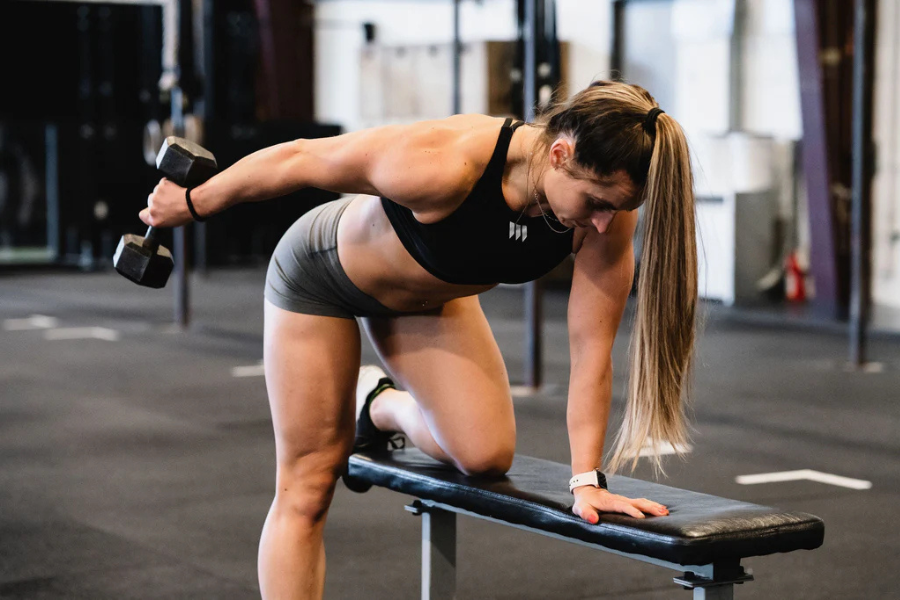
Hold a dumbbell in each hand and hinge forward from your hips until your torso is almost parallel to the floor. Bend your elbows to about 90 degrees with your upper arms close to your sides. From here, straighten your arms and push the dumbbells back until your arms are fully extended behind you, then return to the bent position.
Because your arm is behind your body at the top of the rep, the triceps are able to shorten as much as possible. This makes kickbacks one of the best exercises for feeling that peak squeeze at the back of your upper arm.
Dumbbell floor press variations
You can also perform a close grip dumbbell floor press if you do not have a bench. Lie on the floor with a dumbbell in each hand, elbows resting on the ground. Press the dumbbells up with your palms facing each other and your elbows tucked in. The floor limits range of motion slightly, which can be more comfortable on sensitive shoulders while still loading your triceps heavily.
This type of press is often recommended in tricep focused programs as a way to build pressing strength without relying on a full gym setup.
Sample dumbbell tricep workouts you can start today
Once you are familiar with the movements, you can structure them into quick routines. Here are two simple dumbbell tricep workouts you can alternate during the week. Adjust the weight so the last 2 reps of each set feel challenging but still controlled.
Workout A: Strength focused
Use this routine when you want to push heavier loads and build pressing power.
-
Close grip dumbbell bench press
3 sets of 6 to 8 reps, 90 seconds rest -
Dumbbell floor press, close grip
3 sets of 8 to 10 reps, 60 to 90 seconds rest -
Overhead single arm dumbbell extension
3 sets of 10 to 12 reps per arm, 60 seconds rest
Keep your movement controlled on the way down, then press up with intent. Since this is more strength oriented, try to keep the total session under 40 minutes and avoid adding many extra pressing exercises that might overwork your elbows and shoulders.
Workout B: Muscle focused
This workout leans toward higher reps and more time under tension to encourage tricep growth.
-
Lying dumbbell tricep extension
3 sets of 10 to 12 reps, 60 seconds rest -
Dumbbell triceps kickback
3 sets of 12 to 15 reps, 45 to 60 seconds rest -
Overhead single arm dumbbell extension
2 or 3 sets of 12 to 15 reps per arm, 45 seconds rest
You can finish with a light set of close grip push ups on the floor if your triceps still have some energy. Focus on feeling the back of your arms working rather than chasing the heaviest weight possible in this session.
Form tips to protect your elbows and shoulders
Good technique keeps the stress where you want it, on the triceps themselves, and helps you avoid the aches that come from overusing joints or surrounding muscles.
Keep your upper arm steady. In movements like skull crushers and kickbacks, imagine your upper arm is pinned in place. Only the lower part of your arm should move. When your shoulder starts swinging around, the triceps do less of the work and the exercise becomes less effective.
Move slowly through the lowering phase. The research you have seen from medical sources like Mayo Clinic on triceps extensions stresses the importance of smooth, controlled movement without jerking. Lowering the weight under control not only protects your joints, it also boosts muscle activation.
Use an appropriate training schedule. Since your triceps help with bench presses, shoulder presses, and many push variations, stacking all of these heavy movements on back to back days can push you toward overtraining. Leaving at least 24 hours between demanding upper body sessions gives your triceps time to recover and grow.
Finally, respect any sharp pain. Mild muscle fatigue and a gentle burn during high rep sets are normal, but sudden stabbing pain around the elbow or shoulder is a sign to stop and adjust. You can reduce discomfort by switching to slightly lighter weights or choosing a variation like floor presses that feel better for your joints.
How to progress your dumbbell tricep training
As your dumbbell tricep workouts feel easier, you will want to gradually increase the challenge so you keep seeing results.
You can add a small amount of weight to the dumbbells when you can complete the top end of the rep range for all sets with solid form. If your weight options are limited, you can add an extra set, slow down your lowering phase, or shorten your rest periods slightly. All of these changes make the work more demanding without needing brand new equipment.
Training both sides individually with moves like single arm extensions and kickbacks also helps you notice and correct imbalances. If one arm consistently struggles, you can match the reps of your weaker side with your stronger side instead of pushing only the strong arm ahead.
Having a simple set of dumbbells at home gives you the flexibility to train when it fits your schedule. You can do a short tricep focused session after a full body workout or dedicate a separate day to upper arms. Over time, this consistency will show up in stronger presses and more defined arms.
Start with one of the sample routines this week. Focus on steady, confident repetitions and give your triceps room to rest between sessions. With a few weeks of consistent dumbbell tricep workouts, you will feel the difference every time you push, press, or straighten your arms.
About The Author