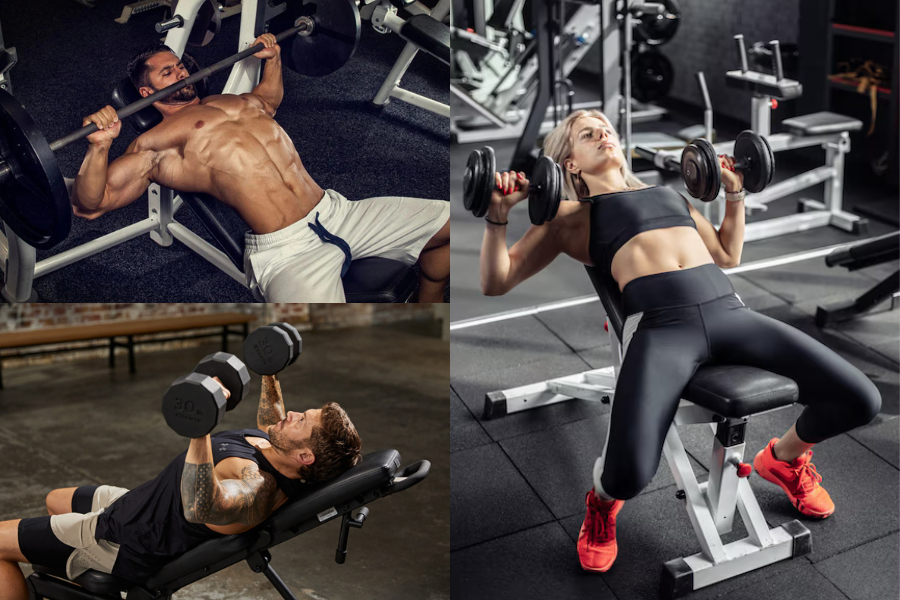
Build Stronger Muscles With This Chest Workout and Dumbbells
A focused chest workout with dumbbells lets you build strength, muscle, and definition without relying on a barbell or big machines. With just a pair of dumbbells and a bench or even some floor space, you can train every part of your chest and see real progress in a matter of weeks.
Below, you will learn how your chest muscles work, the best dumbbell chest exercises, and three complete chest workout with dumbbells routines for beginner, intermediate, and advanced levels.
Understand your chest muscles
Before you start lifting, it helps to know what you are trying to train. Your chest is not just one flat muscle. It includes three main groups that work together whenever you push, reach, or raise your arms.
- Pectoralis major is the largest chest muscle. It drives most pushing moves, such as presses, and helps move and rotate your upper arms.
- Pectoralis minor sits underneath. It helps stabilize your shoulder blade so your presses and flies feel strong and controlled.
- Serratus anterior wraps around your ribs and helps lift your arm overhead by rotating the shoulder blade.
No single dumbbell exercise hits every area equally. To build a fuller chest, you need a mix of angles and movements that target the upper, mid, and lower portions of your pecs.
Why choose a chest workout with dumbbells
You can build an impressive chest with a barbell, cables, or machines. However, a chest workout with dumbbells offers some unique benefits that are hard to match.
More range of motion
With dumbbells, your hands can move freely instead of being locked to a fixed bar. This allows:
- A deeper stretch at the bottom of presses and flies
- A stronger squeeze at the top of each rep
- Natural wrist rotation that feels more comfortable
That extra range of motion increases tension on your chest muscles and can encourage more growth compared to the shorter path you often get with barbells or machines.
Better balance and fewer imbalances
Because each arm works on its own, dumbbells make it harder for your stronger side to secretly take over. Over time this helps:
- Correct left to right strength differences
- Improve symmetry in your chest
- Build more even shoulder and triceps strength
If you have ever noticed one side of your chest looking or feeling stronger, unilateral dumbbell work is one of the simplest ways to fix it.
More joint friendly and safe
Dumbbells let your elbows and shoulders move in the path that feels natural to you. That means:
- Less stress on your shoulder joints
- Easier adjustments if you have wrist or elbow issues
- Safer hard sets when you do not have a spotter, since you can drop the weights to the side
For people who are prone to shoulder discomfort, options like the reverse grip press and hex press are especially helpful because they reduce shoulder strain while still training the chest hard.
Best dumbbell exercises for a bigger chest
You do not need dozens of movements. If you pick a few solid exercises and perform them with good form, you can build serious strength and size. Below are some of the most effective dumbbell chest exercises and how they help.
Dumbbell bench press
The dumbbell bench press is one of the best chest exercises for building strength and muscle. Compared to the barbell version, it usually gives you a fuller range of motion and can be safer if you train alone.
- How to do it: Lie on a flat bench with a dumbbell in each hand. Plant your feet, squeeze your glutes, and keep your shoulder blades pulled back. Lower the dumbbells beside your chest with your forearms vertical, then press them up and slightly toward each other while you squeeze your chest.
- Sets and reps: 3 to 4 sets of 6 to 8 reps.
Common mistakes include flaring your elbows too wide, bending your forearms inward, and rounding your shoulders at the top. Keeping your arm path in line with your chest fibers and your forearms stacked over your elbows improves activation and reduces shoulder stress.
Incline dumbbell press
The incline dumbbell press puts more emphasis on the upper chest by changing the angle of pull. This is key if you want a more lifted, defined look through the top of your chest.
- How to do it: Set your bench to a slight incline, about 15 to 30 degrees. Higher angles tend to shift the work to your front shoulders and can decrease upper chest activation. Press the dumbbells up from the upper chest, lower under control until you feel a stretch, then press back up with a strong squeeze.
- Sets and reps: 3 to 4 sets of 8 to 10 reps.
Research suggests that a small incline in this range can lead to significantly greater upper chest growth than a flat bench, as long as you maintain good form and do not let your shoulders dominate the movement.
Dumbbell chest fly
The dumbbell chest fly focuses on adduction, which is the movement of bringing your arms toward the center of your body. This trains the chest differently from presses and helps you feel a deep squeeze.
- How to do it: Lie on a flat or slight incline bench, arms extended above your chest with a soft bend in the elbows. Open your arms in a wide arc until you feel a stretch across your chest, then bring the dumbbells back together over your chest by squeezing your pecs, not by bending your elbows more.
- Sets and reps: 3 sets of 10 to 12 reps.
Keep the movement slow and controlled. The goal is to feel your chest stretching and contracting, not to swing heavy weights.
Half bench single arm dumbbell press
This unilateral press variation works one side of your chest at a time and forces your core to stabilize.
- How to do it: Lie with your upper back and shoulders on a bench, hips lifted and feet on the floor as if you are doing a hip bridge, or lie fully on a bench but hold one dumbbell at a time. Press the weight up and down like a normal bench press while resisting the urge to rotate or tip to the side.
- What it trains: Chest, triceps, and shoulders, plus your abs and glutes for stability.
- Sets and reps: 3 sets of 10 to 12 reps per side.
Because only one side is loaded, your core has to fight rotation, which builds stability that carries over to other lifts and everyday movements.
Dumbbell floor press
If you have wrist or elbow discomfort or no bench available, the dumbbell floor press is a smart choice.
- How to do it: Lie on your back on the floor with your knees bent. Press the dumbbells over your chest, then lower until your upper arms gently touch the floor. Pause briefly to remove momentum, then press back up.
- What it trains: Chest, triceps, and shoulders with a limited range that is usually easier on your joints.
The floor naturally stops the movement at a safe depth which can help if you tend to overextend at the bottom of a bench press.
Reverse grip dumbbell press
The reverse grip press uses an underhand grip and can be kinder to your shoulders while still hitting the chest.
- How to do it: On a flat or slight incline bench, hold the dumbbells with your palms facing your face. Keep your elbows close to your sides as you lower and press.
- Benefits: Shifts emphasis to the upper chest and reduces shoulder pressure due to the supinated grip and closer elbow path.
If regular presses bother your shoulders, this variation is worth trying.
Hex press
The hex press is usually performed with hexagonal dumbbells pressed together, but you can lightly press round dumbbells toward each other as well to mimic the effect.
- How to do it: Lie on a bench with the dumbbells together over your chest, palms facing in. Keep squeezing them into each other as you lower and press.
- Benefits: Increases inner chest activation, boosts pushing power, and reduces external shoulder rotation which may feel safer for some shoulders.
Continuous tension from pressing the dumbbells together makes light weights feel surprisingly challenging.
How to structure your chest workout with dumbbells
You do not need to perform every exercise in a single session. In most cases, 2 to 4 exercises per workout is enough, especially if you train close to fatigue.
A simple way to plan your session is:
- Start with your heaviest compound presses that require the most force and coordination.
- Follow with another press variation at a different angle.
- Finish with isolation work like flies or pullovers to fully fatigue the chest.
For strength and muscle growth, you can work in a wide rep range, from about 5 to 30 reps, as long as you push close to failure and keep your form tight.
Three complete dumbbell chest workout routines
Use these as templates. You can repeat the same workout twice a week or alternate two versions. Aim to train your chest at least twice weekly for best results, and consider a third session later if your progress stalls.
Beginner dumbbell chest workout
If you are new to lifting or returning after a long break, focus on mastering technique and building consistency.
- Dumbbell floor press
- 3 sets of 8 to 10 reps
- Incline dumbbell press
- 3 sets of 8 to 10 reps
- Dumbbell chest fly
- 2 to 3 sets of 10 to 12 reps
- Push ups
- 2 sets to technical failure, stop when your form starts to break
Rest 60 to 90 seconds between sets. Start with lighter weights than you think you need so you can practice good form and control.
Intermediate dumbbell chest workout
Once you are comfortable with the basics, you can increase volume and use supersets with short rest periods.
- Superset A
- A1: Dumbbell bench press, 3 sets of 6 to 8 reps
- A2: Dumbbell chest fly, 3 sets of 10 to 12 reps
- Rest 60 seconds between rounds
- Superset B
- B1: Incline dumbbell press, 3 sets of 8 to 10 reps
- B2: Half bench single arm dumbbell press, 3 sets of 10 reps per side
- Rest 60 to 75 seconds between rounds
This approach keeps your heart rate up and maximizes training density without needing a lot of extra equipment or time.
Advanced dumbbell chest workout
If you already have a solid base and want a challenge, this routine combines supersets and a high effort burnout finisher.
- Superset A
- A1: Dumbbell bench press, 4 sets of 6 to 8 reps
- A2: Hex press, 4 sets of 10 to 12 reps
- Superset B
- B1: Incline dumbbell press, 3 to 4 sets of 8 to 10 reps
- B2: Dumbbell chest fly, 3 to 4 sets of 10 to 12 reps
- Five minute chest burnout
- Set a timer for 5 minutes and cycle through bodyweight push up variations with no rest
- Start with standard push ups, then regress to knee push ups or incline push ups if needed to keep moving
The goal is to reach deep fatigue in the chest. Expect significant soreness and make sure you allow enough recovery before your next heavy session.
Progress, frequency, and what to expect
To keep building muscle, your chest workout with dumbbells needs some form of progression over time. You can do this by:
- Adding a few reps with the same weight each week
- Increasing the weight once you reach the top of your target rep range
- Adding an extra set for one or two exercises when you feel ready
Most people see noticeable improvements in workout performance in 3 to 4 weeks, such as lifting heavier weights or performing more reps. Visible changes in chest size and shape typically appear between 8 and 12 weeks, especially if your nutrition and sleep support your training.
Aim to train your chest with dumbbells at least twice per week so the muscles get frequent growth signals while still having time to recover. If progress slows, you can move up to three sessions per week as long as your total weekly volume and fatigue are manageable.
Technique tips for safer, stronger dumbbell chest work
A few small adjustments can significantly improve your results and reduce your risk of injury.
- Keep your shoulder blades pulled back and down on the bench. This opens your chest and stops your shoulders from rolling forward and taking over.
- Keep your forearms roughly vertical over your elbows on presses. Letting the dumbbells drift over your face or belly reduces chest tension and can stress your joints.
- Avoid flaring your elbows straight out. A slight tuck keeps your shoulders happier and better aligns the load with your chest fibers.
- Squeeze your chest at the top of each rep. Actively thinking about bringing your biceps together in front of your body can help you feel the right muscles.
- Engage your glutes and abs, especially on heavier sets or unilateral movements, to protect your lower back and improve stability.
With a small set of dumbbells, a bit of floor space, and these guidelines, you have everything you need to run a complete chest workout with dumbbells, whether you are training at home or in a crowded gym. Start with one of the routines above, track your weights and reps, and add a little more challenge each week. Over time, you will notice stronger presses, better posture, and a chest that looks and feels more powerful.
About The Author





