Your Ultimate Guide to an Effective Chest Routine for Women
A strong chest routine for women does much more than tone your upper body. When you train your chest regularly, you support better posture, make everyday tasks easier, and help protect your neck and back from strain. With the right mix of exercises and structure, you can build strength and confidence without spending hours in the gym.
Below, you will learn how your chest muscles work, the best chest exercises for women at home or in the gym, and how to put everything together into a simple, effective chest routine for women.
Understand your chest muscles
Your chest area includes some of the largest muscles in your upper body. The main ones are the pectoral muscles, which sit at the front of your body between your neck, shoulders, and rib cage. These muscles are responsible for moving and controlling your arms, especially during pushing motions like closing a heavy door or getting up from the floor.
When your pecs are strong, they help keep your shoulders in better alignment and support your upper spine. Fitness experts note that this improves posture, which can make breathing, digestion, and circulation more efficient while also giving more power to your shoulders and arms for everyday tasks like carrying grocery bags or holding a baby.
Instead of thinking of chest training as something that will make you “bulky,” think of it as building a solid base for your entire upper body.
Why chest training matters for women
Many women gravitate toward lower body exercises and skip chest work altogether. However, trainers point out that working your chest is crucial for several reasons.
First, strong pecs help you stand taller. By supporting the rib cage and stabilizing the shoulder joint, they can reduce your risk of neck and upper back discomfort. Trainers at Temple Fitness in Franklin, TN note that chest training supports proper shoulder alignment, improves spinal posture, and can even help your breathing by supporting the rib cage.
Second, chest workouts play an important role in your overall fitness and body composition. Maintaining muscle mass helps increase calorie burn, even at rest, which can support healthy weight management and better long term fitness.
Finally, most of the best chest exercises for women also work other muscles like your shoulders, triceps, core, and even back. That means each set you do gives you multiple benefits in one efficient routine.
If you are just starting out, aim to train your chest 2 to 3 times per week, with at least one day of rest between sessions so your muscles can recover.
Key types of chest exercises
An effective chest routine for women usually combines two types of movements: compound pushing exercises and isolation or “focused” exercises.
Compound pressing movements
Compound exercises involve multiple joints and muscle groups, so they are ideal for building overall strength.
Common compound chest exercises include:
- Pushups and their variations
- Dumbbell or barbell bench press
- Incline press ups using a bench or step
- Chest press machine at the gym
These moves target your pecs, deltoids, and triceps at the same time, which is why trainers highlight them as some of the best choices for upper body strength.
Focused chest moves
Focused or isolation moves put more emphasis on your chest muscles while still engaging supporting areas.
Examples include:
- Dumbbell chest fly
- Cable chest fly
- Single arm chest press
- Resistance band fly variations
These exercises usually involve a controlled arc or hugging motion. You keep a slight bend in your elbows to protect the joint while you stretch and contract the chest through a wide range of motion. This is helpful for building balanced strength, especially through the inner chest.
Best beginner friendly chest exercises
If you are newer to strength training or returning after a break, start with approachable variations. You can build a solid foundation without needing advanced skills or heavy weights.
Incline press ups
Incline press ups are an excellent beginner exercise because they reduce how much of your body weight you have to push. You can use a sturdy bench, chair, or even a staircase.
Place your hands on the elevated surface, a bit wider than shoulder width, and walk your feet back until your body forms a straight line from head to heels. Bend your elbows to lower your chest toward the surface, then press back up. Keeping your core tight and your body straight helps you train your chest, shoulders, and triceps while protecting your lower back.
Modified and full pushups
Pushups are a classic chest move for a reason. They are simple, require no equipment, and can be adapted to your current strength level.
If full pushups are not available yet, start with:
- Knee pushups, with your knees on the floor and your body in a straight line from knees to head
- Incline pushups, as described above, to reduce the load
To get the most from each rep, keep your elbows at roughly a 45 degree angle away from your ribs rather than flared straight out. This position helps you engage your chest effectively while reducing stress on your shoulders.
As you grow stronger, you can transition to full pushups on your toes and eventually experiment with more challenging variations like close grip or tempo pushups.
Dumbbell chest press
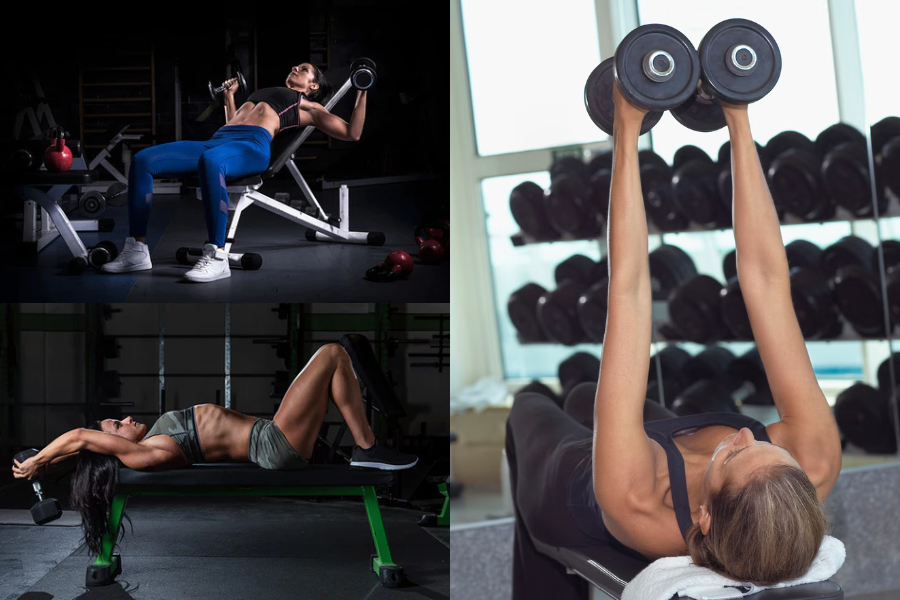
The dumbbell chest press is one of the most accessible pressing exercises for beginners. You can perform it on a bench or on the floor at home. Lying on your back, hold a dumbbell in each hand with your arms bent and your upper arms at about a 45 degree angle from your body. Press the weights up until your arms are straight without locking your elbows, then lower with control.
This move trains both the larger pectoralis major and the smaller pectoralis minor, along with your deltoids and triceps. It also teaches you how to push weight away from your body, which directly carries over to daily tasks like pushing a heavy cart or closing a door.
Glute bridge press
The glute bridge press is a smart multitasking exercise. You lie on your back with your feet flat and knees bent, then lift your hips into a bridge position while pressing dumbbells from your chest up toward the ceiling.
Because you are holding the bridge, your glutes, hamstrings, and core are working while your chest and arms press. This makes it a comprehensive move that builds both upper and lower body strength in one go, which is especially useful if you are short on time.
Intermediate and gym based chest moves
Once you are comfortable with beginner variations and can perform them with good form, you can add more challenging exercises to your chest routine for women.
Dumbbell or barbell bench press
The bench press is often called the ultimate upper body exercise. Using a flat bench, you press weights away from your chest with both arms at the same time. This exercise targets your pecs but also heavily involves your shoulders and triceps.
You can perform a similar motion at home as a floor press if you do not have a bench. In that case, your elbows will touch the floor at the bottom of the movement, which slightly reduces range of motion but still provides an effective stimulus.
Start with a weight you can control for 8 to 12 repetitions while maintaining a stable shoulder position and a neutral spine.
Chest press machine
If you prefer using machines or you are new to free weights, the seated chest press machine is a great alternative. You sit upright with your back supported and push the handles away from your chest, then slowly return to the starting position.
To set the machine up safely, adjust the seat so that when your arms are extended, they are roughly horizontal and in line with your chest. Trainers recommend starting with lighter weight and never locking out your elbows fully at the top to keep tension on the muscles and protect your joints.
Dumbbell and cable chest fly
Chest fly variations are effective for targeting the inner and mid chest. They involve moving your arms in a wide arc, like you are opening and closing your arms for a hug.
For a dumbbell fly, lie on a bench or on the floor holding light dumbbells above your chest with a slight bend in your elbows. Slowly open your arms out to the sides until you feel a stretch through your chest, then bring the weights back together over your chest. Remember to keep your elbows softly bent throughout to maintain muscle tension and protect your shoulders.
Cable flys use a cable machine to provide constant resistance through the range of motion. You can perform them standing or on a bench, which allows you to adjust the angle and hit your chest from slightly different positions.
How to structure a chest routine for women
Once you know the exercises, the next step is to organize them into a routine you can stick with. A well planned chest session should feel challenging but manageable, and it should fit within your weekly schedule.
Sample workout format
A common chest workout structure recommended by trainers involves:
- Choosing 5 to 8 exercises
- Performing 10 to 12 reps per move, or working for 50 seconds followed by 10 to 15 seconds of rest
- Completing 3 total rounds or circuits
- Resting 1 minute between circuits
This type of structure typically takes about 20 to 25 minutes. You only need a pair of dumbbells and a mat for most movements, which makes it easy to do at home.
Example beginner routine
Here is one way you might put together a beginner friendly chest routine for women:
- Incline pushups
- Dumbbell chest press on the floor
- Glute bridge press
- Knee pushups
- Dumbbell chest fly
Perform each exercise for 10 to 12 reps, rest 15 seconds, then move to the next. After all 5 exercises, rest for 1 minute and repeat 2 more times.
As you progress, you can swap in more challenging variations like full pushups, heavier weights, or the bench press and chest press machine if you have access to a gym.
A simple rule of thumb: when an exercise feels easy for all your reps and sets, and your form is solid, it is time to increase the weight slightly or choose a harder variation.
How often to train your chest
Trainers commonly recommend that women train their chest 2 to 3 times per week, with at least one rest day between sessions. If you are completely new to resistance training, you might start with two full body workouts per week that include one or two chest focused moves, then add a dedicated chest workout once you feel comfortable.
Aim for:
- 2 to 3 days per week that include chest work
- 8 to 15 total sets per week for your chest, spread across sessions
- Consistent practice for several weeks before expecting major changes
Pay attention to how your body feels. Mild muscle soreness is normal, especially when you begin a new routine, but sharp pain in your shoulders, wrists, or neck is a sign to stop and reassess your form.
Practical tips for success and safety
To get the most from your chest routine for women, it helps to keep a few practical guidelines in mind.
Warm up before each session with 5 to 10 minutes of light cardio, such as brisk walking or gentle cycling, plus a few dynamic arm swings or wall pushups. This prepares your muscles and joints for heavier work.
Choose weights that feel challenging by the last 2 or 3 reps, yet still allow you to maintain good form. If you find yourself holding your breath, arching your back, or letting your shoulders creep up toward your ears, the load may be too heavy.
Focus on controlled, steady movements instead of rushing. The tempo of your reps, especially on the way down, has a big impact on how much your muscles are working.
Finally, give your body time to adapt. Consistency over weeks and months matters more than any single workout. With a regular, thoughtfully structured chest routine, you will build strength that supports everything else you do, from your workouts to your daily life.
About The Author