The Best Glute Exercises to Boost Your Strength Fast
Glute training has come a long way from a few random squats tacked onto leg day. When you focus on the best glute exercises and structure them well, you build strength, power, and stability that you can feel in every step, jump, and lift.
This guide walks you through what your glutes actually do, which exercises deserve a permanent place in your routine, and how to put them together for faster strength gains.
Understand your glute muscles
Before you load up the bar, it helps to know what you are trying to train. Your glutes are not just one muscle, they are a trio that work together to move and stabilize your hips.
- Gluteus maximus: The largest muscle in your body. It handles hip extension, like when you stand up from a squat, climb stairs, or drive your hips forward in a sprint. It is key for power and shape.
- Gluteus medius: Sits on the outside of your hip. It helps you move your leg out to the side and keeps your pelvis level when you stand on one leg or walk.
- Gluteus minimus: The smallest of the three. It works with the medius to rotate and stabilize your hip, which helps with balance and joint health.
Together, these muscles support posture, protect your lower back, and boost athletic performance in almost every sport, as highlighted in recent guidance from Planet Fitness. When they are weak or underused, you are more likely to deal with knee pain, tight hips, and nagging lower back issues, a pattern also noted by ISSA in their 2023 overview of glute training.
Why strong glutes matter
You might think of glute workouts as mainly aesthetic, but stronger glutes pay off in everyday life and training.
Stronger glutes can help you:
- Maintain better posture when you sit, stand, or carry loads
- Produce more power in running, jumping, and lifting
- Stabilize your knees and ankles to lower your risk of injury
- Support your lower back and reduce strain in heavy lifts
According to Planet Fitness, consistent glute training improves hip extension strength, reduces injury risk, and supports functional movements such as squats, lunges, and stair climbing. ISSA adds that weak or inactive glutes are often linked to ACL injuries, hamstring strains, and lower back pain, especially if you spend a lot of time sitting during the day.
If you want to feel stronger in your workouts and more comfortable in daily movement, targeting your glutes is one of the most efficient ways to get there.
Best compound glute exercises for strength
Compound exercises train multiple muscle groups at once and let you use relatively heavy loads. If your goal is to get stronger fast, these should be your foundation.
Squats and sumo squats
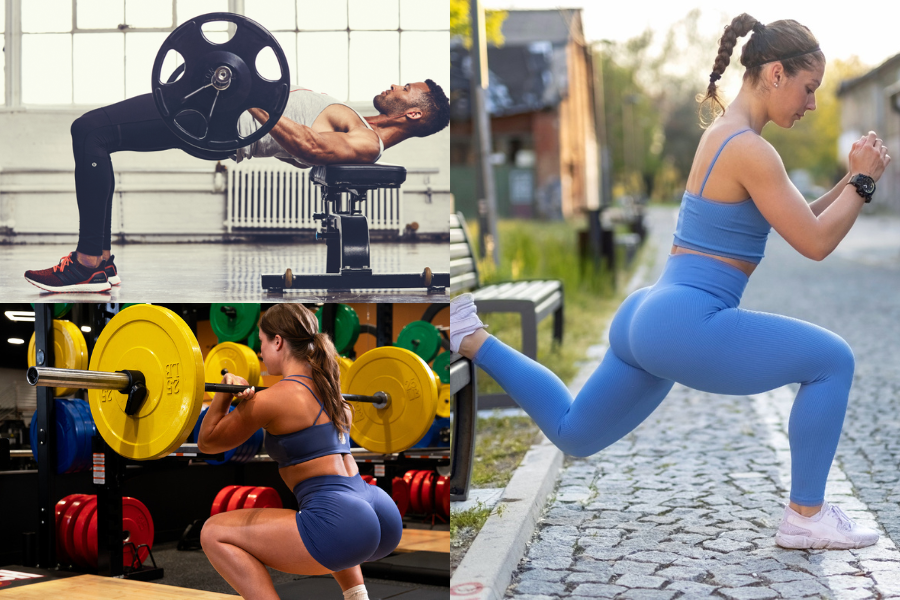
Squats are a classic for a reason. They work your glutes, quads, and hamstrings while challenging your core and overall stability. Gymshark notes that back squats, especially at heavier loads between 90 and 100 percent of your one rep max, significantly increase glute engagement and play a key role in lower body development.
To emphasize your glutes:
- Sit your hips back, not just straight down
- Keep your chest up and knees tracking over your toes
- Aim for a depth where your thighs are at least parallel to the floor if your mobility allows
Sumo squats, which use a wider stance and toes turned slightly outward, shift more work to your glutes and inner thighs. The wider stance can help you feel your glutes engage more at the bottom of the movement.
Romanian deadlifts
Romanian deadlifts (RDLs) are one of the most effective hip hinge exercises you can do for your glutes and hamstrings. You keep a soft bend in your knees and hinge at the hips, focusing on stretching and then contracting the back of your legs.
Key cues:
- Keep the bar or dumbbells close to your legs
- Push your hips back until you feel a strong stretch in your hamstrings
- Drive your hips forward to stand tall, squeezing your glutes at the top
RDLs are especially helpful if you tend to feel squats mostly in your quads. The hinge pattern puts your gluteus maximus in a prime position for strength and size gains.
Bulgarian split squats
Bulgarian split squats are a staple for single leg strength and balance. With your back foot elevated on a bench or step, you lower your back knee toward the floor while your front leg does most of the work.
Gymshark highlights Bulgarian split squats as a powerful unilateral option that improves single leg stability and can be more joint friendly than heavy back squats for some people. Because you train each leg on its own, you can address strength imbalances and challenge your glutes even with moderate weights.
To target your glutes more, lean your torso slightly forward and think about pushing the floor away with your front heel as you stand up.
Step ups
Step ups may look simple, but they are among the top glute strength moves you can do. A 2020 systematic review found that step up variations produced some of the highest gluteus maximus activation levels, often exceeding 100 percent of maximal voluntary isometric contraction, which qualifies as very high muscle activation.
They also translate directly to everyday activities, such as climbing stairs and hiking uphill. To get the most from step ups:
- Use a box or bench that keeps your front knee roughly at hip height
- Drive through your whole foot on the box, not your toes
- Fully straighten your working leg at the top instead of pushing off too much with the back leg
If you work out at home, you can do these with bodyweight or hold dumbbells at your sides for extra resistance.
Conventional and hex bar deadlifts
Traditional deadlifts and hex bar deadlifts both train your glutes, hamstrings, and back. The 2020 systematic review found that these bilateral lifts regularly produced high glute activation, often above 60 percent of MVIC, which places them in the effective range for strength and hypertrophy.
The hex bar version tends to be more upright, which can feel friendlier on your lower back, while still hitting your glutes hard. Either way, focusing on pushing the floor away and locking out with your hips, not your lower back, will keep the work where you want it.
Best isolation glute exercises for growth
Once your compound lifts are in place, isolation exercises help you fully fatigue the glutes and improve mind muscle connection. They also let you train hard with less overall stress on your joints.
Barbell hip thrusts
If you only add one isolation move, make it the hip thrust. Research summarized by Gymshark and ATHLEAN X shows that barbell hip thrusts often outperform back squats and split squats in gluteus maximus activation, largely because they fully move the hips into extension and keep tension directly on the glutes.
You can adjust hip thrusts to hit different areas of your glutes:
- Wider stance and toes slightly turned out to emphasize upper glute fibers
- Band around your knees to increase glute medius and minimus activation
- Different foot distances from the bench to change where you feel the peak tension
If you do not have a barbell, you can use a dumbbell or resistance band across your hips and still get a strong training effect.
Glute bridges
Glute bridges are a hip thrust variation performed from the floor. They are especially useful for beginners or as a warm up because they demand less setup and load while still teaching you to extend through your hips instead of your lower back.
Planet Fitness includes glute bridges in its list of the best beginner glute exercises, noting that they help build strength, mobility, and stability across the hip joint. You can progress them by:
- Holding a single leg bridge at the top for a longer time
- Adding a weight plate or dumbbell across your hips
- Using a wall single leg bridge to increase time under tension, a variation recommended in ATHLEAN X programming
Glute kickbacks and resistance band kickbacks
Glute kickbacks target hip extension with a clear squeeze at the top. When you add a cable or resistance band, you get constant tension on the gluteus maximus through the entire range of motion.
ATHLEAN X notes that banded kickbacks are particularly effective for hypertrophy because they encourage aggressive hip extension and keep the muscle under tension longer. Focus on moving from your hip joint rather than swinging your lower back or simply bending your knee.
Good mornings
Good mornings are another hinge based move that bias the glutes and hamstrings. You rest a barbell on your upper back or hold a lighter weight at your chest, then hinge forward with a flat back.
Because the load sits higher on your body compared with RDLs, you do not need as much weight to challenge your glutes. Keep the movement controlled, especially at the bottom of the range, to avoid loading your lower back more than necessary.
Activation moves to wake up sleepy glutes
If you sit a lot during the day, your glutes may be underactive when you start your workout. Brief activation drills help you feel the right muscles working before you pick up heavier weights.
Peloton experts and physical therapists recommend incorporating glute activation exercises into your warm up before running, cycling, or lower body strength sessions to improve performance and reduce injury risk.
Useful options include:
- Clamshells with or without a mini band
- Banded lateral walks to target glute medius and minimus
- Fire hydrants and donkey kicks
- Simple bodyweight glute bridges or hip thrusts
ISSA also suggests corrective single leg moves such as single leg deadlifts, single leg squats, and side skates to strengthen weak glutes and improve balance, which can reduce knee and ankle injuries over time.
Try spending 5 to 10 minutes on activation work before your main sets. You want your glutes slightly fatigued and “online,” not exhausted, so keep the effort moderate.
Train smart for glute strength and size
The exercises you choose matter, but how you structure your sets and reps matters just as much. Research and coaching guidance from Gymshark, Planet Fitness, and ISSA all point to a few shared principles for building stronger, bigger glutes.
Use the right rep ranges
For hypertrophy and strength, a mix of rep ranges works best:
- Moderate reps (8 to 12) at 60 to 80 percent of your one rep max for most of your sets. This is the sweet spot for muscle growth.
- Low reps (4 to 8) with heavier weights on key lifts like squats, deadlifts, and hip thrusts to build strength and recruit more muscle fibers.
- Higher reps (12 to 15) on lighter isolation or band work to increase muscular endurance and metabolic stress.
Whichever range you choose for a given set, aim to work close to muscular failure while maintaining good form. If you could have kept going for more than 3 or 4 reps, increase the difficulty next time.
Train often enough, but recover
Glutes respond well to frequent training when you manage fatigue. Both Planet Fitness and ISSA recommend working your glutes at least two to three times per week with at least one rest day between sessions that focus heavily on them.
You might split your week like this:
- Day 1: Heavy lower body with squats and RDLs
- Day 3: Glute focused session with hip thrusts, step ups, and kickbacks
- Day 5: Lighter or single leg work such as Bulgarian split squats and lateral band walks
Recovery is where you actually build muscle. Good sleep, adequate protein, and some light mobility work around your hips will help your glutes grow and keep your joints feeling good.
Progress over time
Progressive overload is non negotiable if you want your glutes to keep getting stronger. Planet Fitness and ISSA both encourage gradually increasing volume, resistance, or intensity, and recommend working with a coach or trainer if you are unsure how to progress safely.
You can progress by:
- Adding a small amount of weight to your main lifts
- Performing more total sets for your glutes over the week
- Slowing down the lowering phase for more time under tension
- Reducing rest periods slightly once your conditioning improves
Pick one variable to adjust at a time so you can track what actually drives results for you.
Putting it all together
You do not need to cram every exercise into a single day. A focused mix of compounds, isolation moves, and activation drills will cover all three parts of your glutes and move you toward stronger lifts and more stable hips.
Here is a simple structure to start with:
- Warm up with 5 to 10 minutes of light cardio and 2 or 3 activation moves.
- Perform 2 compound lifts, such as squats and Romanian deadlifts, in the 4 to 8 or 8 to 12 rep range.
- Add 2 or 3 isolation exercises like hip thrusts, glute bridges, and kickbacks in the 8 to 15 rep range.
- Finish with light mobility work for your hips and hamstrings.
Choose one new idea to apply in your next workout, whether it is adding hip thrusts, trying step ups, or committing to two dedicated glute sessions this week. With the best glute exercises in your routine and a little consistency, you will feel the difference in your strength and stability fast.
About The Author