Boost Your Leg Power with the Best Exercises for Calves
A strong pair of calves does more than fill out your jeans. The best exercises for calves help you run faster, jump higher, stay stable on uneven ground, and avoid annoying lower leg injuries. You do not need fancy machines to get results, but you do need consistency and smart exercise choices.
Below you will find a simple guide to how your calves work, the best calf exercises backed by current research, and an easy way to turn them into a weekly routine.
Understand your calf muscles
Before you decide on the best exercises for calves, it helps to know what you are actually training.
Your calves are mainly two muscles working together:
- Gastrocnemius, the larger upper muscle you see just under the skin. It helps with explosive moves like sprinting and jumping and is made up of more fast twitch fibers, as outlined by Sport and Spinal Physiotherapy in 2024.
- Soleus, the deeper lower muscle. It supports posture, balance, and endurance with more slow twitch fibers, also noted by Sport and Spinal Physiotherapy in 2024.
The angle of your knee changes which muscle works hardest. Straight knee exercises focus more on the gastrocnemius. Bent knee movements place more load on the soleus, which was confirmed in a 2014 study by Suzuki et al that looked at knee angle and muscle activation.
Your calves also contain a high amount of slow twitch fibers. Research summarized by Brad Schoenfeld in 2020 found that these muscles grow well with both light and heavy loads, as long as you push close to fatigue. This means higher repetitions with bodyweight can be just as effective as heavy weights, if you work hard.
Why strong calves matter
It is easy to ignore your calves until they start to complain. Training them properly pays off in several ways.
Stronger calves improve athletic performance by boosting your ability to sprint, change direction, jump, and generate force, as shown in research on dynamic calf strength and sprint speed from 2018 and 2021. Bigger, stronger calves were linked to faster short sprints in a 2018 study by Mock et al, which highlighted how important calf strength is for quick acceleration.
Your calves also protect your ankles and shins. Building calf strength increases ankle stability and helps prevent ankle sprains in sports with cutting, twisting, and jumping, such as netball. Regular calf work, paired with stretching and foam rolling, supports the tendons and muscles around your lower leg and can help reduce the risk of shin splints.
Even if you are not an athlete, strong calves make everyday tasks like walking uphill, climbing stairs, or carrying groceries feel easier. They are involved in almost every step you take.
Key training principles for calves
When you want the best exercises for calves to work, how you train matters as much as what you choose.
Aim to train your calves 2 to 3 times per week. Since calf muscles are used to daily activity and contain many slow twitch fibers, they respond well to high volume with high effort. Many programs suggest 15 to 30 repetitions per set, often across 3 or more sets, especially when you use bodyweight.
Foot position is another simple but powerful tool. A 2020 study on foot positioning found that:
- Toes pointing out emphasize the inner (medial) head of the gastrocnemius
- Toes pointing in emphasize the outer (lateral) head
- Toes pointing forward work both heads together
Rotating your foot angle across sets can help you build more balanced calves.
Finally, mix straight knee and bent knee exercises so you hit both the gastrocnemius and soleus. Straight leg raises, hops, and tiptoe carries challenge the upper calf. Seated or bent knee raises hit the deeper soleus.
Best bodyweight calf exercises
If you want to start right away with little or no equipment, the following bodyweight options are some of the best exercises for calves you can do at home.
Standing calf raises
Standing calf raises are a classic for a reason. You can do them on flat ground or on a stair for extra stretch.
Stand tall with feet hip width apart, then press through the balls of your feet to lift your heels as high as you can. Pause and squeeze your calves, then lower slowly until your heels are just above the floor or slightly below if you are on a step. According to Surrey Physio in 2024, you can begin with 20 to 30 repetitions, twice per day using both legs, and later progress to single leg raises for more challenge.
Single leg calf raises
Once two leg raises feel easy, single leg calf raises are one of the most effective upgrades for strength and balance.
Stand on one leg, using a wall or chair for light support if needed. Slowly rise onto the ball of your foot, pause, then lower under control. Surrey Physio recommends 20 to 30 repetitions twice daily here as well, which will feel much tougher because you are placing your full body weight on one side.
You can also change your toe angle between sets to cover different parts of the gastrocnemius as suggested in the 2020 foot positioning study.
Hopping variations
Hopping is like doing a series of fast, explosive single leg calf raises. It closely mimics the demands of running and jumping.
Start with small hops on one foot, focusing on quick contact and a soft landing. As your calves and ankles get stronger, you can hop faster, aim for a bit more height, shorten your ground contact time, or hop over small obstacles. Research listed in the guide on calf strengthening notes that hopping is a functional way to build calf power and can be progressed in many ways.
Hopping drills such as One Leg Over the Line and the 3 Hurdle Drill also build quickness, lateral movement, and stability. These are often performed in 2 sets of 10 repetitions per side.
Best weighted calf exercises
Weights are optional, but if you have them, they open up more of the best exercises for calves and let you increase intensity without endless repetitions.
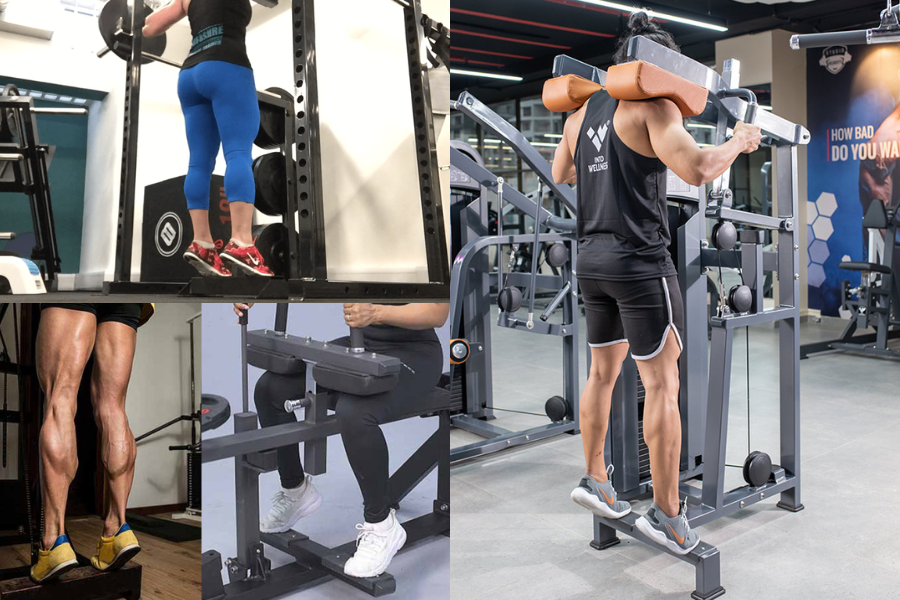
Seated calf raises
Seated calf raises are one of the best ways to target your soleus because your knees stay bent. Sit on a bench or sturdy chair with your feet flat and a weight resting across your thighs. Lift your heels as high as you can, squeeze at the top, then lower slowly.
Surrey Physio recommends seated calf raises, including Bosu variations, for 20 to 30 repetitions twice daily. Another guide suggests doing 2 sets of 10 reps per side with a slow lowering phase and a strong squeeze at the top. Both approaches emphasize control and a full range of motion.
Straight knee and bent knee raises
Using weights does not change the basic movements, but it increases the load.
- Straight knee calf raises are performed standing with your knees locked out or only slightly soft. These target the gastrocnemius. You can progress from 3 sets of 10 repetitions to single leg, heavier weights, or explosive versions as your strength improves.
- Bent knee calf raises are done with a slight bend in your knees to shift more work to the soleus. You can use the same progressions as straight leg raises. The key is to maintain the knee angle during the set so the soleus stays engaged, as described in the 2014 Suzuki study.
Both variations can be performed with a barbell, dumbbells, or even heavy household items held in your hands while you raise and lower your heels.
Tiptoe farmers carry
The tiptoe farmers carry combines calf strength with balance and core stability. Hold a dumbbell or heavy object in each hand, rise onto your tiptoes, and slowly walk forward while keeping your heels lifted and your torso upright.
This exercise appears in research based lists of the five best calf exercises alongside standing, seated, and eccentric calf raises and squats into calf raises. Performing the carry for time or for distance helps build endurance in your calves and ankle stabilizers.
Dynamic and plyometric options
Once you have a solid strength base, you can start layering in more dynamic movements for power and athletic performance. These are still some of the best exercises for calves, but they come with higher impact, so increase them gradually.
Step ups challenge your calves each time you drive up onto a bench or step. Surrey Physio suggests regular step ups for 10 to 15 repetitions twice per day to build calf and leg strength. Plyometric calf step ups increase the pace. You step briskly onto the bench, drive your opposite knee upward, then step back down and repeat. Surrey Physio recommends 10 to 15 repetitions per leg twice daily for these as well.
You can also increase calf involvement in moves you might already do:
- Jump squats, broad jumps, and burpees all increase calf workload but should be approached with care because of the impact on your joints
- Walking or running on an incline, like uphill walks or treadmill inclines, forces your calves to work harder for each step
- Lunges and plié squats performed with heels lifted make your calves work continuously to stabilize you
If you add these movements, pay attention to how your ankles and shins feel. Scale back if you notice pain instead of normal muscle fatigue.
For most people, a mix of controlled strength work and a small dose of faster, springy exercises creates the best balance of calf size, strength, and resilience.
Sample weekly calf routine
Use this simple structure to work the best exercises for calves into your week. Adjust sets and reps based on your current level. If you are new, start on the lower end and focus on good form.
Day 1: Strength focus
- Standing calf raises, 3 sets of 15 to 20 reps
- Seated calf raises, 3 sets of 15 to 20 reps
- Tiptoe farmers carry, 2 rounds of 30 to 45 seconds
Day 2: Control and variation
- Single leg calf raises, 2 to 3 sets of 10 to 15 reps per leg
- Bent knee calf raises, 3 sets of 15 to 20 reps
- Foot position sets, 1 extra set each with toes in, out, and forward
Day 3: Power and function
- Hopping in place, 2 sets of 10 to 15 hops per leg
- Step ups or plyometric calf step ups, 2 to 3 sets of 10 to 15 reps per leg
- Incline walk or light jog, 10 to 15 minutes
Finish your training days with gentle calf and ankle stretches, such as wall calf stretches or calf and ankle stretch drills, often prescribed as 2 sets of 10 reps per side with about 30 seconds rest. This helps keep your calves mobile and can support recovery and injury prevention.
Putting it all together
To get more from your calf training, focus on three simple habits:
- Include both straight knee and bent knee movements so you work the gastrocnemius and soleus
- Use high effort, controlled repetitions for most sets and add load or single leg variations as exercises become easy
- Rotate foot positions and sprinkle in functional moves like walking on an incline, hopping, or step ups
Choose one or two of the best exercises for calves from this guide and add them to your next workout. Over the next few weeks, keep an eye on your sprint speed, your jump height, or simply how your legs feel on the stairs. You will likely notice your calves working harder, feeling stronger, and supporting every step you take.
About The Author