Discover the Most Effective Chest Exercises for Women
A strong, balanced chest is about much more than appearance. The best chest exercises for women help you push, pull, carry, and stabilize your body in everyday life, while also supporting your shoulders and posture. You can build that strength with simple moves at home or in the gym, no complicated equipment required.
Below, you will find the most effective chest exercises for women, broken down into bodyweight and weighted options, plus tips on form, progression, and how to put them into a complete workout.
Understand why chest training matters
When you think about upper body strength, you might picture arms or shoulders first. Your chest muscles are the engine behind many of those movements.
Your main chest muscles are the pectoralis major and minor, supported by the serratus anterior along your ribcage. Together, they help you push a door closed, carry groceries, or lift yourself from the floor. Certified trainers in 2024 have highlighted how important these muscles are for overall upper body strength and posture, especially for women who often spend long hours at desks or on phones.
Chest exercises also:
- Support shoulder health by stabilizing the joint
- Work your triceps and front deltoids at the same time
- Engage your core and upper back when you use good form
If you tend to feel “weak” in pushups or overhead presses, consistent chest work can make those movements feel much more controlled.
Start with beginner friendly bodyweight moves
If you are new to strength training, bodyweight chest exercises are a smart place to start. Your body does not care whether resistance comes from dumbbells or your own weight. What matters is that your muscles are challenged.
Incline press ups
Incline press ups are one of the best chest exercises for women who want a gentle entry point. Raising your hands higher than your feet reduces the amount of body weight you have to push.
You can use a sturdy bed, sofa, chair, bench, or even a staircase. The higher the surface, the easier the move. As you get stronger, you lower the incline by moving to a lower step or surface.
- Place your hands on the raised surface, slightly wider than shoulder width.
- Step your feet back until your body forms a straight line from head to heels.
- Brace your core and squeeze your glutes.
- Bend your elbows at about a 45 degree angle from your ribs, lowering your chest toward the edge.
- Press back up until your arms are almost straight, without locking your elbows.
Aim for 2 to 3 sets of 8 to 12 reps. When that feels manageable, decrease the height and repeat.
Modified pushups on knees
Modified pushups help you practice the correct motion without handling your full body weight.
- Start in a high plank on your hands, then lower your knees to the floor.
- Keep a straight line from your head through your hips and knees.
- Place your hands slightly wider than shoulder width, fingers spread.
- Lower your chest toward the floor, elbows at a 45 degree angle from your body.
- Press back up while keeping your core engaged.
Move slowly and focus on control. You want your chest, not your hips, to reach toward the floor first.
Bear plank shoulder taps
Bear plank shoulder taps are a great way to work your chest and core together. Trainers recommend this move because it demands serious stability through your midsection.
- Start on hands and knees, wrists under shoulders, knees under hips.
- Lift your knees a few inches off the floor, keeping your back flat and core tight.
- Without shifting your hips, lift one hand to tap the opposite shoulder.
- Place it back down and repeat on the other side.
Keep your abs braced and your hips as still as possible. Think “quiet” movement. Try 2 sets of 10 taps per side.
Progress to full bodyweight chest exercises
Once the beginner variations feel solid, you are ready for full bodyweight chest work. These moves will build more strength and muscle definition through your entire upper body.
Standard pushups and hand release pushups
Pushups are a classic for a reason. They recruit your chest, shoulders, triceps, and core all at once. You can always return to incline or modified pushups if you need to.
- Set up in a high plank, hands slightly wider than shoulders, feet hip width apart.
- Engage your core to keep a straight line from head to heels.
- Lower your chest toward the floor, elbows at a 45 degree angle.
- Press the floor away to return to the top.
If you struggle to reach full depth, try hand release pushups:
- Lower your body fully to the floor from a plank position.
- Lift your hands briefly off the floor, squeezing your shoulder blades together.
- Place your hands back down and press up in one strong motion.
Hand release pushups increase your range of motion and help you recruit more muscle fibers.
Diamond, incline, and decline variations
Changing your hand or foot position shifts the focus within your chest and arms.
- Diamond pushups: Place your hands close together under your chest, with thumbs and index fingers forming a diamond shape. This targets your triceps and upper chest.
- Incline pushups: Hands elevated, feet on the floor. This variation is easier and emphasizes the lower chest.
- Decline pushups: Feet elevated on a bench or step, hands on the floor. This increases the load and hits the upper chest more.
You do not need to master all of these at once. Rotate one variation into your routine at a time and see how it feels.
Isometric holds and uneven pushups
Isometric work builds muscular endurance, which helps you hold form during harder sets.
For a pushup hold:
- Lower halfway down from a plank and pause for 5 to 10 seconds.
- Push back up or lower closer to the floor and hold again.
Uneven pushups, where one hand is on a slightly elevated surface, teach each side to work independently and can help with strength imbalances. Alternate sides so both arms get equal work.
Add weights for faster strength gains
Once you are comfortable with bodyweight movements, adding resistance is the next step. You can use dumbbells, a barbell, or even heavy water bottles at home.
Bench press and close grip bench press
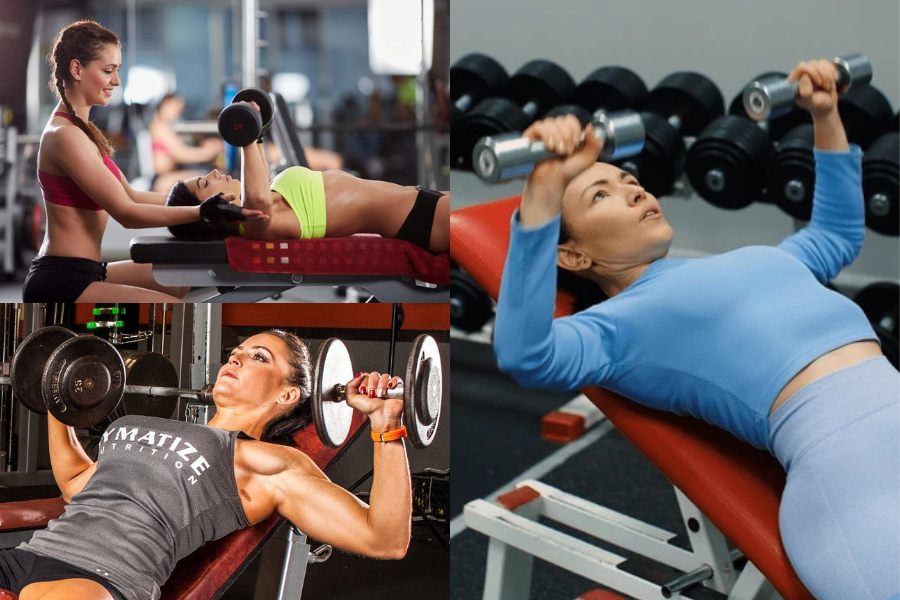
The bench press is one of the best chest exercises for women who want to build strength efficiently. It targets your pectorals, front deltoids, and triceps.
If you do not have a bench, you can lie on the floor with dumbbells or weighted objects.
- Lie on a bench or the floor, feet planted and spine neutral.
- Hold dumbbells or a bar over your chest, arms straight but not locked.
- Lower the weight until your elbows are at about a 45 degree angle from your body.
- Press up while keeping your shoulders down and away from your ears.
A close grip bench press uses a narrower hand position. This shifts more emphasis to your triceps while still engaging the chest. It is a useful variation if you want stronger arms for pushups or overhead work.
Dumbbell floor press and single arm variations
The dumbbell floor press is a joint friendly alternative to the traditional bench press and is easy to do at home.
- Lie on your back on the floor, knees bent and feet flat.
- Hold dumbbells directly over your chest, palms facing forward.
- Lower until your upper arms gently touch the floor.
- Press back up, focusing on squeezing your chest at the top.
Single arm or alternating presses challenge your core and help correct strength imbalances:
- Alternate arms each rep.
- Or complete a full set with one arm before switching sides.
Keep your elbows at about a 45 degree angle to protect your shoulders.
Seated chest press machine
If you train in a gym, the seated chest press machine is a helpful option. It guides your path of motion so you can focus on pushing hard without worrying as much about balance.
Sit tall with your back against the pad, feet planted. Grip the handles, keep your shoulders relaxed, then press the handles forward until your arms are almost straight. Do not lock your elbows. Slowly return to the start.
Adjust the seat so that the handles are roughly in line with the middle of your chest. This alignment ensures you are using your chest muscles effectively instead of overloading your shoulders.
Sculpt the inner chest with fly variations
Pressing exercises build overall chest strength. Fly movements target the inner portion of the chest by focusing on horizontal adduction, which is the motion of bringing your arms toward the center of your body.
Dumbbell chest fly
You can do dumbbell chest flys on a bench or the floor.
- Lie on your back, holding a dumbbell in each hand above your chest, palms facing each other.
- With a slight bend in your elbows, slowly open your arms out to the sides.
- Lower until your elbows are at or just below chest level.
- Bring the weights back together over your chest in a wide hugging motion.
Move with control and avoid letting the weights pull your shoulders too far back. The goal is tension in your chest, not an extreme stretch.
Cable chest fly
Cable flys are often done standing, using the cable machine at the gym. They are excellent for keeping constant tension on the chest.
Stand in the middle of the machine, grab the handles, and step slightly forward. With a small bend in your elbows, bring your hands together in front of your chest, then slowly return to the start. You can adjust the cable height to target slightly different angles.
Try a sample chest workout for women
To bring everything together, here is a simple chest focused workout you can customize. Pick the version that suits your equipment and current strength level.
At home, bodyweight focused
- Incline press ups, 3 sets of 8 to 12
- Bear plank shoulder taps, 2 sets of 10 per side
- Standard or modified pushups, 2 to 3 sets of 6 to 10
- Pushup hold, 2 sets of 3 to 5 holds, 5 to 10 seconds each
At home, with weights
- Dumbbell floor press, 3 sets of 8 to 12
- Single arm floor press, 2 sets of 8 to 10 per side
- Incline pushups, 2 sets of 8 to 12
- Dumbbell chest fly on floor, 2 sets of 10 to 12
In the gym
- Barbell or dumbbell bench press, 3 sets of 6 to 10
- Seated chest press machine, 2 to 3 sets of 8 to 12
- Cable chest fly, 2 sets of 10 to 12
- Decline or diamond pushups, 2 sets to near fatigue
Rest 45 to 90 seconds between sets. You should finish with your chest feeling worked but not strained.
A useful rule of thumb: if you can easily do more than 12 to 15 reps with perfect form, increase the difficulty by adding weight, lowering the incline, or choosing a harder variation.
Form, frequency, and safety tips
To get the most out of these chest exercises, pay attention to how you move, not just how hard you push.
- Train your chest 1 to 3 times per week, depending on your overall routine.
- Leave at least one rest day between hard chest sessions so your muscles can recover.
- Keep your shoulders “packed” by gently pulling your shoulder blades down and back before each set.
- Exhale as you push or press, inhale as you lower.
- If you feel sharp pain in your shoulders or wrists, stop and adjust your position or choose a different variation.
Over time, consistent chest work will help you feel stronger in pushups, more stable in planks, and more confident in everyday tasks that require upper body strength.
Pick one or two of the best chest exercises for women from this list and add them to your next workout. As they become easier, progress the variation or load. You will build a powerful, supported upper body that looks and feels strong in everything you do.
About The Author