The Best Back Exercises for Women to Boost Confidence
A strong back does more than help you stand tall. The best back exercises for women can ease everyday aches, improve your posture, and give you the kind of quiet confidence you feel in your clothes and in the gym. You do not need heavy equipment or hours of free time, just a few focused moves you repeat consistently.
Below you will find simple, effective back exercises and short workouts you can do at home or at the gym. Mix and match them based on your schedule and fitness level, and use the form tips to stay safe and get more out of every rep.
Why back strength matters for women
If you sit a lot, carry kids, or work at a computer, your back works harder than you might realize. When those muscles are weak, they fatigue quickly and your posture collapses forward. Over time, that can lead to stiffness, pain, and a rounded upper back.
Certified personal trainer Colleen Conlon notes that strengthening back muscles like your lats and traps can help build muscular endurance, sculpt your upper body, and improve posture, especially if you spend long days sitting. Athletic trainer Vanessa Abrams also points out that targeting the muscles that support your spine can decrease pain linked to large breasts, repetitive lifting, or prolonged sitting.
Your back muscles also tend to tire faster than other muscles. That is why higher repetitions and multiple sets work especially well when you want to strengthen this area.
Key back muscles you are targeting
You do not need to memorize anatomy, but knowing the main players helps you understand why each exercise matters:
- Latissimus dorsi, the large muscles along the sides of your back that help create a “V” shape
- Trapezius and rhomboids, the muscles between your shoulder blades that keep your shoulders back
- Rotator cuff and rear deltoids, the smaller muscles that stabilize your shoulders
- Erector spinae and multifidus, the muscles that support your spine along your lower and mid back
- Core and glutes, which work with your back to protect your spine and keep you upright
Most of the best back exercises for women use pulling, rowing, or bracing motions that recruit several of these muscles at once.
Bodyweight back exercises you can start today
If you are new to strength training, begin with bodyweight moves. These help you learn control and alignment without worrying about weights.
Superman
The Superman exercise is a simple way to wake up both your upper and lower back along with your glutes and hamstrings.
How to do it:
Lie face down with arms extended in front of you, legs straight. Lift your head, chest, arms, and legs off the floor at the same time. Pause briefly at the top, then lower with control. Repeat up to 10 times.
Focus on length rather than height. Think about reaching your fingers forward and your toes back so you feel an even effort through your entire backside.
High plank
The high plank builds strength in your core and back muscles, which are both critical for good posture.
Start on your hands and toes with your wrists under your shoulders and your body in a straight line from head to heels. Brace your abs, gently squeeze your glutes, and keep your neck neutral. Hold for 20 to 30 seconds, rest, and repeat 2 or 3 times.
As you get stronger, you can add shoulder taps or move into renegade rows with dumbbells for more back activation.
Side plank
Side planks train the muscles along the sides of your waist and into your glutes. These help support your lower back and keep your pelvis aligned.
Lie on your side, prop yourself up on your forearm, and stack your feet. Lift your hips to form a straight line from shoulders to ankles. Hold for 15 to 30 seconds, then switch sides. You can bend your bottom knee for extra stability if needed.
Downward-Facing Dog and glute bridge
Yoga and Pilates inspired moves can also support your back.
Downward-Facing Dog helps relieve back tightness and strengthens and aligns your back muscles. From a plank, lift your hips up and back so your body forms an inverted V. Press your chest gently toward your thighs and think about lengthening your spine.
Glute bridges are performed lying on your back with knees bent and feet flat. Tighten your belly and butt, then raise your hips until your body forms a straight line from knees to shoulders. Hold for three deep breaths, then lower. Start with about 5 repetitions and work toward 20 to 30 as your strength improves.
Both moves improve hip and pelvis alignment, which can ease lower back discomfort and help you stand taller.
Best dumbbell back exercises for women
Once you feel comfortable with basic bodyweight exercises, light dumbbells add just enough challenge to build strength and muscle tone.
Bent-over row
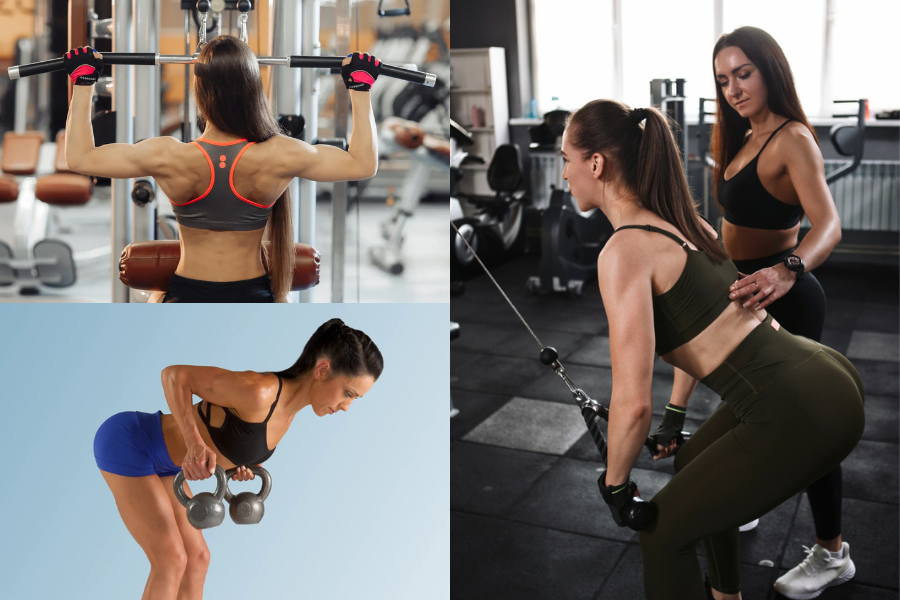
The bent-over row is one of the best back exercises for women because it targets your lats, rhomboids, and rotator cuff muscles all at once.
Stand with your feet hip-width apart, knees slightly bent. Hinge forward at your hips so your torso is almost parallel to the floor, with a dumbbell in each hand. Keeping your back flat, pull the weights from just below your knees toward your rib cage, then lower with control. Aim for 10 to 15 repetitions.
Think about squeezing your shoulder blades together at the top and keep your neck in line with your spine, looking slightly ahead of your toes.
Upright row
Upright rows focus on the middle and upper back as well as your shoulders.
Stand tall with dumbbells in front of your thighs, palms facing your body. Pull your elbows up toward the ceiling, keeping the weights close to your torso, until your elbows reach or slightly exceed shoulder height. Lower slowly. Repeat 10 to 15 times.
Keep your shoulders relaxed away from your ears. If you feel pinching in the front of your shoulder, lighten the weight or reduce your range of motion.
Shoulder raises
Shoulder raises help build strength in your upper back and shoulders, which supports better posture.
Stand with knees slightly bent and a gentle arch in your lower back. Hold dumbbells at your sides. Lift both arms out to the sides until they are at or just below shoulder height, pause, then lower. Repeat for 10 to 15 repetitions.
Move in a smooth arc, and avoid swinging the weights. You should feel the work across the top of your shoulders and upper back rather than in your neck.
Reverse fly
Reverse flys emphasize the rhomboids, trapezius, and rear deltoids.
Hinge forward at the hips with a slight bend in your knees and dumbbells hanging beneath your shoulders. With a long neck and chin slightly tucked, lift your arms out to the sides until they align with your shoulders, then lower back to the starting position. Perform 10 to 15 reps.
Avoid hunching your shoulders. Imagine you are trying to gently squeeze a pencil between your shoulder blades.
Effective resistance band moves for posture
Resistance bands are an easy way to build a strong back at home or while traveling. They are portable, affordable, and provide adjustable resistance without needing heavy equipment. Research from Gymreapers notes that bands can improve muscle activation and mind muscle connection, letting you target your back from different angles for better strength and muscle development.
Bent-over band rows and single-arm rows
Horizontal band rows target the lats, rhomboids, and trapezius. Anchor the band in front of you at about waist height. Hold one end in each hand, take a step back to create tension, and pull your hands toward your rib cage while squeezing your shoulder blades together. Slowly return to the starting position.
Single-arm horizontal rows use the same motion with one arm at a time. This helps you identify and correct side to side strength imbalances.
Band face pulls and T or Y pulls
Band face pulls train the smaller upper back and shoulder muscles like your rear delts, rhomboids, and mid trapezius, which are key for shoulder stability. Attach the band at about eye level. Hold the ends with palms facing down, then pull the band toward your face while flaring your elbows out. Pause, then return with control.
T pulls and Y pulls are similar. With the band anchored in front of you, pull your arms out to the sides to form a “T” or slightly overhead to form a “Y.” In each variation, focus on keeping shoulders down and core engaged while you squeeze your shoulder blades together.
Band assisted pullups and chinups
If you are working toward your first pullup, loop resistance bands can give you a helpful boost. Band assisted pullups and chinups provide assistance so you can practice the full movement even if you cannot yet lift your entire bodyweight. Over time, they help build raw back strength and improve your motor mechanics so you can progress to unassisted pullups.
Loop resistance bands that come in several tension levels let you scale exercises as you get stronger, and you can combine bands for more resistance when you are ready.
Stretching and mobility to support your back
Strength work is only part of the story. Gentle stretches keep your spine mobile and your muscles supple so you can move through all your exercises with better form.
The knee to chest stretch and lower back rotational stretch both help lengthen and relax your lower back. Performed lying on your back, they are usually recommended twice a day with 2 or 3 repetitions per side.
Cat stretch is done on hands and knees by slowly arching your back toward the ceiling, then relaxing. Repeating this 3 to 5 times twice a day can improve spinal flexibility.
Shoulder blade squeezes are an easy desk friendly move. Sit up straight on a chair without arms, pull your shoulder blades together, hold for five seconds, and relax. Repeat 3 to 5 times twice daily to reinforce the muscles that keep your shoulders back.
Sample 15 minute back workout for women
When you are ready to put everything together, try this simple routine. It is based on guidance that recommends higher repetitions and multiple sets for back muscles, which fatigue faster than other muscle groups.
- Bent-over row, 8 to 10 reps
- Upright row, 8 to 10 reps
- Reverse fly, 8 to 10 reps
- Bird Dog (from hands and knees, extend opposite arm and leg), 8 to 10 reps per side
- Dumbbell deadlift, 8 to 10 reps
Move through each exercise with control, lifting the weight in about one count and lowering in three counts to emphasize the eccentric or lowering phase. Use light free weights, about 10 pounds or less, so you can maintain clean form. Rest for up to two minutes after you finish one round, then repeat the circuit up to three times.
You can follow a similar structure with band exercises if you do not have dumbbells. Choose five moves, work in the 10 to 15 rep range, and focus on feeling your back muscles engage on every pull.
If you are new to exercise or dealing with pain or medical conditions, check with a doctor or qualified professional before starting a new workout routine.
How to progress safely and stay consistent
Aim to train your back 2 or 3 times per week, leaving at least one rest day between sessions. Begin with one or two sets of each exercise and gradually build up to three sets of 10 to 15 repetitions.
Pay attention to how your posture feels in daily life. You may notice it is easier to sit up straight at your desk, carry groceries, or stand in a long line without slumping. Those small changes are real signs of progress.
Most importantly, pick a few of the best back exercises for women that you actually enjoy. Start with just five or ten minutes. As your strength grows, so will your confidence, and your back will quietly support almost everything you do.
About The Author