How Strength Training for Quads Improves Your Athletic Performance
Strength training for quads does much more than build bigger legs. When you train your quadriceps effectively, you improve how you run, jump, change direction, and even how you move through daily life. Strong quads give you a more powerful base, better control in high speed movements, and greater protection for your knees and hips.
Below, you will learn how strength training for quads works, why it matters for performance, and which exercises and training strategies give you the best return for your effort.
Understand your quad muscles
Your quadriceps are a group of four muscles on the front of your thigh. Each one plays a slightly different role in how you move, so you want your training to hit all four.
- Rectus femoris sits in the middle of your thigh. It helps flex your hip and extend your knee, so it is involved when you sprint, kick, or drive out of a squat.
- Vastus lateralis is the largest quad muscle and runs along the outer side of your thigh. It is a major driver of knee extension and gives your thighs much of their width.
- Vastus medialis is on the inner side of your thigh and helps with knee extension and stabilization. You might recognize its teardrop shape just above the knee.
- Vastus intermedius lies deep between the others and supports knee extension as well.
Research from Gymshark highlights that targeting all four of these muscles is key for balanced quad development and strength, not just looks, because each one contributes to knee extension and overall leg function in a slightly different way, especially the rectus femoris which also flexes the hip.
When you understand what these muscles do, it becomes easier to see why certain exercises and angles feel different and why changing your form can instantly increase quad activation.
Why quad strength boosts athletic performance
If you play sports, lift weights, or simply want to move better, quad strength is one of your biggest performance levers.
More power in squats, jumps, and sprints
Your quads are heavily involved in knee extension, which drives you out of the bottom of a squat, propels you forward during sprints, and powers take off when you jump. Muscle & Fitness notes that quadriceps development is crucial for heavy squats and deadlifts and also for daily athletic function, because your legs provide the foundation of strength for almost all movements that are not seated.
When you increase quad strength, you can:
- Stand up faster and more explosively from a squat
- Generate more vertical jump height
- Accelerate more sharply out of a cut or first step
Over time, this translates into better numbers in the gym and more impact on the field or court.
Better balance, stability, and joint control
Strong quads stabilize your knees and hips when you land, cut, or decelerate. This is especially important in sports that require sudden direction changes or stops. Exercises like split squats, lunges, and Bulgarian split squats improve not only quad strength but also your ability to control your body weight on one leg, which carries over to sprinting and single leg landings.
Unilateral work, such as lunges and Bulgarian split squats with an upright torso and a slightly shorter stance, has been shown to promote balanced quad development and improve stability while reducing glute dominance so your quads do more of the work.
Lower injury risk and healthier aging
Strong quadriceps help support your knees, control how your patella tracks, and reduce strain on ligaments and tendons during demanding movements. This is helpful whether you are pushing hard in your sport or simply going up and down stairs.
Interestingly, a study using data from the National Health and Nutrition Examination Survey (NHANES) on adults aged 60 and older found a strong positive link between quadriceps strength and cognitive performance. Higher quad strength was associated with better scores on a standard cognitive test, even after accounting for health and lifestyle factors. The researchers suggested that muscle and brain health may be connected through shared mechanisms like blood vessel function and inflammation.
The takeaway for you is simple. Keeping your quads strong may support not only your movement but also aspects of long term brain health.
Best quad focused exercises for performance
Not all leg exercises hit your quads in the same way. To get the most from strength training for quads, you want a mix of big compound movements and targeted isolation work.
Quad focused squats
Standard back squats are excellent, but they can sometimes fatigue your lower back before your quads are fully worked, which can limit quad growth and strength gains. To focus more on your thighs, adjust your squat variations and setup.
Useful quad dominant squat variations include:
- Front squats keep the bar in front of your body, which encourages a more upright torso and greater knee bend. This shifts more load to your quads and less to your hips and lower back.
- Heel elevated goblet squats involve holding a dumbbell at your chest and lifting your heels slightly on plates or wedges. This increases your forward shin angle and knee flexion, both of which boost quad activation.
- Hack squats and machine squats allow you to maintain a very upright torso while driving your knees forward, which targets your quads with less demand on your core and lower back.
- Sissy squats are an advanced option that places very high tension on the quads, particularly the rectus femoris, by creating deep knee flexion with minimal hip involvement.
Gymshark points out that these quad focused squats emphasize knee extension over hip engagement, which is ideal when you want to grow and strengthen your quadriceps specifically.
If your ankles feel tight, slight heel elevation can make it easier to sink into deeper knee flexion without your heels lifting off the floor. This simple tweak often makes your quads light up.
Unilateral quad builders
Single leg training is one of the most direct ways to improve your performance in running, change of direction, and deceleration, because in sport you are rarely pushing off both legs in perfect symmetry.
Good unilateral choices include:
- Forward lunges with your front foot on a small plate or wedge. The foot elevation increases knee flexion and shifts the effort to your front leg quad.
- Bulgarian split squats with a slightly shorter front stance and upright torso. This setup reduces hip hinge and makes your front knee travel further over your toes, which in turn loads your quads more.
- Split squats on flat ground focus the work into your front leg while stretching the hip flexors of the back leg. Beginners can use a support or rail for balance.
By adjusting stance length and torso angle, you can fine tune how much the movement hits your quads versus your glutes. Gymshark highlights that these unilateral exercises help correct muscle imbalances, improve stability, and strengthen your quads in positions that look a lot like real sport movements.
Isolation moves for complete quad development
To fully develop your quads, especially the rectus femoris, you benefit from at least one isolation exercise that locks in on knee extension without loading other joints heavily.
The main options are:
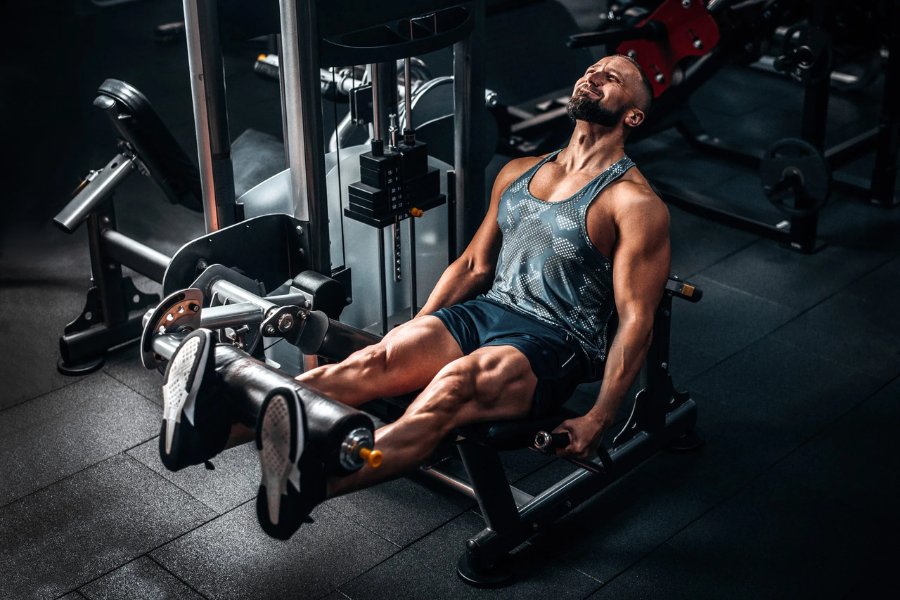
- Leg extensions on a machine. This is a classic quad isolation exercise that allows you to focus purely on extending the knee. It is particularly useful because it does not heavily tax your lower back or hips, so you can use it more frequently or at the end of a session when you are already tired.
- Banded Spanish squats use a band around the back of your knees and anchor point behind you. The band helps keep your shins more upright while still allowing deep knee flexion, and it can be more comfortable if heavy squats irritate your knees.
- Terminal knee extensions (TKEs) with a band emphasize the last portion of knee extension and can be helpful both for strengthening and for rehabbing around the knee under professional guidance.
The Gymshark guide calls leg extensions particularly effective for isolating and growing the quadriceps, and also notes that rectus femoris growth is significantly better when you include targeted knee extension work such as leg extensions or sissy squats compared with squats alone.
If knee health is a concern or you are returning from injury, performing these isolation movements with controlled tempo and moderate loads, ideally under the supervision of a professional, is a smart strategy.
How to program strength training for quads
Once you know the right exercises, the next step is to structure your training so you see consistent strength and performance gains without burning out.
Weekly frequency and volume
A helpful guideline from the Gymshark research is to train your quads twice per week, include at least two quad focused exercises in each session, and reach a minimum of around ten total sets per week in the 8 to 12 rep range for hypertrophy and strength.
This can look like:
-
Day 1, strength biased
-
Front squat: 3 to 4 sets of 6 to 8 reps
-
Bulgarian split squat: 3 sets of 8 to 10 reps per leg
-
Day 2, hypertrophy biased
-
Heel elevated goblet squat or hack squat: 3 to 4 sets of 8 to 12 reps
-
Leg extensions: 3 sets of 10 to 15 reps
Aim for at least 48 hours between heavy quad focused sessions so your muscles and joints can recover properly.
Effort level and range of motion
To see real changes in strength and muscle size, you need to push your sets close to the point where you could not complete many more reps with good form. Research summaries indicate that for optimal quad hypertrophy, you should bring most working sets to within about three reps of failure, using controlled tempo and quad focused form rather than simply piling on weight. Muscle & Fitness also emphasizes that pushing sets hard, sometimes using higher reps and techniques like pairing two leg exercises back to back, can induce greater muscle growth as long as your form stays sharp.
Equally important is your range of motion. A common mistake is stopping halfway, for example on squats, leg presses, or leg extensions. That might let you move more weight, but it often limits quad growth because you avoid the deeper knee angles where your quads have to work hardest. Muscle & Fitness notes that truncated range of motion and ego lifting tend to grow the weight stack more than your legs, while also increasing the risk of poor form.
Focus on deep, controlled reps that stay pain free for your joints. Think about:
- Sitting into a depth where your knees bend well past 90 degrees if mobility and comfort allow
- Keeping your torso as upright as possible on quad focused squats
- Letting your knees travel forward over your toes when appropriate, especially with heel elevation, so your quads take the load
Technique tips for safer, more effective quad work
Good technique not only protects you but also makes each rep more productive.
Key pointers include:
- Avoid leaning excessively forward and pushing your hips backward in squats, which shifts work away from your quads and can increase spinal strain.
- Use heel elevation if your ankles are tight. This lets your knees move forward more freely and helps you stay upright.
- Keep your core braced lightly so your torso does not collapse under the weight.
- Start with lighter weights while you practice quad focused positions and gradually increase load as your control improves.
When in doubt, filming your sets from the side and front or working with a coach can help you see whether your knees, hips, and spine are moving the way you intend.
Putting it all together for better performance
Strength training for quads is one of the most direct ways to upgrade your overall athletic performance. When you train your quads with a smart mix of compound lifts, unilateral work, and isolation exercises, you gain:
- More power in jumps, sprints, and heavy lifts
- Better stability and control in cuts, landings, and direction changes
- Stronger, more resilient knees and hips
- A physical base that supports everything from sport specific skills to everyday movement
Start by picking one squat variation, one unilateral movement, and one isolation exercise from the list above. Train them twice a week, focus on full range of motion and solid technique, and gradually push your sets closer to challenging effort.
Over the next few weeks, you will feel the difference every time you run, climb stairs, or stand up with weight on your back.
About The Author


