No-Equipment Bodyweight Calf Exercises You Can Start Today
Bodyweight calf exercises are one of the simplest ways to build strong, resilient lower legs without any equipment. With just your body weight and a little floor space, you can strengthen the muscles that power your walking, running, and jumping, and you can help protect your ankles and knees from injury.
Below, you will find bodyweight calf exercises you can start today, plus a simple way to turn them into a quick home workout.
Get to know your calf muscles
Your calves are more than a single muscle on the back of your leg. They are mainly made up of two large muscles, the gastrocnemius and the soleus, that run down the back of your lower leg.
The gastrocnemius is the larger, more visible muscle that gives your calf its shape. It helps with explosive movements like sprinting and jumping. The soleus sits underneath and is more involved in endurance activities such as walking and standing.
Bodyweight calf exercises target both muscles without equipment. That means you can train them at home, in a stairwell, or even during short breaks in your day.
Strong calves support ankle stability, improve running and walking efficiency, and help reduce your overall risk of lower leg injuries.
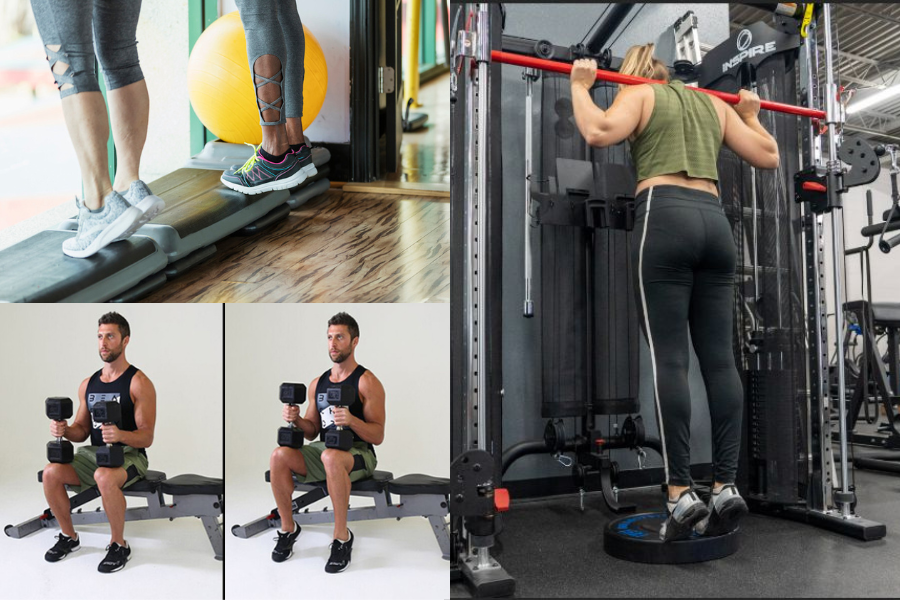
Classic standing calf raises
Standing calf raises are the foundation of most bodyweight calf exercises. They are easy to learn and highly effective when you perform them with control.
Start with a simple version you can do on flat ground, then progress to an elevated surface.
How to do a basic standing calf raise
- Stand tall with your feet hip width apart.
- Engage your core and keep your knees soft, not locked.
- Slowly lift your heels off the floor until you are on the balls of your feet.
- Pause for a second at the top and squeeze your calves.
- Lower your heels back down with control.
Aim for 2 to 3 sets of 10 to 20 repetitions. Move at a steady pace instead of bouncing, and focus on a full range of motion from heels flat to as high on your toes as you can comfortably go.
Using steps and different foot positions
If you have access to a step, stair, or curb, you can increase the challenge:
- Place the balls of your feet on the edge of the step with your heels hanging off.
- Lower your heels below the level of the step for a deeper stretch.
- Press up onto your toes, then lower slowly until you feel a comfortable stretch again.
You can also change your foot position to emphasize different parts of the calf:
- Toes pointed slightly outward
- Toes pointed slightly inward
Rotating your feet even a small amount changes which fibers of the gastrocnemius work hardest. This is a simple way to make basic calf raises more complete without extra equipment.
Single leg calf raises for strength and balance
When you are ready for more intensity, switch to single leg calf raises. Using one leg at a time effectively doubles the load on that leg and increases the demand on your balance.
Single leg raises are especially useful if you want to improve ankle stability, restore normal gait after injury, or build more noticeable muscle.
How to do a single leg calf raise
- Stand near a wall, counter, or sturdy chair for light support.
- Shift your weight onto one leg and lift the other foot slightly off the floor.
- Engage your core and keep your standing knee soft.
- Slowly raise your heel as high as you can.
- Pause for a moment at the top.
- Lower your heel back to the floor with control.
Start with 2 sets of 8 to 12 repetitions per leg and build up over time. If you feel unsteady, keep a fingertip on the wall or chair as you move. As your balance improves, gradually reduce the amount of support you use.
Single leg calf raises are also a useful milestone in rehab programs. Being able to perform them through a full range of motion is often a step toward returning to higher impact activities like running and jumping.
Lunge pulses to work calves and thighs
Lunge pulses are a variation of the classic lunge that make your calves work harder. Because your heel stays lifted and your knee is bent, both the calf and the muscles around your knee share the workload.
How to do lunge pulses
- Step one foot forward into a split stance, feet about hip width apart from side to side.
- Bend both knees so your back knee moves toward the ground and your front knee stacks over your front ankle.
- Lift the heel of your back foot so you are on the ball of your foot.
- From this position, move up and down a few inches, pulsing without fully straightening your legs.
- Keep your torso upright and your front heel flat on the ground.
Try 10 to 15 pulses on one leg, then switch sides. You should feel your front thigh and glutes working, but your back calf will also be engaged to help control the small up and down movements.
Lunge pulses are a handy choice when you want your calf work to support overall leg strength instead of isolating a single muscle.
Mountain climbers for explosive calf work
Mountain climbers are usually thought of as a core and cardio exercise, but they also challenge your calves. Because you are driving your feet off the floor in a rapid, repetitive motion, your calves get a strong conditioning effect.
How to do mountain climbers
- Start in a high plank position with your hands under your shoulders and your body in a straight line.
- Engage your core and keep your hips level.
- Drive one knee toward your chest while the other leg stays extended.
- Quickly switch legs, as if you were running in place in a plank.
Work for time instead of counting reps. Begin with 20 to 30 seconds and build up as your fitness improves. The quick, explosive nature of mountain climbers not only elevates your heart rate, it also trains your calves to react and push off quickly.
Jump rope and “imaginary rope” jumps
Jump rope is a classic way to build calf strength and endurance while also working your cardiovascular system. Frequent small hops keep your calves engaged the whole time.
If you do not have a rope, you can perform the same jumping motion without one and still get most of the benefits.
How to use jumping for calf strength
- Stand with feet hip width apart and knees slightly bent.
- Jump with small, quick hops off the balls of your feet.
- Land softly and keep your heels slightly off the ground.
You can start with one minute of continuous jumping and work up to three minutes as it becomes easier. Even short sessions like this can noticeably fatigue your calves because they do not get much rest between jumps.
Simple at home calf variations
Once you are comfortable with the basics, you can add small changes that keep your bodyweight calf exercises challenging and interesting.
Outward and inward calf raises
Stand with your feet shoulder width apart. For outward raises, turn your toes slightly away from each other. For inward raises, point your toes slightly toward each other.
In each position, perform slow, controlled calf raises:
- Lift your heels as high as possible.
- Pause for a second at the top.
- Lower with control back to the starting position.
Keeping your knees soft helps you avoid unnecessary strain and keeps the focus on your calves instead of your joints.
Tiptoe walks
Walking on your tiptoes is a simple way to use your calves while moving around your space.
- Lift your heels and walk forward on the balls of your feet for about 30 seconds.
- Maintain good posture and avoid locking your knees.
You can repeat short intervals like this a few times. This variation improves both calf strength and balance, and it fits easily into daily activities, for example while you wait for the kettle or move between rooms.
Isometric calf holds
Isometric calf raises increase the challenge by adding a hold at the top of the movement.
To try this, perform a standard calf raise and, once you reach your highest point, hold that position. Take a deep inhale and count to 3 before lowering back down.
This longer time under tension increases the workload on your calves even though you are not moving much. You can use this technique in both double leg and single leg calf raises.
Do not forget to stretch your calves
Calf stretches help maintain flexibility and can reduce your risk of injury, especially if you are adding more calf focused training to your routine.
A simple approach is to hold stretches for about 30 seconds, repeat them 3 times, and use two positions to target both the gastrocnemius and the soleus.
- For the gastrocnemius, keep your back leg straight as you lean into a wall.
- For the soleus, bend your back knee slightly while keeping your heel on the ground.
Regular stretching after your workout, or at the end of the day, can help your calves feel less tight and better prepared for future sessions.
How to build a quick calf workout
You can combine these bodyweight calf exercises into a short routine you can repeat 2 to 3 times per week. This is enough frequency for most people to see gains in strength and endurance.
Here is one way to structure it:
- Warm up with 1 to 2 minutes of light marching in place.
- Standing calf raises, 2 sets of 15 to 20 reps.
- Single leg calf raises, 2 sets of 8 to 12 reps per leg.
- Lunge pulses, 1 to 2 sets of 10 to 15 reps per side.
- Mountain climbers or jump rope, 30 to 60 seconds.
- Finish with calf stretches for both the gastrocnemius and soleus.
As you get stronger, you can increase repetitions, slow down the movement for more control, or add extra sets. You can also adjust your foot position or use more single leg work to keep progressing without needing any equipment.
Final thought
Strong calves do not require a gym membership or special machines. By using these simple bodyweight calf exercises and practicing them regularly, you give yourself a solid foundation for everything from daily walks to more demanding workouts. Starting with a few minutes today can lead to better balance, more powerful steps, and healthier lower legs over time.
About The Author