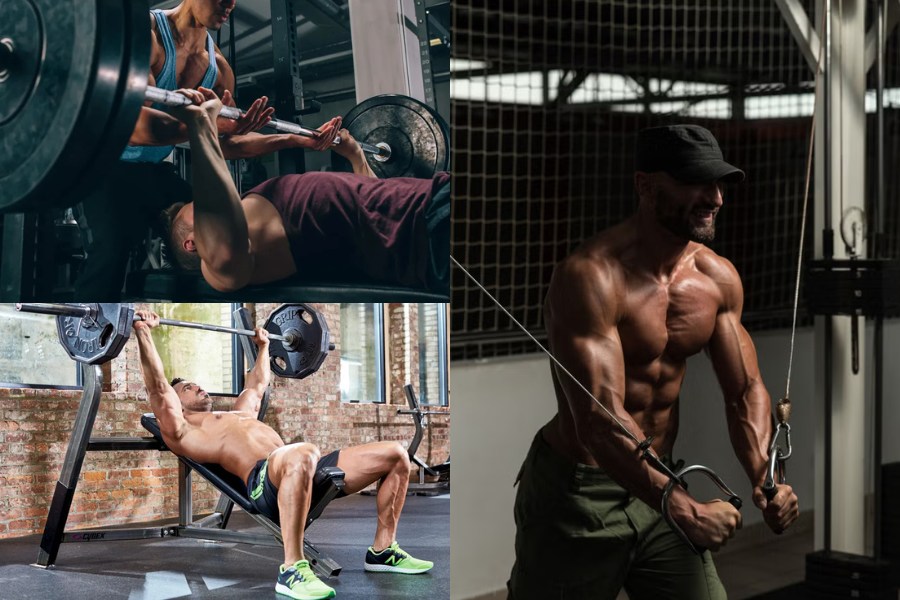
Get Ripped Faster with the Best Men’s Chest Workout
A strong chest does more than fill out your T‑shirt. The best mens chest workout helps you push heavier weight, protect your shoulders, and build a balanced, athletic upper body. With the right mix of pressing, fly movements, and pushup variations, you can get ripped faster without living on the bench press alone.
Below, you will learn how your chest muscles work, the most effective exercises to train each area, and how to put everything together into a clear workout you can follow at the gym or at home.
Understand your chest muscles
If you want the best mens chest workout, it helps to know what you are actually training. Your chest is not just one slab of muscle. It is mainly two:
- Pectoralis major: the large, fan shaped muscle across the front of your chest. It attaches from your breastbone and clavicle out to your upper arm and controls movements like pushing, pressing, and hugging.
- Pectoralis minor: a smaller, triangular muscle underneath the pec major. It helps move and stabilize your shoulder blade, which affects how strong and safe your pressing feels.
The pectoralis major has three main regions with fibers that run in slightly different directions, as explained in the 2024 ATHLEAN X chest workout guide:
- Upper or clavicular head
- Middle or sternal head
- Lower or abdominal head
The best chest routine hits all three. That means:
- Incline moves to target the upper chest
- Flat press and fly moves for the mid chest
- Slightly declined or dipping motions for the lower chest
When you understand this, exercise choice and angles make more sense. You are not just going through motions, you are lining up resistance with the way each set of fibers actually pulls.
Avoid common chest training mistakes
Many men train chest hard but still do not see the shape or size they want. Often, the problem is not effort, it is strategy.
Relying only on the bench press
The barbell bench press is a classic strength builder and still a fundamental chest exercise for size and power, as highlighted in a 2026 guide from Men’s Health. The issue is not the lift itself, it is only doing that lift.
If you over rely on flat barbell benching, you tend to overdevelop the lower and mid pecs and under train the upper chest. Over time, that can lead to a droopy looking chest and more stress on your shoulders, elbows, and wrists.
Neglecting the upper chest
Undertraining your upper chest is one of the fastest ways to stall your progress. The upper pecs run from your collarbones halfway down your chest. When this area is underdeveloped, your torso can look bottom heavy.
When you prioritize incline presses and low to high movements, you fill out the area near your collarbones. This makes your chest look higher and ties it in better with your shoulders and traps, which gives you that raised, athletic look.
Letting ego ruin your form
If you load up more weight than you can control, the work shifts to your triceps, front delts, and momentum instead of your pecs. You might move the bar, but your chest is not getting the full benefit.
As bodybuilder Jay Cutler likes to say, you need to work the muscles, not the weight. Slowing your reps, feeling the stretch, and squeezing at the top will always build more chest than bouncing heavy weight off your ribcage.
Warm up for safer, stronger sessions
A proper warm up prepares your joints, increases blood flow, and helps you feel your chest working from the first set. Skipping this step increases your risk of strains or pec tears and can limit your strength.
Spend 5 to 10 minutes before your first working set on:
- Light cardio like brisk walking or cycling
- Dynamic shoulder circles and arm swings
- A few sets of easy pushups or band flyes
Research emphasizes that warming up and stretching the chest muscles improves flexibility and range of motion, which is essential for both performance and injury prevention. Think of it as insurance for your shoulders and an on switch for your pecs.
Master the essential chest exercises
The best mens chest workout builds around a few key movement patterns: heavy presses, targeted flyes, dips, and smart pushup variations. Each one hits the chest from a different angle.
Barbell flat bench press
The flat bench press is still your main move for overload. It lets you move the most total weight and challenges the mid chest fibers that love heavy work.
Focus on:
- A medium grip that feels natural on your shoulders
- Shoulder blades pulled together and slightly down into the bench
- Feet planted to create a stable base
Retracting your shoulder blades, essentially pinching them together, keeps the tension in your pecs and off your front delts. This technique helps protect your shoulders and lets you push harder over time.
Incline dumbbell bench press
For many lifters, the incline dumbbell press is the missing piece. It targets the upper portion of the pectoralis major and often feels better on your shoulders than the flat barbell press.
A 2026 training guide notes that incline dumbbell presses provide a greater muscular challenge with less shoulder stress when you use 3 to 4 sets of 8 to 10 reps. The independent dumbbells also make your stabilizers work harder, which evens out left and right strength differences.
Set the bench to a low incline, about 15 to 30 degrees, so you stay in the upper chest sweet spot instead of drifting into front delt land.
Dumbbell chest fly
The dumbbell fly is all about tension and stretch. You do not need huge weights here. Your goal is to open your arms wide until you feel a deep but comfortable stretch, then bring the weights together by hugging with your chest.
Dumbbell flyes are typically programmed for 3 sets of 10 to 12 reps to maximize pec engagement and muscle growth. Keeping a slight bend in your elbows protects your joints and keeps more tension in your chest instead of your biceps.
Cable or band fly variations
Cables and bands keep tension on your chest through the entire range of motion and are easier on your shoulders than heavy dumbbells. They are great for warm ups, accessory work, or high rep finishers.
Different cable angles slightly shift the emphasis:
- Horizontal flyes at chest height hit the mid chest
- Low to high flyes move from hip level up toward your face for upper chest
- High to low flyes move from above shoulder height down toward your hips for lower chest
These are often programmed for 3 to 4 sets of 12 to 15 reps for hypertrophy and muscular endurance.
Chest dips
Dips are a powerful way to build chest depth and width, especially in the lower region. When you lean slightly forward and let your elbows flare naturally, your pecs take on most of the load.
Chest dips also demand stability from your shoulders and core, which turns them into a full upper body challenge. Including dips in your routine alongside presses and flyes gives you a very complete chest workout.
If full bodyweight dips are too tough, use an assisted dip machine or loop a resistance band around the bars and under your knees for support.
Use pushup variations to fill the gaps
Pushups are not just for beginners. When you use smart variations, they become one of the best tools for chest strength and definition.
Classic and advanced pushups hit your chest from multiple angles and can be done anywhere. Variations such as regular, incline, decline, plyometric, and time under tension pushups have all been shown to strengthen the chest and build balanced upper body strength.
Key pushup variations to include
You can rotate these into your week, or chain several together in a single finisher circuit.
- Regular pushups: your baseline movement for the mid chest.
- Incline pushups: hands on a bench or box. These are easier and shift a bit more emphasis to the lower pecs, great if you are building up strength. Recommended 3 to 4 sets of 8 to 15 reps.
- Decline pushups: feet up on a bench or step. These stress the upper chest and are more challenging. Aim for 3 to 4 sets of 5 to 15 reps while keeping your body in a straight line.
- Diamond pushups: hands close together under your chest. These hammer your inner pecs and triceps. Research suggests 3 to 4 sets of 8 to 15 reps with 30 to 60 seconds rest can be very effective.
- Isometric pushups: lower halfway and hold for about 15 seconds. This massively increases time under tension, which is a big driver of muscle growth.
- Explosive or plyometric pushups: use enough power to lift your hands off the floor, sometimes with a clap. These activate fast twitch fibers and can be done for 3 to 4 sets of 8 to 15 reps with 45 to 60 seconds rest.
If you are training at home with no equipment, one effective routine includes 3 rounds of 10 regular pushups, 10 incline pushups, 10 decline pushups, and 5 slow, time under tension pushups, paired with conditioning moves like star jumps and mountain climbers.
Put it together into a complete chest workout
You now have the pieces. Here is how you can combine them into a simple workout that targets upper, mid, and lower chest in the same session.
Use lighter weight than you think the first time you run this workout. Nail your form and mind muscle connection before trying to progress the load.
Sample gym chest workout
-
Warm up
5 to 10 minutes light cardio and 2 sets of 10 to 15 band or cable flyes. -
Barbell flat bench press
3 to 4 sets of 6 to 8 reps, resting 2 to 3 minutes. Focus on power and control. -
Incline dumbbell bench press
3 to 4 sets of 8 to 10 reps. Think about stretching at the bottom and squeezing at the top. -
Dumbbell chest fly
3 sets of 10 to 12 reps with light to moderate weight. -
Cable or band fly (angle of your choice)
3 sets of 12 to 15 reps to finish off the chest. -
Chest dips or diamond pushups
3 sets to near technical failure. Stop 1 to 2 reps before your form breaks down.
Sample at home chest workout
If you only have your bodyweight or a pair of dumbbells, combine these moves:
-
Pushup ladder:
3 rounds of -
10 incline pushups
-
10 standard pushups
-
10 decline pushups
-
5 slow isometric pushups at the end of each round
-
Optional dumbbell work:
-
3 sets of 8 to 12 flat or floor dumbbell presses
-
3 sets of 10 to 12 dumbbell floor flyes
Dumbbell routines like weighted dips, eccentric floor flyes, and ladder style bench presses can also be used at home to build strength and size, even without a full gym setup.
Progress your chest gains safely
To keep growing and avoid plateaus, you will want to progress some part of your training over time. That does not always mean adding more weight.
You can build your chest more efficiently by:
- Adding a rep or two to each set while keeping form strict
- Slowing the lowering phase of each press or pushup for more time under tension
- Pausing at the bottom or mid point of reps
- Introducing intensity techniques like drop sets or partial reps to failure occasionally
These techniques, used in moderation, significantly increase muscle stimulus beyond simple 3 sets of 8 to 12, according to advanced chest training protocols.
Just make sure you are not sacrificing form. Avoid ego lifting that forces you to bounce, twist, or rely on everything except your pecs. You will get better results and you will protect your shoulders at the same time.
Key takeaways
- The best mens chest workout hits your upper, middle, and lower pecs with the right mix of presses, flyes, dips, and pushups.
- Over relying on the flat bench and skipping incline or cable work can leave your chest unbalanced and your shoulders overworked.
- Warm ups, good scapula position, and controlled tension keep your chest growing while reducing injury risk.
- Smart pushup variations and simple dumbbell moves mean you can still build an impressive chest at home.
- Progress by improving form, adding reps, and using controlled intensity techniques instead of just piling on more weight.
Pick one of the sample routines and commit to it twice a week for the next 6 to 8 weeks. Track your sets, reps, and how each exercise feels. When you focus on quality movement and consistent effort, your chest will respond.
About The Author


