Are there any downsides to Pilates?
A lot of people talk about Pilates as if it is a magic fix for every ache, stiffness, or fitness goal. Pilates can be a smart way to build strength and body awareness, but you might still wonder, are there any downsides to Pilates?
You will get the most out of Pilates if you understand where it falls short, who should be cautious, and how to practice it safely. Below, you will find a clear look at the potential drawbacks so you can decide if Pilates is the right choice for your body and your goals.
Pilates is not a complete workout on its own
Pilates focuses on controlled movements, posture, and core strength. What it does not provide very well is cardio.
Pilates is not considered an aerobic exercise, so it does not raise your heart rate enough to count as your main cardiovascular workout. That means if your primary goal is better heart health or significant fat loss, you will still need to include separate cardio such as brisk walking, running, cycling, or swimming in your weekly routine (WebMD, eBody Pilates).
Even reformer classes that use a jump board to add a bit of intensity generally do not burn as many calories as high intensity interval training. If you expect Pilates to be an all in one workout that builds strength, improves flexibility, and burns a large number of calories, you may be disappointed (The Paseo Club).
In practice, this means you will likely need to set aside separate time for cardio, especially if you are aiming for weight loss or improved endurance.
Weight loss and muscle gain can be slow
If you are asking, are there any downsides to Pilates for body composition, the main one is speed of change. Pilates builds strength in a controlled, low impact way, but it is not the most efficient option if your main goal is burning fat quickly or building bulky muscle.
Compared with high intensity interval training or heavy strength training, Pilates generally leads to:
- Lower calorie burn per session
- Slower visible changes in muscle size
- A lean, toned look rather than significant muscle mass
Sources point out that Pilates is not ideal if rapid fat loss is your top priority, because its focus is on precision and technique instead of intensity or heavy loads (The Paseo Club, eBody Pilates).
If you enjoy Pilates and want to change your body composition more noticeably, you may want to combine it with resistance training using weights and a separate cardio routine.
Classes and equipment can be expensive
One of the practical downsides of Pilates is cost, especially if you are interested in reformer classes.
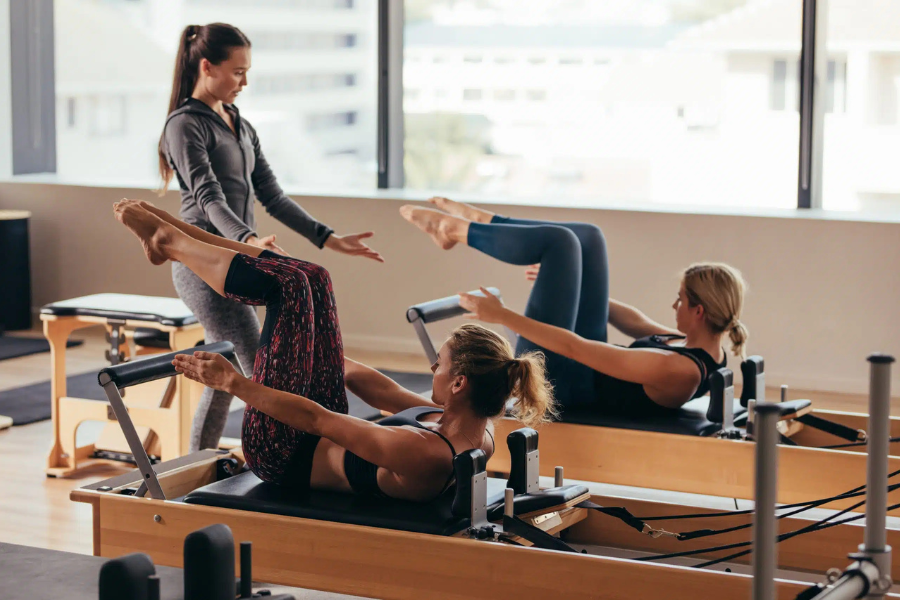
Reformer Pilates usually takes place in small classes with specialized machines and highly trained instructors. That combination tends to push prices higher than a standard group fitness class or a basic gym membership. Several sources note that reformer Pilates is often significantly more expensive, which can be a barrier if you are on a budget or already paying for a gym (The Paseo Club, eBody Pilates).
There is also the cost of equipment if you want to practice at home. Many Pilates exercises use reformers, chairs, barrels, and other apparatus. Without access to these, you are limited to mat work, which is helpful but does not fully replicate a studio reformer experience (The Paseo Club).
Private lessons may be even more expensive. If you have injuries or significant physical limitations, you might need one on one sessions because group classes are not always able to adapt fully to your needs. That increases both the cost and the time commitment (The Paseo Club).
Pilates has a learning curve
Pilates looks gentle from the outside, but it is very detail focused. You are often thinking about your breath, your core activation, your spine position, and the path of your limbs all at once.
Because of this, you may find the first few sessions surprisingly challenging mentally. Beginners often need time to learn how to coordinate breathing with movement and how to engage deep core muscles instead of overusing the neck or lower back. One source notes that Pilates has a noticeable learning curve that can feel frustrating initially, especially without clear guidance from a certified instructor (eBody Pilates).
There is also a social factor. Many Pilates classes are predominantly female, which can make some men feel out of place or self conscious if they are in the minority in the room (The Paseo Club).
If you prefer very simple, follow along workouts or you feel uncomfortable in more technique heavy settings, this aspect of Pilates may feel like a downside at first.
Injury risk with poor technique or existing conditions
Pilates is often marketed as “safe for everyone,” but that is not completely accurate. Done correctly, it is low impact and joint friendly. Done poorly or without the right modifications, however, it can aggravate issues or create new ones.
Common technique related problems
Because Pilates places a lot of emphasis on form, there is a real risk of injury if you move too quickly into advanced exercises or do not have access to quality instruction. Potential issues include:
- Muscle strains in the neck or back if the core is not engaged properly
- Ligament sprains in the wrists, especially during plank variations
- Joint pain in the knees, lower back, or neck from poor alignment
- General soreness (Delayed Onset Muscle Soreness) one or two days after a workout, especially when you are new or suddenly increase intensity (SVRG, ChaiseFitness)
Certain exercises carry a higher risk than others. Roll ups, leg circles, and plank leg lifts, for example, can contribute to lower back pain, spinal disc compression, or wrist strain if you do them with poor positioning or without enough core strength (ChaiseFitness).
Mat Pilates and reformer Pilates both have specific risks. A mat that is too thin may lead to knee or wrist discomfort. On a reformer, it is possible to bump or bruise your knees or ankles against hard parts of the machine (ChaiseFitness).
When Pilates can worsen existing pain
If you already have back problems, you may be told that Pilates will help. Sometimes that is true. In other cases, especially if exercises are not properly modified, Pilates may increase pain or strain.
Research discussed in 2024 notes that Pilates can increase pain in some people with chronic low back issues, and may not always improve function in that group (Mya Care). Pilates can also aggravate existing back conditions or create new strains if you push too hard, ignore discomfort, or do not use correct technique (SVRG).
If you have radiculopathy or sciatica, certain Pilates positions may irritate nerve roots and trigger symptoms, so you need to proceed with caution and medical guidance (Mya Care).
Not ideal for some medical conditions
Pilates is not automatically suitable for every body or every medical situation. For some conditions, it needs significant modification. For others, it may be temporarily or fully off limits.
You should talk with your doctor and inform your instructor if you have any of the following:
- Recent back or knee injuries. You are usually advised to wait for medical clearance before starting or restarting Pilates (WebMD).
- Osteoporosis or very low bone density. Deep spinal flexion can raise fracture risk when bone density is reduced (Mya Care).
- Unstable spondylolisthesis or spinal fractures. These are considered contraindications for Pilates and similar exercise until cleared by a specialist (Mya Care).
- Diabetic retinopathy or certain complications of diabetes. Some positions and pressure changes may not be advised, so your instructor needs to know your condition (WebMD, Mya Care).
- Neurological conditions like multiple sclerosis or Parkinson’s disease, or recent surgeries. These require personalized advice and possibly private sessions for safe modifications (Mya Care).
- Severe osteoporosis or high blood pressure. You should speak with a healthcare provider before beginning Pilates to check if particular moves need adjustment (eBody Pilates).
Pregnancy is another situation where you should proceed with care. It is usually recommended that you talk to your doctor first. After the first trimester, you will generally be told to avoid lying flat on your back for long periods, and a prenatal specific Pilates program is a better, safer fit (WebMD).
Pelvic floor strain in some women
For women, a less obvious downside of certain Pilates exercises is the effect on the pelvic floor.
Classical Pilates often involves strong abdominal bracing and movements like The Hundred, Teaser, and Rollover. These can create significant downward pressure inside your abdomen, which increases the load on the pelvic floor muscles. In women who already have pelvic floor risk factors, that pressure can raise the chance of problems such as prolapse or leakage (Pelvic Exercises).
For example, The Pilates Hundred performed with both legs raised off the mat puts notable pressure on the pelvic floor. You can reduce that load by modifying the exercise, such as keeping one foot down and keeping your head and shoulders on the mat (Pelvic Exercises).
Advanced movements like Hundred II, Teaser, and Rollover are harder to modify and tend to increase pelvic floor pressure. If you are at increased risk of pelvic floor issues, you may need to avoid these altogether (Pelvic Exercises).
Another factor is spine position. Flattening or imprinting the lower back into the mat can over recruit strong outer ab muscles and increase pelvic floor load, while keeping your natural lower back curve usually engages the deeper core and reduces strain on the pelvic floor (Pelvic Exercises).
Because every woman’s risk profile is unique, core exercises in Pilates often need individual adjustment rather than a one size fits all approach.
Time commitment and energy demands
Pilates typically uses slower, controlled movements. This is part of what makes it effective for alignment, but it also means workouts can take longer to achieve a moderate training effect compared with a short, intense cardio session.
If you have limited time to exercise, you may find that a 20 minute run offers more in terms of cardio and calorie burn than a 20 minute Pilates session. Some people see this as a downside, especially if they are trying to fit exercise into a very busy schedule (eBody Pilates).
Beginners sometimes also notice mild dizziness or nausea during early classes. Rapid changes in body position or irregular breathing patterns can lead to that uncomfortable feeling until your body and breathing control adapt (SVRG).
What science says about older adults and bone health
If you are older or have low bone density, you may be wondering if Pilates is risky or helpful.
A systematic review up to December 2020 looked at Pilates for people aged 50 or older with low bone mineral density or a history of fragility fractures. The evidence suggested that Pilates might improve physical functioning and health related quality of life, although the certainty of this evidence was low (PubMed).
However, the review did not find clear evidence that Pilates reduces falls, improves bone mineral density, or affects mortality, fractures, or adverse events. The majority of participants were women, so data on men in particular is limited (PubMed).
In simple terms, Pilates may help you feel and move better, but it is not proven to protect bones or prevent falls on its own, and potential harms are not fully mapped out for every group.
How to make Pilates work for you
Pilates can still be a valuable part of your routine if you take a thoughtful approach.
To reduce the downsides:
- Get medical clearance if you have any existing conditions or recent injuries.
- Start with beginner friendly classes and progress gradually instead of jumping straight into advanced moves.
- Prioritize qualified instructors, especially at first, so you learn proper alignment, breathing, and core engagement.
- Combine Pilates with separate cardio sessions if heart health or fat loss is a priority.
- Speak up in class about pregnancy, pain, pelvic floor issues, or past injuries so exercises can be modified.
- Notice the difference between normal muscle soreness and sharp or joint related pain. Stop if something feels wrong.
The more honest you are about your body and your goals, the easier it will be to decide how much Pilates to include and which style or level is best for you.
If you go in with realistic expectations and the right support, Pilates can be a useful tool in your fitness toolkit, rather than a one size fits all solution that leaves you frustrated or uncomfortable.
About The Author