What does Pilates do to your body?
A regular Pilates practice does a lot more than tighten your core. When you ask “what does Pilates do to your body,” you are really asking about strength, posture, mobility, balance, pain, stress, and even your mood. Research suggests that with consistent practice, Pilates can reshape how you move, how you feel in your body, and how your body responds to daily life.
Below, you will see how Pilates affects you from head to toe, plus what it realistically will not do, so you can set expectations and build a routine that works.
Build real, functional strength
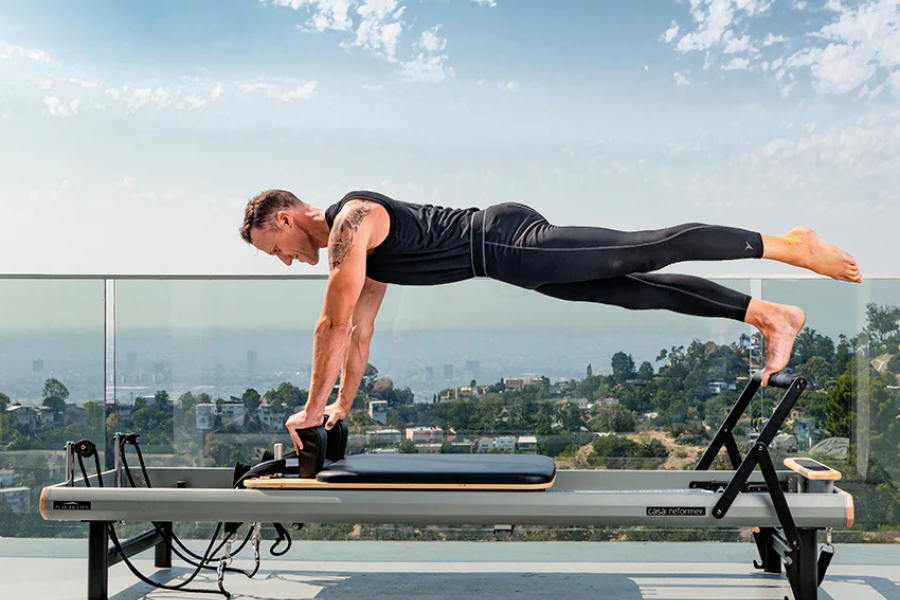
Pilates is a form of strength training. You use your body weight, springs, bands, or a reformer machine as resistance, and you repeat controlled movements to challenge your muscles.
Instead of isolating one muscle at a time, you train multiple muscle groups together. This builds what is often called functional strength, the kind of strength that carries over to how you walk, lift, reach, and sit every day, not just what you can do with a single exercise machine (GoodRx).
In one 12 week study of post menopausal women, practicing Pilates twice a week led to measurable gains in strength. Handgrip strength increased by about 8 percent, lower body strength on a 30 second chair stand test improved by over 23 percent, and abdominal strength increased by about 31 percent (PMC). These are big changes from just a few hours a week.
Over time, you can expect:
- Stronger abdominals, obliques, and lower back
- Better endurance in your hips and legs
- More strength in your shoulders and upper back for posture and lifting
You may not become a powerlifter, but everyday tasks like carrying groceries, climbing stairs, or picking up kids or pets often feel easier and more stable.
Strengthen and protect your core
When you think about what Pilates does to your body, your core is the main event. Most movements begin from or pass through the trunk, so your deep abdominal muscles, pelvic floor, and spinal stabilizers are constantly working.
Research has linked Pilates to increased core strength and stability, which then supports and stabilizes your whole body and helps decrease back and hip pain along with some pelvic floor issues (Healthline). By strengthening these deep muscles, your core starts to act like a natural brace that holds you in better alignment.
A strong core can help you:
- Maintain a neutral spine when you sit or stand
- Feel more controlled and steady when you twist, reach, or bend
- Protect your lower back during daily tasks and workouts
You may notice that your midsection feels more “switched on” during the day, even outside of class, simply because you are more aware of how to engage these muscles.
Improve posture and alignment
Pilates has a major impact on your posture. If you spend a lot of time sitting or looking down at screens, you probably have some degree of rounding in your shoulders, head forward posture, or a tilted pelvis. Pilates targets this directly.
A large 2024 review of 13 studies with 783 participants found that Pilates significantly improved different aspects of body posture across ages, including spinal deformities, forward head posture, pelvic tilt, and thoracic kyphosis, which is rounding of the upper back (PMC). Programs that ran 50 to 60 minutes twice a week for 8 to 38 weeks showed positive effects on spinal alignment and pelvic position (PMC).
Pilates helps by:
- Strengthening the muscles that support your neck, spine, and pelvis
- Stretching tight areas that pull you out of alignment
- Training your body to find a more neutral, stacked posture
You also build postural awareness. According to Healthline, Pilates stretches, lengthens, and strengthens the muscles around your spine, and as you move, you practice full body alignment and balanced muscle development, which improves your ability to notice and correct slouching (Healthline).
You might start to catch yourself hunching sooner and adjust your posture with less effort.
Many people report that they look taller and more “open” after a few weeks of Pilates, even if the scale has not changed, simply because their posture is better.
Increase flexibility and joint mobility
Pilates is not just about strength. It also improves flexibility and mobility in a way that is very usable in daily life.
Instead of holding long, passive stretches, you move into and out of lengthened positions with control. This active stretching builds a balance between strength and flexibility. Research shows that Pilates allows your muscles to stretch more and increases your joint range of motion, which supports functional fitness and daily movements (GoodRx).
Expert insights also suggest that Pilates uses dynamic, active lengthening, which improves not just how far you can stretch, but how well you can use that flexibility during real activities and sports (Complete Pilates).
Over time you may notice:
- Easier overhead reaching and twisting
- Less stiffness in your hips and hamstrings
- Smoother motion at your shoulders and spine
Healthline also points out that the combination of strength and controlled, smooth movements increases flexibility and mobility by improving range of motion at your joints with a functional balance of strength and stretch (Healthline).
Support your back and reduce pain
If you live with back discomfort, you might wonder if Pilates can help or hurt. Most evidence suggests that when you practice with good instruction and appropriate modifications, it can be very helpful.
Pilates strengthens the deep abdominal and pelvic floor muscles that act like a corset or brace around your spine. This extra support can decrease lower back pain and improve your ability to handle daily movement without flaring symptoms (Healthline).
The 2024 systematic review found that Pilates exercises improved muscle strength and endurance around the neck, spine, lumbar region, and pelvis. This helped correct postural problems and provided better spinal stability, which in turn contributed to pain relief and improved quality of life (PMC).
You still want to:
- Talk with your healthcare provider if you have a current or past back injury
- Start with beginner or clinical Pilates if you are in pain
- Let your instructor know what bothers you so they can modify moves
Used thoughtfully, Pilates can be part of a long term strategy to manage or reduce back issues rather than inflame them.
Enhance balance and reduce fall risk
Pilates can also affect your balance, both dynamic (moving) and static (standing still).
In that 12 week study of post menopausal women, twice weekly Pilates significantly improved dynamic balance. Participants improved their performance on the 8 foot up and go test by almost 6 percent, although this was considered a small clinical change (PMC). The same study found big reductions in side to side sway when standing, a 22 percent reduction with eyes open and over 10 percent during a dual task condition, which suggests better control when multiple demands are placed on you (PMC).
At the same time, the program did not create a large, clinically meaningful change in some measures of static balance in that specific group (PMC). So you can expect some improvements, but Pilates is not a magic cure for every balance challenge.
Other research notes that strengthening your core and stabilizer muscles with Pilates helps posture and balance and can reduce falls in older adults, sometimes more than general fitness programs do (GoodRx).
In daily life, this might feel like:
- Less wobbling when you stand on one leg
- More confidence walking on uneven ground
- Better recovery if you trip or get bumped
Support mental health and reduce stress
Pilates is often described as a mind body exercise because you focus on breathing, control, and awareness with every movement. This does not mean it is the same as yoga. Traditional Pilates emphasizes control of movement and muscular endurance rather than spiritual or flow based practice (Better Health Victoria). However, the mental effects are still real.
A 2025 observational study found that a weekly one hour Pilates session for three months significantly decreased anxiety, depression, and somatization symptoms in adults aged 50 to 64 compared with people who were not active. The improvements in anxiety were especially strong (PMC). The same study reported better use of leisure time and less stress related behavior, suggesting that Pilates helped participants “take their mind away” from daily commitments (PMC).
Other experts explain that Pilates:
- Promotes mindful breathing that supports heart rhythm and nervous system balance
- Reduces stress hormones like cortisol while increasing serotonin and endorphins
- Improves sleep, focus, and emotional regulation over time (EW Motion Therapy, PMC)
As you practice, you may feel more grounded and calm, both during class and in the rest of your day.
Change how your body looks, but not like a crash diet
You might secretly hope that Pilates will “lean you out” or be a quick fix for weight loss. This is where it helps to be honest about what Pilates does and does not do to your body.
Several sources point out that Pilates is not a powerful calorie burner. One estimate suggests that mat Pilates burns around 95 calories per hour and reformer Pilates about 130 calories per hour, which is lower than many cardio focused workouts (Complete Pilates). People discussing their own experiences also note that Pilates alone, especially just a couple of short sessions a week, usually does not melt fat or cause dramatic weight loss (Reddit).
In that 12 week study of post menopausal women, researchers found no significant changes in body composition, such as trunk lean mass or fat mass, when the women did not change their diet (PMC).
Here is what you can expect instead:
- More muscle tone and definition, especially through your core and hips
- Better posture, which makes you look and feel different in clothes
- Possible indirect help with body composition through increased muscle mass and metabolic rate (Complete Pilates)
If you pair regular Pilates with a nutrition plan that creates a modest calorie deficit, then, like any exercise, it can support weight loss. The workouts alone, however, are not a shortcut. Online conversations also warn that the influencer marketing that implies Pilates alone gives you fast visual changes or major weight loss is misleading (Reddit).
Improve body awareness and confidence
Pilates asks you to notice how your body moves. You pay attention to your breath, the angle of your joints, and which muscles are working. Over time, this builds proprioception, which is your sense of where your body is in space.
According to Healthline, this improved body awareness helps your body respond better to stimuli, prevents falls and injuries, and may even make it easier to notice real hunger and fullness signals so you are less likely to eat mindlessly (Healthline).
The 2024 review also found that by promoting core strength and body awareness, Pilates improved participants’ quality of life and fostered a more positive attitude toward their bodies and daily life (PMC).
You might experience this as:
- Feeling more connected to your body rather than frustrated by it
- Catching and correcting awkward movement patterns before they cause pain
- Building confidence as you master new exercises and feel progress
How often you need to practice to see changes
You do not have to live in the studio to benefit. Several studies used programs with 1 to 2 sessions per week for 45 to 60 minutes and still saw improvements in strength, posture, and mental health over 8 to 12 weeks (PMC, PMC, PMC).
Better Health Victoria notes that many people notice postural improvements after about 10 to 20 sessions when they practice at least 2 to 3 times per week (Better Health Victoria). That usually translates to a few months of steady, realistic effort.
If you are starting out, you can:
- Aim for 1 to 2 classes or home sessions per week
- Focus on learning proper technique rather than rushing into advanced moves
- Pair Pilates with walking or another form of cardio if weight loss or heart health is a goal
Consistency matters more than intensity. Pilates is designed to be adaptable, so you can keep showing up even when you are tired, stressed, or managing old injuries (Better Health Victoria).
In simple terms, what Pilates does to your body is help it work more like it is meant to. You build strength that supports your joints, posture that uses less effort, flexibility that you can actually use, and a calmer nervous system that handles stress better.
If you are ready to feel those changes, you can start with one short session this week. Pay attention to how you stand and breathe afterwards. That small shift is where the long term benefits begin.
About The Author





