Surprising Exercise Bike Calorie Burn Facts You Should Know
A stationary bike can be one of the most efficient tools for weight loss and heart health, but exercise bike calorie burn is often misunderstood. You might be burning more than you think in some cases and less than the screen suggests in others. Once you understand what really affects your calorie burn, you can tailor your rides to get better results in less time.
Below, you will find clear, research-backed facts that make your workouts easier to plan and track.
How many calories you really burn
If you weigh around 150 pounds and cycle at a moderate pace for 60 minutes, you might expect to burn roughly 480 calories on a stationary bike according to PureGym’s US blog as of 2024 (PureGym). That is a solid session, especially if you ride consistently several times a week.
For comparison, a 60 minute workout on an elliptical machine burns roughly 340 calories for the same 150 pound person at a similar intensity, and that number can increase with HIIT style sessions (PureGym). This is one reason an exercise bike is such a popular option for weight loss and overall fitness.
However, that 480 calorie figure is an average. Your own calorie burn can be quite different once you factor in your body, your bike, and your effort.
Why calorie counts vary so much
Two people can ride side by side at the same speed and resistance and still burn very different amounts of energy. Several personal factors affect exercise bike calorie burn every time you pedal.
Key influences include your:
- Weight and body composition
- Age and gender
- Fitness level
- Workout intensity and resistance settings
Heavier people and people with more muscle usually burn more calories during the same workout since their bodies use more energy to move and to support active tissue (PureGym). Your age and gender also play a role because of hormonal differences and how much muscle you naturally carry.
Environmental details can nudge your calorie burn up or down too. Hotter conditions may increase sweating and energy use, while cooler environments may slightly reduce how much you burn on the bike according to We R Sports (We R Sports).
How exercise bikes estimate calories
Under the surface, most calculators and machines use the same basic approach. They rely on a concept called METs, which stands for Metabolic Equivalent of Task.
One MET is the energy you use when you sit quietly. If a ride is listed as 6 METs, your body is working six times harder than when you are resting (runbundle). For example, cycling at 100 watts on a stationary bike is roughly equal to 6 METs.
From there, your calorie burn is estimated using your:
- MET level
- Body weight
- Duration of your workout
This approach makes it possible to calculate total calories for different intensities and time frames (runbundle). A tool like the Stationary Bike Calorie Calculator uses your weight, time, and either workout intensity or power in watts to estimate your burn, and it works across upright, recumbent, and spin style bikes (runbundle).
If your bike shows watts, or power output, your estimate gets even more accurate. Many modern bikes and apps map intensity levels to watts using data such as the 2024 Compendium of Physical Activities (runbundle).
Screen vs reality: are bike counters accurate?
Here is where things get surprising. The number on your bike screen might not match what you actually burned.
For ellipticals, calorie burn can be overestimated by 20 to 42 percent because the machine often counts momentum as effort (PureGym). Exercise bike displays are also known for inaccuracy. Users in the Reddit Fitness community report that built in counters often overshoot, while bike power meters are much more reliable. Heart rate monitors still have limitations, but they tend to be better than guessing or relying only on the console number (Reddit Fitness).
Newer exercise bike models do a better job since they account for more variables, but there is still a wide range between brands and designs (We R Sports).
If you want a simple, more accurate estimate and your bike shows watts, you can use this formula that several Reddit Fitness users rely on:
Calories burned = Watts × Hours × 3.6
So if you cycle at 100 watts for 15 minutes, you multiply 100 by 0.25 hours, then by 3.6. That gives you about 90 calories. At 200 watts for the same 15 minutes, you are closer to 180 calories burned (Reddit Fitness).
The key takeaway is simple. Treat most built in calorie counters as ballpark figures, not precise measurements.
How intensity changes your calorie burn
Effort level has one of the biggest effects on your exercise bike calorie burn. Even a small increase in intensity can push your numbers up quickly.
Reddit Fitness users reporting their own rides suggest that:
- Low to moderate intensity often burns about 90 to 150 calories per 15 minutes
- Moderate to high intensity can reach roughly 150 to 250 calories per 15 minutes (Reddit Fitness)
Harvard data shared by MerachFit notes that an average person weighing 70 kg burns around 400 calories in a 45 minute moderate to high intensity stationary bike workout (MerachFit). At a moderate level, a 30 minute ride usually lands closer to about 150 to 300 calories, depending on your weight and MET level (We R Sports, MerachFit).
If your goal is fat loss, this is good news. You have several levers you can pull to increase calorie burn without needing to ride for hours at a time.
Why bike type and resistance matter
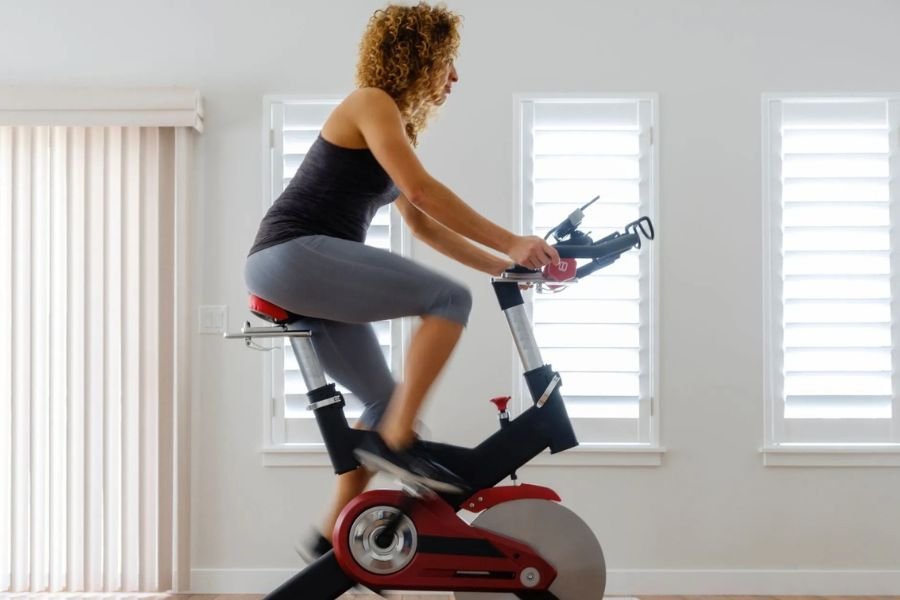
Not all stationary bikes feel the same, and they do not all burn calories at the same rate either. The position of your body and how much muscle you recruit can nudge your burn up or down.
According to MerachFit, spin bikes usually burn the most calories. They are built for higher intensity rides that engage your entire lower body and your core. Upright bikes typically come next, and recumbent bikes trail behind because the supported seat position reduces how much your core and stabilizing muscles have to work (MerachFit).
Resistance plays a big role as well. Pedaling fast with very low resistance can feel like you are working hard, but you actually burn more when you increase resistance enough that your muscles are pushing against something substantial. Magnetic resistance systems are helpful because they allow precise control, so you can steadily increase the challenge over time (MerachFit).
Higher resistance hill style rides can even approach 1,000 calories per hour for very fit riders according to data discussed by CarolBike (CarolBike). You may not aim for that level, but it shows how powerful resistance can be.
The power of intervals and sprints
If you are short on time, interval training is your friend. High intensity interval training and newer methods like REHIT, which stands for Reduced Exertion High Intensity Training, can increase exercise bike calorie burn for the same workout length.
MerachFit notes that adding HIIT to your cycling routine can increase your calorie burn by up to 30 percent compared to steady state cardio and can boost how many calories you burn after the workout ends through the EPOC effect, or excess post exercise oxygen consumption (MerachFit).
Research summarized by CarolBike shows that interval methods like HIIT and REHIT consistently burn more calories than steady rides of the same duration. A 15 minute REHIT workout on the CAROL Bike even burns more calories than a 30 minute run because about 66 percent of the calories are burned in the hours after you finish (CarolBike).
Short, all out sprint workouts can raise your metabolism for up to 48 hours through that same EPOC effect. CarolBike highlights a protocol with just two 20 second maximum sprints that meaningfully boosts fat loss over time (CarolBike).
If your joints allow it and your doctor has cleared you for intense exercise, mixing a few intervals into your weekly rides is one of the most efficient ways to get more out of every minute.
Small technique tweaks that raise burn
You can also adjust how you ride to get more calorie burn without completely changing your plan.
Pedaling out of the saddle, or standing up, increases your metabolic cost because your upper body and core have to work harder to stabilize you. A 2016 study referenced by CarolBike found that standing sprints and hill reps burn more calories than seated efforts at the same speed (CarolBike).
Combining this with resistance intervals works especially well. For example, you might:
- Warm up in the saddle at low resistance
- Increase resistance for a 30 to 60 second standing climb
- Recover seated at low to moderate resistance
- Repeat several times
This structure builds leg and core strength and elevates your heart rate so you burn more during and after the ride.
Tools that make tracking easier
If knowing your numbers motivates you, a few simple tools can keep you on track without getting obsessed with exact precision.
A stationary bike calorie calculator that uses your weight, time, and intensity or watts gives you a tailored estimate and works across different bike types, including recumbent models (runbundle). You can log these numbers in a simple spreadsheet or fitness app so you see your progress over weeks and months.
Fitness trackers or heart rate monitors can improve accuracy over the built in bike counter, since they factor in your age, gender, and baseline activity level (We R Sports). While they are not perfect either, they are usually closer to the truth and they can show you which rides feel hardest for your body in real time.
If your bike has a power meter, even better. Use the simple watts based formula as your main reference and treat the screen calories as a rough estimate.
What matters most for weight loss
It is easy to get caught up in tiny differences between devices, formulas, and modes. In practice, what matters most for exercise bike calorie burn and long term fat loss is consistency.
Regular sessions, even at a moderate pace, add up over weeks and months. An average person can burn about 150 calories in a 30 minute moderate ride and around 400 calories in a 45 minute moderate to high intensity session, and that is before you count any strength training or walking you might also do that day (We R Sports, MerachFit).
Focus on:
- Riding often enough to make it a habit
- Gradually increasing resistance or duration
- Adding short intervals when you feel ready
- Using calorie numbers for guidance instead of perfection
If you keep showing up for your rides and steadily nudge the difficulty upward, your heart health will improve, your legs will get stronger, and your total daily calorie burn will rise, even if the screen is not 100 percent accurate.
About The Author