Get Stronger and Fitter with Friendly Elliptical Cardio Workouts
Elliptical cardio workouts can be a gentle way to get stronger, leaner, and more confident about movement, especially if high-impact exercise has never felt like a good fit. With the right approach, you can use an elliptical to protect your joints, burn calories, and build full-body strength in the same session.
Below, you will find how elliptical workouts help your health, how to use the machine correctly, and simple plans you can follow whether you are a beginner or ready for more intensity.
Understand why ellipticals are joint friendly
If running bothers your knees, hips, or back, elliptical cardio workouts can feel like a relief. Your feet stay in contact with the pedals, so there is no pounding with every step. That lower impact can be helpful if you have knee or hip arthritis, past injuries, or conditions like osteoporosis or low back pain, while still allowing you to get a solid cardio session in (Healthline).
Interestingly, you are not trading effectiveness for comfort. Research shows that elliptical workouts can raise your heart rate, oxygen use, and calorie burn to levels similar to treadmill running, which means they can stand in for higher impact workouts when you need them to (Healthline). This balance is one reason ellipticals are common in both physical therapy clinics and regular gyms.
Use proper form for a full body workout
Good form is what turns a basic elliptical session into a joint friendly, full body strength and cardio workout. It also makes the motion feel smoother and more natural.
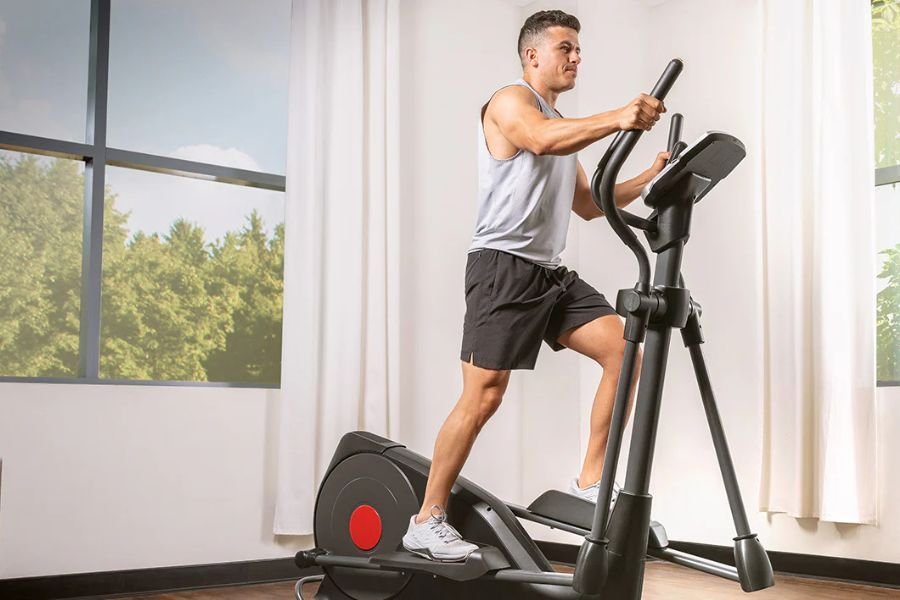
Stand tall rather than leaning on the console. Keep your shoulders relaxed, your core slightly engaged, and your gaze forward, not down at your feet. This posture helps you avoid neck and back strain and improves how much your muscles contribute to each stride (CNET).
If your machine has moving handles, use them. Actively push and pull instead of resting your hands on the stationary bars. When you do this, you involve your shoulders, back, chest, biceps, and triceps along with your legs and core, which turns the workout into a full body session rather than only lower body work (CNET, Healthline).
Adjust resistance and incline to build strength
Once you feel comfortable with the basic motion, you can use resistance and incline to shape your workout. These two settings determine how challenging each stride feels and which muscles you emphasize.
Increasing the resistance makes your muscles work harder, similar to adding weight in strength training. This helps build strength and muscle tone, especially in your glutes, quadriceps, hamstrings, and calves (CNET, Set For Set).
Changing the incline can feel like climbing a hill. A higher incline usually shifts more work to your glutes and hamstrings and can increase calorie burn because your body has to work harder to move your weight upward (CNET, SOLE Fitness). Start with smaller changes and notice how each adjustment feels before you raise it further.
Learn which muscles you work
Elliptical cardio workouts are not only about your heart and lungs. When you use the machine correctly, you train several major muscle groups at once.
Your lower body does much of the work. The primary muscles are the glutes, quadriceps, hamstrings, and calves. These muscles power the pushing and pulling of the pedals and support your joints with every stride (Set For Set, Healthline).
If you use the moving arms, you also work your chest, back, shoulders, biceps, and triceps. Your core muscles, including your abdominals and obliques, help keep you stable and balanced, especially when resistance or incline is higher. This combination can help you build overall strength and improve posture while getting your cardio in (Healthline).
Use forward and backward motion for balance
One simple way to change how your elliptical workout feels is to change pedal direction. Many machines allow you to pedal both forward and backward, and each direction puts slightly different emphasis on your muscles.
Pedaling forward usually focuses more on your quadriceps and feels similar to jogging or climbing stairs. When you switch to pedaling backward, your hamstrings and glutes take on more work, which can help correct imbalances if you tend to be quad dominant from activities like cycling or running (Healthline, CNET).
You can alternate directions during the same workout. For example, you might go forward for 3 to 5 minutes, then go backward for 1 to 2 minutes. This keeps your session interesting, spreads the workload across more muscles, and can reduce overuse.
Support healthy weight loss with the elliptical
If your main goal is fat loss, elliptical cardio workouts can be part of an effective plan, especially when combined with healthy eating, strength training, sleep, and stress management. The key is creating a consistent calorie deficit without punishing your body.
In general, a 30 minute elliptical session can burn roughly 170 to 400 calories, depending on your weight, fitness level, and how hard you are working (Healthline, Cleveland Clinic). Some estimates suggest that with higher intensity and resistance, you might reach around 400 calories in half an hour, but your personal numbers can vary (Set For Set).
The American Council on Exercise suggests at least 150 minutes of moderate activity per week for weight loss. That could look like five 30 minute elliptical sessions or four 45 minute ones, paired with strength training to support muscle and metabolism (Garage Gym Reviews). When you combine regular exercise with a daily calorie deficit of around 500 to 1,000 calories through diet and movement, you may be able to lose about 1 to 2 pounds per week, which is a commonly recommended pace (Lose It!).
Choose between steady state and intervals
You do not have to train at full effort all the time to see results. You can use both steady state cardio and high intensity interval training, depending on your experience level and how you feel that day.
Steady state means you work at a moderate intensity for the whole workout, usually 20 to 40 minutes, where you can still talk but not sing. This is often a good approach when you are starting out or returning from a break, and it supports heart health and endurance at 60 to 70 percent of your maximum heart rate (Set For Set, Cleveland Clinic).
High intensity interval training, or HIIT, alternates short bursts of hard work with easier recovery periods. For example, you might push for 30 to 60 seconds at 80 to 90 percent of your maximum effort, then recover for 30 to 90 seconds at a lower pace. HIIT on an elliptical can burn more calories in less time and may keep your metabolism elevated for a while after you finish (CNET, SOLE Fitness, Healthline).
The American Heart Association suggests keeping your heart rate in the range of 50 to 70 percent of maximum for moderate exercise and 70 to 85 percent for vigorous exercise to make your time count (Lose It!).
Try beginner and intermediate workout ideas
You can use these basic structures to start planning your elliptical cardio workouts. Adjust the exact resistance and incline based on how your machine is built and how your body feels.
If you are new to exercise or have health conditions, it is a good idea to talk with your doctor first, and a certified personal trainer can help you find safe settings and form if the motion feels awkward at the beginning (Healthline).
Beginner steady state workout, about 20 minutes
- Warm up for 5 minutes at very low resistance, comfortable pace.
- Increase resistance slightly and work at an easy to moderate pace for 10 minutes. You should be able to hold a conversation.
- Cool down for 5 minutes by returning to your starting resistance and slowing your stride.
Intermediate interval workout, about 25 minutes
- Warm up for 5 minutes at low resistance.
- For 15 minutes, alternate:
- 1 minute at higher resistance and faster pace (hard but controlled)
- 1 minute at lower resistance and slower pace (easy recovery)
- Finish with a 5 minute cool down at low resistance and gentle pace.
For a strength focus, you might also try a shorter climbing style workout. Gradually increase incline every few minutes while keeping resistance moderate, then lower both during the cool down. Some plans pair a 30 minute resistance session with quick strength moves like squats and push ups off the machine to further support muscle and fat loss (Set For Set).
Build a routine you can stick with
Consistency is what turns elliptical cardio workouts into visible changes in your energy, strength, and body composition. Many people do well with 4 to 5 sessions per week, which can add up to the 150 to 300 minutes of weekly cardio often recommended for gradual weight loss and improved health (SOLE Fitness).
If you are brand new, starting with 15 to 20 minutes and working up over several weeks is usually more sustainable than jumping straight to long, intense workouts. Allow at least one full rest day per week and pay attention to any pain that feels sharp or unusual, especially in your joints. The low impact design of ellipticals can help protect your knees and hips in the long term, but recovery still matters (Cleveland Clinic, SOLE Fitness).
Try setting one small, clear goal for your next workout, such as adding 3 minutes to your usual time, slightly increasing resistance for one interval, or practicing better posture the entire session. These small, repeatable wins are what make you stronger and fitter over time without overwhelming you.
About The Author