Easy Chest Exercises for Women That Deliver Real Results
A strong, defined chest is not just for bodybuilders. The right chest exercises for women help you stand taller, move more easily in daily life, and create a balanced, toned upper body. When you train your chest, you are working a major muscle group that deserves attention just like your glutes, back, or legs.
You also do not have to worry about shrinking your breasts or getting bulky. Your breast size is mostly determined by fat and genetics, not by how often you press or push. What will change is your posture, strength, and overall shape, which can make your chest look lifted and more supported.
Why chest exercises matter for women
Your chest muscles, called the pectorals, stretch from your collarbones to your upper ribs and across toward your shoulders. When you train these muscles, you gain more than just visible definition.
Chest exercises for women help you:
- Improve posture by pulling your shoulders back instead of letting them round forward
- Avoid muscle imbalances that show up when you only train your back or lower body
- Build functional strength for pushing doors, lifting kids, carrying groceries, and sports like boxing or swimming
- Increase overall upper body tone, especially in the shoulders and triceps, since many chest moves are compound exercises
Because so many everyday movements involve pushing away from your body, a stronger chest makes your whole routine feel easier and more efficient.
Common myths about chest training
If you have skipped chest day in the past, you are not alone. Many women have heard at least one of these myths.
“Chest exercises will shrink my boobs”
Your breasts sit on top of the pectoral muscles. Training the pecs does not melt breast tissue. Fat loss happens across your body as a whole, depending on your nutrition and overall activity, not from one specific exercise.
What chest training can do is build a firmer base behind the breast tissue. That makes your chest look higher and more supported, especially when paired with good posture.
“I will look too bulky”
Building large, bulky muscle size usually requires a very high training volume, heavy weights, and a calorie surplus, along with favorable genetics and often years of focus. Most women who perform regular chest exercises build lean, firm muscle that creates a smoother, more athletic silhouette, not a bulky one.
“Push-ups are enough, I do not need anything else”
Push-ups are excellent, but they are just one tool. Varying your grip, angle, and type of resistance helps you train the upper, middle, and inner chest more evenly. A few simple variations, like incline or decline push-ups, can completely change where you feel the work.
How to warm up your chest safely
Before you lift, press, or push, it is worth spending a few minutes warming up. This helps protect your shoulders and elbows and prepares your chest muscles to work harder.
You can try a short routine like this:
- Arm circles, 20 to 30 seconds forward and 20 to 30 seconds backward
- Shoulder rolls, 10 forward and 10 backward
- Wall push-ups, 10 to 15 slow reps
- Light band pull-aparts or chest openers, 10 to 15 reps
Warming up the joints and increasing blood flow reduces the risk of sprains or strains and lets you feel your chest muscles activating sooner during your workout.
Key form tips for better results
The way you perform each chest exercise matters as much as which exercise you pick. Two women can do the same workout and see different results depending on how well they feel and control the target muscles.
Focus on these principles during chest exercises for women:
- Retract your shoulders gently by drawing your shoulder blades back and slightly down into the bench or into your ribcage if you are doing push-ups
- Keep your elbows at about a 45 degree angle from your sides, not flared straight out or glued to your ribs
- Move the weight or your body with control, avoiding bouncing or jerking
- Think about squeezing your chest at the hardest part of the movement instead of just locking out your elbows
When you prioritize muscle engagement rather than just “moving the weight,” you recruit more chest fibers and rely less on momentum or your arms to cheat through the reps.
A simple cue that helps: instead of thinking “push the weight up,” think “bring my upper arms toward the center of my chest.”
Effective bodyweight chest exercises for women
You can build a strong chest at home with no equipment. Your body does not distinguish between resistance from a dumbbell and resistance from your own bodyweight. It only reacts to effort and tension.
Standard push-up
The classic push-up trains your chest, shoulders, triceps, and core at the same time.
- Start in a high plank with hands slightly wider than shoulder width
- Keep your body in a straight line from head to heels
- Lower until your chest is just above the floor, then press back up
If this is too challenging, place your hands on a sturdy elevated surface like a bench, counter, or step. This incline version reduces how much bodyweight you have to push.
Incline push-up
Incline push-ups, where your hands are higher than your feet, place slightly more emphasis on the lower portion of your chest.
- Place your hands on a stable surface at hip or chest height
- Walk your feet back into a straight body line
- Bend your elbows and lower your chest toward the edge, then push away
As you get stronger, move to a lower surface to increase the difficulty.
Decline push-up
Decline push-ups shift more work to the upper chest by elevating your feet.
- Place your feet on a low step, sturdy chair, or couch
- Hands go on the floor slightly wider than shoulder width
- Lower your chest toward the ground, pause briefly, and press up
Because your upper chest is often undertrained, this variation can help create a higher, more balanced shape around the collarbones.
Diamond push-up and other variations
Diamond push-ups, where your hands form a diamond shape under your chest, increase the demand on your triceps and upper chest. They are challenging, so you can perform them on your knees or as an incline while you build strength.
Other helpful push-up variations include:
- Hand release push-ups, where you lift your hands briefly at the bottom for more range of motion and muscle activation
- Push-up holds, where you pause in the lowered position to build endurance
- Uneven push-ups, where one hand is on a ball or elevated surface to highlight and correct side to side imbalances
Mixing in these options keeps your bodyweight chest workouts interesting and effective for the long term.
Simple dumbbell chest exercises you can do anywhere
If you have access to a pair of dumbbells or similar household items, you can expand your chest exercises for women without a full gym setup.
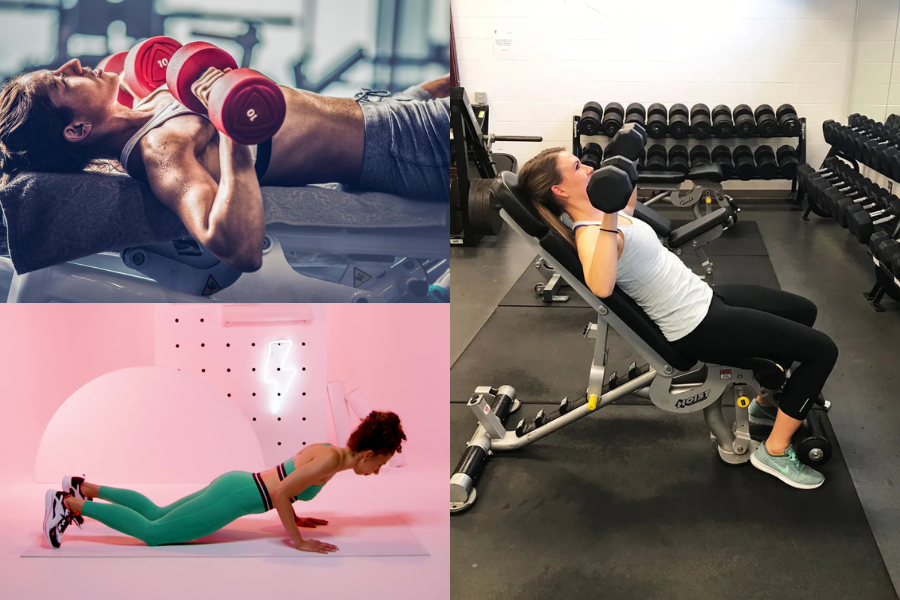
Dumbbell or floor chest press
A dumbbell chest press mimics the motion of a bench press and covers the middle portion of your chest.
- Lie on a bench or on the floor with a dumbbell in each hand
- Start with weights over your chest, palms facing forward
- Lower your arms until your elbows are about level with your torso
- Press back up while keeping your shoulder blades stable on the bench or floor
If you do not have a bench, the floor press still delivers great chest and triceps work and limits the range to protect your shoulders.
Glute bridge chest press
To train more muscles at once, try combining a hip bridge with a chest press.
- Lie on your back with knees bent and feet flat
- Press your hips up into a bridge and keep your core braced
- With dumbbells in hand, perform a regular chest press
This move recruits your chest along with your glutes, hamstrings, and core, which turns it into a full body strength exercise that also challenges your stability.
Chest fly variations
Chest fly exercises focus on the inner chest and teach you to control your arms as they move away from the body.
- Lie on a bench or mat with a slight bend in your elbows
- Start with dumbbells above your chest, palms facing each other
- Open your arms out wide in a gentle arc until you feel a stretch across your chest
- Squeeze your chest to bring the bells back together over your body
You can also perform a standing cable or band chest fly if you have access to a cable machine or resistance bands. The key is to avoid locking your elbows and to stop the movement before your shoulders feel strained.
Smart training structure for real results
You do not need an hour long routine to get stronger. A focused 20 to 25 minute session can be enough if you stay consistent.
One simple way to organize your workout is:
- Choose 5 to 8 chest exercises, mixing bodyweight and dumbbell options
- Perform 10 to 12 reps of each move, or work for 40 to 50 seconds followed by 10 to 20 seconds of rest
- Move through all exercises to complete a circuit
- Rest 1 to 2 minutes, then repeat the circuit 2 more times
If you are just starting out, complete one circuit and see how you feel. As your strength improves, add more rounds or adjust the difficulty by using a lower incline, slightly heavier weights, or more advanced push-up variations.
Common mistakes that hold back chest gains
A few small habits can quietly slow your progress. Watching for these early on helps you get more from every rep.
Letting your shoulders do all the work
If your shoulders and arms always feel more tired than your chest, you may be:
- Flaring your elbows straight out to the sides
- Allowing your shoulders to roll forward at the bottom of a press
- Rushing the movement and bouncing at the bottom
Practice retracting your shoulder blades and moving through a controlled range where your chest feels the tension. Quality repetitions matter more than quantity.
Ego lifting or adding weight too quickly
Using more weight than you can control shifts effort away from the chest and into your joints and secondary muscles. It also increases your risk of injury.
Instead of chasing heavier dumbbells every session, look for signs of progress such as:
- Better control and smoother reps
- A stronger squeeze in your chest at the top of each move
- The ability to perform more reps with the same weight and good form
Relying only on machines or one exercise
If you have access to a gym, chest machines can be useful, but free weights and bodyweight moves usually deliver better overall muscle activation. Overdoing just one exercise, like the flat barbell bench press, can overdevelop the lower chest and leave the upper chest undertrained.
For a more balanced look and feel, pair standard presses with incline variations and fly movements. This encourages even development from your collarbones down to the mid-chest area.
Putting it all together
Chest exercises for women are not about chasing a certain “gym look.” They are about building strength that supports your posture, makes everyday life easier, and creates a balanced, confident upper body.
You can start small. Pick two exercises from the bodyweight list and one dumbbell exercise if you have weights. Try one or two sets today, paying close attention to form and how your chest feels. Then slowly build up from there.
With consistent practice, you will notice that pushing heavy doors, carrying groceries, or even holding a plank starts to feel more solid and steady. That is your chest returning the favor for the time you invested in it.
About The Author