Simple and Effective Bicep Workout Routine You’ll Love
Why a simple bicep workout routine works
A simple bicep workout routine is often all you need to build noticeable size and strength. You do not need dozens of fancy moves, you just need a few solid exercises, smart volume, and consistency.
Your biceps brachii has two heads, the long head that helps create the peak and the short head that adds width and support. Together with the brachialis and brachioradialis muscles, these give your upper arm and forearm their size and shape, as highlighted in recent guidance from Gymshark and Muscle & Fitness. When you train all of them with good form, your arms grow in a balanced way that looks and feels strong.
Understand your bicep muscles
Before you jump into your routine, it helps to know what you are actually training.
The biceps brachii sits on the front of your upper arm. It has a long head and a short head. The long head contributes to the rounded “peak” you see when you flex. The short head lies more toward the inside of your arm and adds support and thickness across the front.
Underneath the biceps is the brachialis, which research suggests is roughly 50% stronger than the biceps and plays a major role in elbow flexion. Training it well can make your upper arm look thicker because it pushes the biceps up from beneath. The brachioradialis runs along the top of your forearm and helps complete the “full arm” look.
When your bicep workout routine includes different curl angles and grips, you hit all of these muscles, not just the obvious ones on top.
How often and how hard to train biceps
If you want visible results, your training frequency and effort matter as much as your exercise selection.
Current guidance suggests that training your biceps 2 to 3 times per week leads to greater hypertrophy than working them only once per week, with roughly 3.1% more growth week over week when frequency is higher. For most people, that means two focused bicep sessions or one dedicated session plus biceps work alongside back or pulling exercises.
In each workout, aim for:
- 2 to 4 different bicep-focused exercises
- 3 to 4 sets per exercise
- 8 to 12 challenging reps per set
This 8 to 12 rep range is often recommended for hypertrophy because it lets you use weights that are heavy enough to stress the muscle, but not so heavy that your form falls apart.
You do not want to train biceps every day. Curling daily does not give your muscles time to repair the microtears you create when you lift. Recovery is when growth actually happens. If you skip rest, you are more likely to feel run down and see your progress stall.
Key principles for bigger biceps
Before you look at a specific workout, lock in a few core principles. These make any bicep workout routine more effective.
First, use progressive overload. Gradually increase the challenge over time by adding a bit of weight, a rep or two, or an extra set. Without this steady increase, your muscles adapt and stop growing, a point that Muscle & Fitness stresses in its programming recommendations.
Second, prioritize form and control. The biceps respond well when you move the weight with a smooth tempo. Strength coach Jeff Cavaliere recommends slowing both the lifting and lowering phases to around four seconds so you fully engage the muscle and protect your joints.
Third, train through a full range of motion. Let your arm straighten at the bottom, then curl until your elbow is fully flexed, without letting your shoulder take over. Cutting the range or swinging with your hips might move the weight, but it shifts the work away from your biceps.
Finally, vary your grips and angles over time. Hammer curls hit the long head and brachioradialis, preacher curls and concentration curls emphasize the short head, and different barbell or EZ bar grips can shift focus between inner and outer portions of the muscle.
Quick warm up before you curl
You do not need a long warm up, but you do want your elbows, shoulders, and upper back ready to move.
Spend about 5 minutes on:
- Light banded or assisted chin ups for blood flow
- Rotational dumbbell curls with very light weights to grease the pattern
- A simple plank or inverted plank to wake up your core
- A gentle straight arm stretch behind your back to open the biceps
Your goal here is to feel warm and mobile, not tired. You should finish your warm up feeling ready to work, not like you already did a workout.
Simple beginner bicep workout routine
This beginner friendly bicep workout routine uses just three moves. You can do it 1 to 2 times per week, either on its own or after a back or upper body session.
1. Seated dumbbell curl
The seated dumbbell curl is a great starting point because it limits cheating and keeps tension on the biceps.
How to do it:
- Sit tall on a bench with a dumbbell in each hand, arms straight down, palms facing forward.
- Keep your elbows close to your sides and your shoulders relaxed.
- Curl the weights up toward your shoulders, focusing on squeezing your biceps.
- Pause briefly at the top, then lower the dumbbells slowly until your arms are straight again.
Aim for 3 sets of 10 to 12 reps with a weight that feels challenging by the last few reps but still allows clean form.
2. Standing barbell curl
The standing barbell curl trains both heads of the biceps and lets you gradually increase weight for strength and size.
How to do it:
- Stand with your feet about hip-width, holding a barbell with an underhand grip.
- Keep your elbows just in front of your hips, chest up, and core tight.
- Curl the bar up in a smooth arc without swinging your hips or leaning back.
- Squeeze at the top, then lower the bar in a controlled way all the way down.
Work up to 3 sets of 8 to 10 reps. Focus on not letting your elbows drift forward or your shoulders roll in, which can take stress off your biceps.
3. Single arm preacher curl
The single arm preacher curl emphasizes the short head and gives you a strict, locked-in position that makes cheating almost impossible.
How to do it:
- Set an incline bench at a steep angle and sit with your chest against the pad.
- Place one upper arm along the bench, holding a dumbbell with an underhand grip.
- Start with your arm almost straight, then curl the weight toward your shoulder.
- Pause for a second at the top, then slowly lower back to full stretch.
Do 2 to 3 sets of 10 to 12 reps per arm. Since this is unilateral, it can also help you address left and right imbalances by adding an extra set for your weaker side, an approach Muscle & Fitness recommends for evening out arm size.
Intermediate bicep workout routine to level up
Once you are comfortable with the basics, you can move to a slightly more advanced bicep workout routine that targets the long and short heads more specifically and brings the brachialis and brachioradialis into the mix.
Here is a sample 2 day split you can rotate through your week, using 8 to 12 reps for 3 to 4 sets unless noted.
Day A: Peak and pump focus
- EZ bar curl, medium underhand grip, to hit both heads
- Hammer curl, standing or seated, to emphasize the long head and brachioradialis
- Preacher curl, with an EZ bar or dumbbell, to target the short head
- Concentration curl, lighter weight and slow tempo, to finish with strong mind muscle connection
These exercises match many of the mass building favorites listed by Gymshark, who highlight concentration curls, hammer curls, EZ bar curls, and preacher curls as top choices for biceps growth.
Day B: Cable and chin up focus
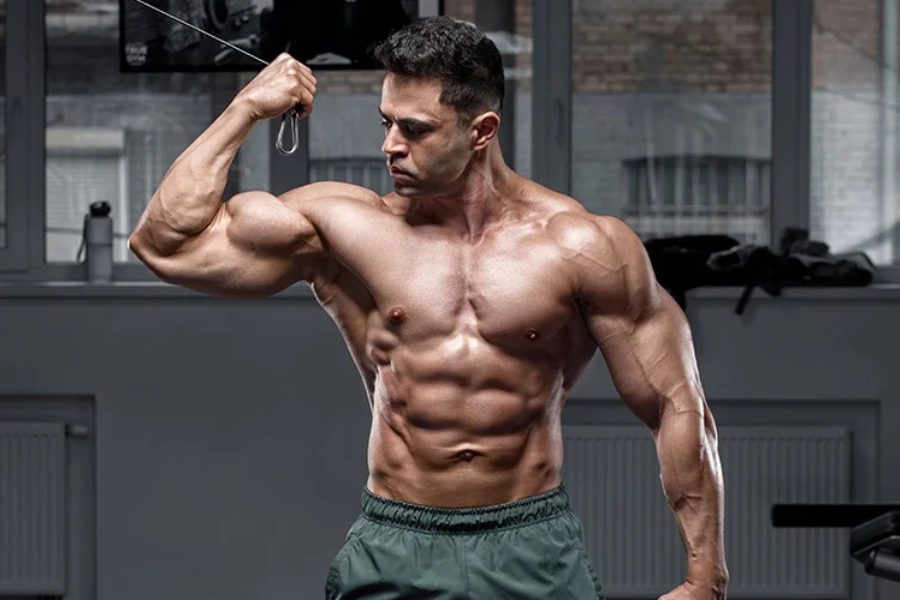
- Single arm high cable bicep curl to keep constant tension on the short head
- Chin ups, underhand or neutral grip, to train both biceps heads along with your back
- Incline dumbbell curl to stretch the long head with your arms behind your body
- Machine bicep curl or cable preacher curl to finish in a supported position
If you train biceps twice a week, you might use Day A on Monday and Day B on Thursday, adjusting to your schedule and recovery.
Form tips and common mistakes
Even the best bicep workout routine stops working if your form drifts. A few small adjustments can keep your arms doing the work instead of your hips or lower back.
Keep your elbows fixed. If they drift forward as you curl, your shoulders start helping too much. Think about keeping your elbows pinned just in front of your ribs and moving only at the elbow joint.
Control your tempo. Avoid jerking the weight up and letting it drop. Cavaliere recommends about four seconds up and four seconds down for many curls, which keeps the biceps under tension longer and reduces injury risk.
Finish the curl before you twist. Many people twist from a neutral to a palms up position halfway through the rep, which skips the hardest part where the biceps are under maximum tension. Instead, curl first, then rotate your wrist slightly near the top to intensify the contraction.
Finally, avoid leaning too far back with heavy weights. If you feel your lower back arching and your body swinging the dumbbells, your biceps are no longer the limiting factor. Reduce the weight, tighten your core, and rebuild from there so your arms, not your spine, do the heavy lifting.
If a set only feels hard because you are swinging, it is not your biceps that are getting stronger, it is your momentum.
When and how to add intensity
Once you have built a solid foundation and your form is reliable, you can sprinkle in more advanced techniques to push your biceps further.
Some lifters use “cheat reps” with a slightly heavier weight, adding a small amount of body drive to help lift the weight and then focusing hard on a very slow lowering phase. This eccentric focus can encourage more growth, but it is best reserved for experienced lifters who already own strict reps, as highlighted in Athlean-X guidance.
You can also increase difficulty without adding weight by:
- Pausing for 1 to 2 seconds at the top of each curl
- Adding iso holds, for example holding one dumbbell at the top while the other arm performs reps, a technique popular in Men’s Health UK programming
- Reducing rest periods slightly between sets
Remember, more is not always better. The goal is steady, long term progression, not to destroy your arms so badly that you cannot train again for a week.
Putting your bicep routine into your week
To fit this into your broader plan, start with something like:
- 2 bicep focused sessions per week, 20 to 30 minutes each
- 1 to 2 back or full upper body sessions that also include pulling movements like rows and pull downs
If you are new to lifting, keep biceps at 1 to 2 days per week and see how your body responds before adding more. As Nuffield Health notes, curls of various types are the core of biceps training and you do not need to work them daily to grow.
Stick with your chosen bicep workout routine for at least 6 to 8 weeks, slowly nudging up weights, reps, or sets. Take progress photos, track your workouts, and pay attention to how your arms look and feel in everyday movements.
Pick one routine layout from this guide, try it in your next session, and notice how much better your biceps respond when you train with purpose instead of just grabbing any curl machine that is free.
About The Author