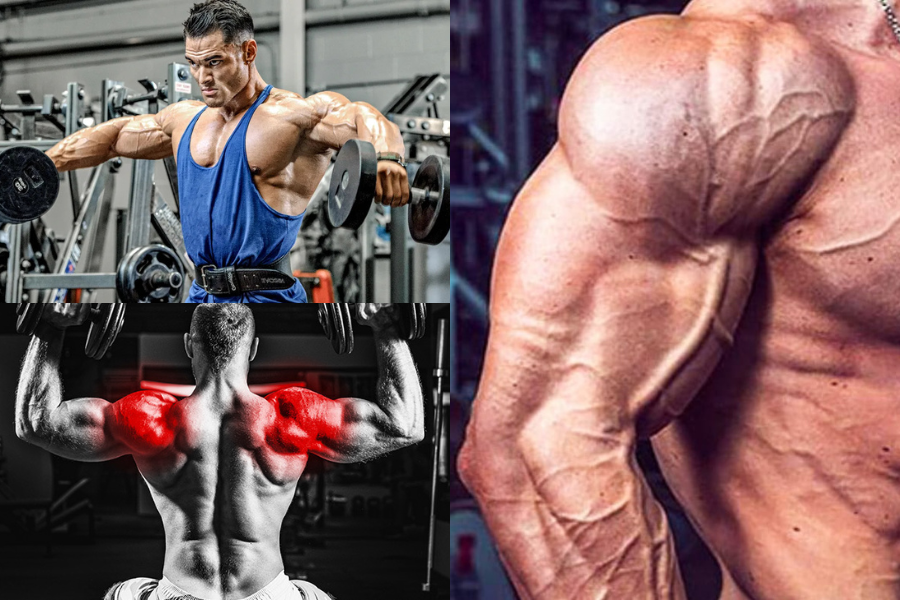
Discover the Most Effective Best Shoulder Workouts for Men
A strong shoulder workout does more than build wider shoulders. The best shoulder workouts for men also support healthy joints, better posture, and stronger lifts in every other part of your training. With a smart plan, you can build size and strength while protecting this complex joint from injury.
Below, you will learn how your shoulder muscles work, which exercises deserve a spot in your routine, and how to put them together into effective workouts you can follow right away.
Understand your shoulder muscles
Before you load up a bar, it helps to know what you are training. Your shoulder is one of the most mobile joints in your body, which is great for lifting, throwing, and pressing, but it also means you need balanced strength around it.
Key muscles you are working in a shoulder workout include:
- Deltoids: front (anterior), middle (lateral), and rear (posterior) heads that lift your arm in different directions
- Rotator cuff: small stabilizing muscles that keep your upper arm centered in the shoulder joint
- Trapezius: upper and mid back muscles that help raise and rotate your shoulder blades
- Rhomboids: muscles between your shoulder blades that pull them together
- Serratus anterior: muscles along your ribs that help control your shoulder blade position
Your deltoid is the main mover in most pressing and raising exercises, but the other muscles keep your joint stable and healthy. The best shoulder workouts for men do not just hammer front delts. They also train the lateral and rear delts, traps, and rotator cuff so your shoulders look broad, feel strong, and stay resilient.
Warm up and protect your joints
A cold, stiff shoulder is far easier to injure than one that is warm and activated. Because you use your shoulders in so many movements, they are worth a few extra minutes of prep.
Orthopedic specialists like Dr. Kade McQuivey from Banner Health stress that exercises targeting the rotator cuff help strengthen the shoulder and prevent injuries in activities that involve repetitive or overhead motions, especially when paired with proper form and technique. Regular conditioning with resistance bands and light dumbbells is a simple way to build that joint strength and stability.
Simple warm up sequence
Before heavy pressing, spend 5 to 10 minutes on:
- Dynamic mobility
- Arm circles (small to large, both directions)
- Shoulder rolls forward and backward
- Light band pull-aparts to open your chest
- Rotator cuff activation
- Overhead band press: 2 sets of 15 reps, holding each rep at the top for about three seconds
- External rotations with a light band, keeping your elbow close to your side
- Light ramp-up sets
- Start your main press with very light weight and higher reps before moving to your working sets
During your workout, focus on stable arms, no elbow locking at the top, and controlled movement. Dr. McQuivey highlights that correct shoulder rotation and elbow angles during lifts and throws are crucial to avoid joint strain.
Focus on big compound shoulder exercises
Compound exercises form the foundation of the best shoulder workouts for men. These moves let you lift heavier weights, hit multiple muscles at once, and build overall upper body strength.
Overhead shoulder press
The overhead shoulder press is one of the best all-around shoulder builders. It primarily hits the front delts but also works the lateral delts, traps, triceps, and upper chest. You can perform it seated or standing, using dumbbells or a barbell.
Basic setup:
- Stand tall, core braced, feet around shoulder-width apart
- Hold the weight at shoulder height with your wrists stacked over your elbows
- Press up in a controlled path until arms are nearly straight, but do not lock out hard
- Lower under control to just below chin level
Aim for 3 to 4 sets of 6 to 10 reps using a weight you can press with smooth form.
Push press
The push press is a powerful variation that uses leg drive to help you move heavier loads. Because you can handle more weight and perform more reps, it is excellent for strength and muscle gain in your delts, triceps, and upper chest.
How to use it in your workout:
- Perform 3 to 4 sets of 6 to 8 reps
- Place it first after your warm up so you are fresh and explosive
Military press
The military press is a stricter version of the overhead press. Traditionally done with a barbell and your feet close together, it demands serious full-body tension and core strength.
You can program the military press in two main ways:
- For strength: 5 sets of 5 reps
- For size: 3 to 4 sets of 6 to 10 reps
Dumbbell variations often show higher muscle activation because each arm works independently and your stabilizers have to work harder. In both cases, keep your ribs down and hips neutral so your lower back does not over-arch.
Landmine press
If you have shoulder mobility issues or past injuries, the landmine press can be a joint-friendly alternative. Here you press a barbell anchored at one end, which creates a diagonal pressing path that typically feels more natural and less stressful on the shoulder joint.
Because it emphasizes the front and lateral delts with less discomfort for many lifters, it is a smart option for higher-rep hypertrophy sets, such as 3 to 4 sets of 10 to 12.
Add key isolation moves for shape
Once your heavy compound work is done, isolation exercises let you focus on specific heads of the deltoid and supporting muscles. This is where you refine shoulder shape, create that V-taper, and address weak points.
Lateral raises for width
Lateral raises target your lateral delts, the “caps” that create broad, rounded shoulders. Lighter weights and controlled reps work best.
Execution tips:
- Slight bend in your elbows
- Raise the dumbbells to just below shoulder height
- Lead with your elbows, not your hands
- Avoid swinging or using your lower back
Stick to 8 to 12 controlled reps per set. The goal is a smooth lift and slow lowering, not maximum weight.
Rear delt flys and face pulls
Rear delts and upper back muscles are easily neglected but crucial for posture and shoulder health. Rear delt flys and face pulls target the rear delts, traps, and rhomboids, all of which help balance your pressing volume.
These exercises can:
- Improve your posture by pulling your shoulders back
- Enhance pulling strength
- Make your shoulders look fuller from every angle
A cable or band face pull with a focus on squeezing your shoulder blades together at the peak is especially effective.
Arnold press
The Arnold press, popularized by Arnold Schwarzenegger, is a twist on the dumbbell press that rotates your arms through a large range of motion. You start with palms facing you and elbows in front, then rotate your palms outward as you press overhead.
Because it works both front and side delts and challenges the rotator cuff through that rotation, it is excellent early in your workout. A pyramiding rep scheme such as 12, 10, 8, and 6 reps over four sets lets you progressively increase weight and effort.
Rear delt rows and cable laterals
Rear delt rows, performed by rowing with your elbows flared out, can activate the rear and middle delts even better than some presses and lateral raise variations. They are ideal after your main presses for 8 to 12 or more reps per set.
Bent over single-arm cable laterals are another precise way to hit the rear delts. The constant cable tension gives a deep stretch and strong contraction while helping your core stay engaged for stability.
Train through the full range of motion
To build impressive shoulders, you want more than simply moving weight up and down. Your shoulder workouts should include exercises that load your muscles in the stretched and contracted positions, as well as some explosive work so the entire shoulder girdle stays powerful.
A “perfect” shoulder session aims to:
- Fully activate the front, middle, and rear delts
- Include at least one heavy overload movement
- Train through a long range of motion, including a good stretch at the bottom
- Add some faster or more explosive work when appropriate
Tri-sets using a cable machine for rear, middle, and front delt raises, starting with your arm slightly behind your body, are a useful way to build that stretch-focused training. For example, you could perform:
- Rear lateral raise
- Middle delt raise
- Front delt raise
Do 2 to 3 rounds of 7 reps each movement, focusing on a smooth stretch and controlled squeeze.
For explosive training, you can pair heavy cheat lateral raises with a push press. Use a slightly heavier weight than usual on lateral raises, then immediately follow with a dumbbell push press to technical failure. Three supersets per arm will challenge the entire shoulder complex, including supporting muscles.
Example shoulder workouts for men
To put everything together, here are two sample sessions. Use one or rotate both through your week.
Hard and heavy shoulder workout
This workout suits you if you enjoy lifting heavy and want a focus on power and strength with added size.
- Warm up and rotator cuff activation
- Push press: 3 to 4 sets of 6 to 8 reps
- Barbell or dumbbell overhead press: 4 sets of 8 to 10 reps
- Lateral raises: 3 sets of 10 to 12 reps
- Rear delt rows: 3 sets of 10 to 15 reps
- Shrug or trap finisher: 2 to 3 sets of 12 to 15 reps
Rest 90 to 120 seconds between heavy sets and about 60 seconds between isolation sets.
Hypertrophy and joint-friendly shoulder workout
If you want muscle growth with more moderate loads and gentler joint angles, try this structure.
- Warm up with dynamic stretches and band work
- Landmine press or Arnold press: 4 sets of 8 to 12 reps
- Seated dumbbell military press: 3 sets of 8 to 10 reps
- Lateral raises: 3 sets of 12 reps, slow and controlled
- Face pulls: 3 sets of 12 to 15 reps
- Bent over single-arm cable laterals: 2 to 3 sets of 12 reps per arm
Aim for 9 to 15 total working sets for shoulders across the week to balance growth and recovery. Focus on progressive overload, such as adding a small amount of weight, extra reps, or an extra set over time.
Train shoulders at home with simple equipment
If you train at home, you can still follow the same principles using compact gear. Resistance bands with handles and door anchors let you work pushdowns, curls, rows, chest presses, abs, and shoulder movements in a small space. Products like the Twister Arm Trainer and EAST MOUNT Twister Arm Exerciser offer adjustable resistance ranges that target your shoulders, arms, and chest and can be used for progressive upper body strength.
For heavier home training, you might consider a shoulder press machine like the Mikolo Deltoid and Shoulder Press Machine or weighted tools such as an adjustable macebell or clubbell system. These setups are designed to build shoulder, grip, and forearm strength in a way that mimics real-world movement patterns.
Whatever equipment you choose, the same rules apply: warm up thoroughly, prioritize form, and build up resistance gradually.
Strong, balanced shoulders are built over months, not days. Consistency with smart programming will always beat one “perfect” workout done once.
Key takeaways and next steps
- Target all three deltoid heads plus your rotator cuff, traps, and upper back for size, strength, and injury prevention
- Start each workout with a warm up that includes dynamic stretches and light band work for your rotator cuff
- Base your routine around compound presses, such as overhead presses, push presses, and landmine presses
- Add isolation work for lateral and rear delts, including lateral raises, rear delt flys, face pulls, and rear delt rows
- Train in the 8 to 12 rep range at about 70 to 80 percent of your one-rep max for muscle growth, and use progressive overload to keep improving
Pick one of the sample workouts and commit to it for the next 6 to 8 weeks. Track your weights, reps, and how your shoulders feel. With steady effort and careful attention to form, you will see broader, stronger, and more resilient shoulders looking back at you in the mirror.
About The Author





