Hamstring Muscle Strengthening Exercises to Boost Your Strength
A strong pair of hamstrings does much more than help you sprint faster. When you build them up with smart hamstring muscle strengthening exercises, you support your knees, hips, and lower back, and you move with more power and control in almost everything you do.
Below you will find a practical guide to what your hamstrings actually do, how to tell if they are weak, and simple routines you can use at home or in the gym to strengthen them safely.
Understand why hamstrings matter
Your hamstrings are a group of three muscles at the back of each thigh, the biceps femoris, semitendinosus, and semimembranosus. Together, they bend your knee and extend your hip, which makes them essential for walking, running, squatting, and stabilizing your pelvis during everyday tasks.
When these muscles are weak, several problems can show up:
- Extra strain on your lower back, hips, and knees
- A higher risk of hamstring pulls and tears that heal slowly, as highlighted by ACE Physical Therapy, LLC
- Knee instability and changes in your walking pattern
- Reduced performance in moves that require power, like running, jumping, and squatting
Many people, especially athletes, unintentionally prioritize their quadriceps and glutes and skip focused hamstring training. Over time, that imbalance can make your knees feel cranky and your hips less stable.
If you want smoother, safer movement, your hamstrings deserve as much attention as your more visible front-of-thigh muscles.
Spot the signs of weak hamstrings
Before you jump into hamstring muscle strengthening exercises, it helps to know whether your hamstrings are underperforming.
Common signs of weakness include:
- A dull ache under your buttocks or at the back of your thigh during or after activity
- Feeling unstable or wobbly when you run downhill, decelerate quickly, or change direction
- Less range of motion when you bend forward, often with a tugging sensation behind the knees
- Tightness that never seems to improve, even when you stretch regularly
Physical therapist Dr. Julie Ann Aueron notes that normal hamstring length is often assessed by lying on your back, flexing your hip to 90 degrees, and trying to straighten your knee. If this feels extremely tight or painful, your hamstrings may need daily stretching and strengthening to catch up.
The good news is that consistent, targeted training can improve both strength and flexibility so that your hamstrings support you instead of holding you back.
Choose the right types of exercises
Not all hamstring exercises work your muscles in the same way. To build strong, balanced hamstrings, you want a mix of movements that target both major functions, bending the knee and extending the hip.
Knee flexion focused moves
These involve curling your heel toward your glutes. Traditional options include:
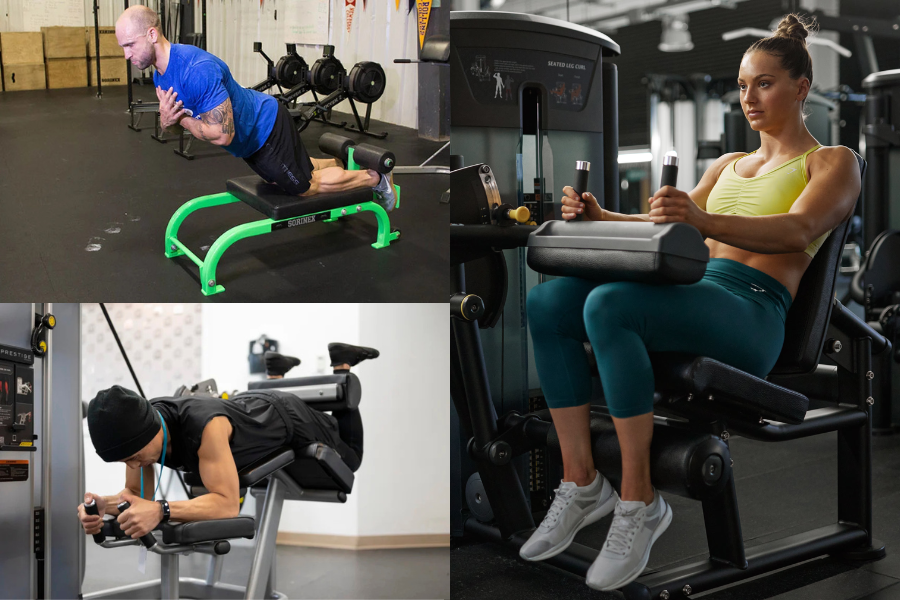
- Machine hamstring curls
- Lying or seated resistance band curls
- Glute-ham curls on a ball or bench
A 2018 study from the University of Wisconsin–La Crosse found that the prone leg curl machine produced relatively equal activation of the biceps femoris and semitendinosus in resistance trained adults, making it a very efficient choice if you have access to a gym.
Hip extension focused moves
These emphasize driving your hips back and forward:
- Romanian deadlifts (RDLs)
- Kettlebell swings
- Good mornings
- Hip extension at about 45 degrees of hip flexion
Hip extension at around 45 degrees of hip flexion helps recruit the entire hamstring group more symmetrically. This is especially helpful if you have a history of recurring hamstring strains.
The American Council on Exercise has highlighted kettlebell swings and single-arm or single-leg Romanian deadlifts as highly effective because they activate the hamstrings to a similar degree as the prone leg curl machine in electromyography testing.
Multi-joint and specialty moves
Some exercises challenge the hamstrings at both the hip and knee joints, which makes them particularly valuable:
- Nordic hamstring curls
- Hip thrust variations
- Stability ball leg curls
Nordic curls specifically bias the semitendinosus muscle, which plays a key role in stabilizing your knee and protecting the ACL. This is promising if you are recovering from or trying to prevent ACL issues.
By mixing these different categories, you give all three hamstring muscles a reason to adapt, instead of overloading just one area.
Start with beginner friendly hamstring exercises
If you are new to strength training or coming back from a layoff, begin with simple hamstring muscle strengthening exercises that feel stable and easy to control. Focus on slow, smooth reps and good positioning rather than heavy resistance.
1. Glute bridges
Glute bridges are a gentle way to wake up your hamstrings and glutes together.
- Lie on your back with knees bent and feet hip width apart.
- Brace your core, press through your heels, and lift your hips until your body forms a straight line from shoulders to knees.
- Pause for one to two seconds at the top, then lower with control.
Aim for 2 to 3 sets of 10 to 15 repetitions. Over time, you can progress to single-leg bridges to further challenge the hamstrings.
2. Bodyweight Romanian deadlifts
You can practice the movement pattern without weights at first.
- Stand tall with feet about hip width apart and a slight bend in the knees.
- Hinge at your hips by sending them back, keep your back flat and spine neutral.
- Lower your torso while keeping the weight in your heels until you feel a stretch in your hamstrings, then squeeze your glutes to return to standing.
Start with 2 sets of 8 to 10 reps, going only as low as you can while maintaining a flat back.
3. Donkey kicks
Donkey kicks isolate one hip at a time and help you feel your hamstrings and glutes doing the work.
- Begin on hands and knees, wrists under shoulders and knees under hips.
- Brace your core, then lift one foot toward the ceiling by driving your heel up. Keep your knee bent at 90 degrees.
- Pause briefly, lower slowly, and repeat all reps on one side before switching.
Try 2 sets of 12 to 15 reps per leg. Focus on small, controlled movements instead of swinging your leg.
Progress with resistance bands at home
Resistance bands are one of the most practical tools for hamstring training at home or while traveling. They simulate gym machines by applying continuous, variable tension, so your muscles work harder through the entire range of motion.
Bands also make progressive overload simple. You can move from lighter bands around 20 to 35 pounds of resistance up to heavier ones near 150 pounds as you get stronger, which supports ongoing strength and muscle gains.
A few effective banded hamstring exercises include:
- Lying hamstring curl with a band anchored near your feet
- Seated hamstring curl by looping a band around your heels and a stable object
- Band Romanian deadlift by standing on the band and holding the ends
- Band pull through by anchoring the band behind you and hinging at the hips
- Band donkey kickback using a hip band around your thighs
A typical at home session might look like this:
Perform 2 to 3 sets of 8 to 15 reps for 3 different band exercises, resting 60 to 90 seconds between sets. Train twice per week with at least 48 hours between sessions so your hamstrings can recover and adapt.
Resistance band guides from companies such as Gymreapers highlight that this style of training is affordable and accessible while still allowing serious hamstring development.
Try intermediate gym based hamstring moves
Once you are comfortable with basic movement patterns and band work, you can add more challenging hamstring muscle strengthening exercises in the gym. These moves load the muscles more heavily and can give you noticeable strength and size gains.
Romanian deadlifts with weight
Romanian deadlifts are one of the best all around hamstring builders when performed with good form.
- Stand with a barbell or pair of dumbbells held in front of your thighs.
- Keep a soft bend in your knees and hinge at the hips, sliding the weight down your legs.
- Stop when you feel a strong stretch in your hamstrings, usually just below the knees.
- Squeeze your glutes and hamstrings to return to standing, and do not round your back.
Surrey Physio recommends starting the movement from around knee height and focusing on squeezing your shoulder blades at the top. Try 3 sets of 10 to 12 reps with a weight that feels challenging in the last few reps while still allowing good technique.
Kettlebell swings
Kettlebell swings add a power component while heavily recruiting your hamstrings.
- Stand with feet slightly wider than hip width and a kettlebell about a foot in front of you.
- Hinge at the hips, grab the handle, and hike the kettlebell back between your legs.
- Drive your hips forward explosively to swing the weight up to chest height, arms relaxed.
- Let the kettlebell swing back down and repeat in a smooth rhythm.
The American Council on Exercise found that kettlebell swings can activate the hamstrings to a level comparable to prone leg curls, which makes them an efficient choice if you want both conditioning and strength.
Machine or banded curls
If you have access to a leg curl machine, prone and seated leg curls allow you to isolate the hamstrings more directly. The University of Wisconsin–La Crosse study noted that prone leg curls provide balanced activation of both biceps femoris and semitendinosus, which is useful when you want even development.
If you do not have a machine, band hamstring curls can be a strong substitute. Some people find that band curls cause cramping at first, so start with fewer reps, for example 2 sets of 10 to 12, and gradually build to 3 sets of 12 to 14 as your muscles adapt.
Add advanced options carefully
If you are already lifting regularly and want to further challenge your hamstrings, you can layer in more demanding exercises. These are not necessary for beginners, but they can be valuable tools when introduced gradually and with good supervision.
Nordic hamstring curls
Nordic curls put a high load on the hamstrings, especially the semitendinosus, which supports knee stability and ACL protection.
- Kneel on a soft surface. Have a partner hold your ankles or anchor them under a sturdy object.
- Cross your arms over your chest and keep your body straight from head to knees.
- Slowly lean forward, resisting with your hamstrings as long as you can.
- Catch yourself with your hands and use them to help push back up.
Because these are intense, start with a very small volume, such as 1 set of up to 10 controlled reps one or two times per week.
Higher volume hamstring days
If your hamstrings chronically lag behind the rest of your legs, you can dedicate a session specifically to them. Some coaches recommend a structure like:
- 4 sets of Romanian deadlifts
- 4 sets of lying leg curls or banded curls
- 4 sets of seated leg curls or another curl variation
This puts you at about 12 total sets, which is a solid stimulus for growth if you focus on steady progression in weight or reps over the weeks. Be sure to balance this with appropriate quad and glute work so that your legs stay well aligned and your knees feel supported.
Train smart to avoid injury
Hamstring work should make you stronger, not sidelined. A few simple habits will help you stay on the safe side as you add hamstring muscle strengthening exercises to your routine.
First, always warm up with light cardio and dynamic leg movements before heavy work. Then, during each exercise, brace your core and engage your glutes so your hamstrings do not have to compensate for a sloppy spine position. Research from ACE Physical Therapy notes that proper form is essential and that it is acceptable to start with a slightly limited range of motion and gradually expand it as you gain control.
Second, progress slowly. Increase reps, sets, or resistance in small steps, give yourself at least 48 hours between dedicated hamstring sessions, and keep one or two rest days in your weekly plan.
Third, pay attention to your overall recovery. A balanced diet that includes fruits, vegetables, lean protein, and whole grains supports muscle repair and helps you maintain a healthy body weight, which reduces unnecessary stress on your knees, hips, and back.
Hamstrings that are both strong and mobile are your best defense against pulls, strains, and everyday aches. Start with a couple of the exercises above this week, keep the movements controlled and consistent, and you will gradually feel more power and stability every time you walk, climb stairs, or push yourself in a workout.
About The Author


