Transform Your Body With a Simple Glute Workout Routine
A consistent glute workout routine can do more than change how your jeans fit. Strong glutes support your posture, protect your lower back, and power everyday movements like climbing stairs, running, and lifting. With the right mix of exercises, frequency, and recovery, you can build a stronger lower body without spending hours in the gym.
Below, you will learn how to structure a simple, effective glute workout routine you can actually stick with.
Understand your glute muscles
Before you start, it helps to know what you are training. Your glutes are not just one muscle, they are a trio that work together.
The three-part glute team
You have three main glute muscles:
- Gluteus maximus, the largest muscle that drives hip extension, like when you stand up from a squat or push your hips up in a bridge
- Gluteus medius, located on the outer side of your hip, which stabilizes your pelvis when you walk, run, or stand on one leg
- Gluteus minimus, the smallest and deepest muscle that assists with hip stability and rotation
These muscles are the largest muscle group in your body and are essential for functional movement, posture, and back support. When you train all three, you not only shape your glutes, you also help your body move better and feel more stable in daily life.
Set realistic goals for your routine
Your glute workout routine will look different depending on what you want to achieve and how often you can train.
If you want visible growth and better strength, research and coaches generally recommend training your glutes around three days per week. Programs like the Women’s Health Glute Gains Challenge use three weekly strength sessions over six weeks to build stronger, bigger glutes, with some participants potentially adding up to an inch of muscle by the end of the program.
Think about your main focus:
- Aesthetic changes like more lift and shape
- Performance improvements like running faster or jumping higher
- Pain prevention and better posture, especially if you sit a lot
Your goal will guide how heavy you lift, how many reps you do, and how often you train.
Build a simple weekly glute workout routine
You do not need a complex plan to see progress. A straightforward weekly structure works well for most people.
How often to train
For optimal glute growth, trainers like Sandy Brockman recommend working your glutes three days per week. This frequency is high enough to stimulate growth, but still allows for recovery if you spread sessions across the week.
A simple schedule could look like:
- Day 1: Heavy strength focus
- Day 2: Lighter, higher rep and lateral work
- Day 3: Mixed strength and power
Make sure you leave at least one rest day between heavy sessions. Guidance from coaches like Adam Rosante and brands like Glute God emphasizes taking two to three days of rest between very demanding lower body days so your muscles can recover and grow.
Why once a week is not enough
Training your glutes only once a week is usually not enough for noticeable change, especially if you sit a lot during the day. Consistent, strategic training two to three times per week is far more effective for building strength and size without overtraining.
Warm up and activate your glutes
Your warm up is not optional for glute training. Because long periods of sitting can weaken your glutes and tighten your hip flexors, jumping straight into heavy lifts can leave your glutes “asleep” and shift the work to your quads or lower back.
Start with general movement
Begin with about 5 minutes of light cardio to get your heart rate up and blood flowing. You can:
- Walk quickly
- Jog lightly
- Cycle at an easy pace
Follow that with dynamic stretches like leg swings or hip circles to open your hips and counteract tightness.
Add glute activation drills
Glute activation means intentionally squeezing your glutes so you feel them working before you start lifting. Programs like Bootycamp build this into every session with drills such as:
- Band walks
- Clamshells
- Glute pulses
Brands like Gymshark also recommend activation exercises like lateral band walks, banded glute bridges, and kickbacks. These moves establish a strong mind muscle connection so your glutes actually do the work in your main lifts.
Spend 5 to 10 minutes here and focus on feeling your glutes contract, not just rushing through the motions.
Learn beginner glute exercises
If you are new to strength training or returning after a break, start with bodyweight or light resistance. The aim is to build control, not chase heavy weights right away.
Beginner-friendly moves
Good beginner glute exercises include:
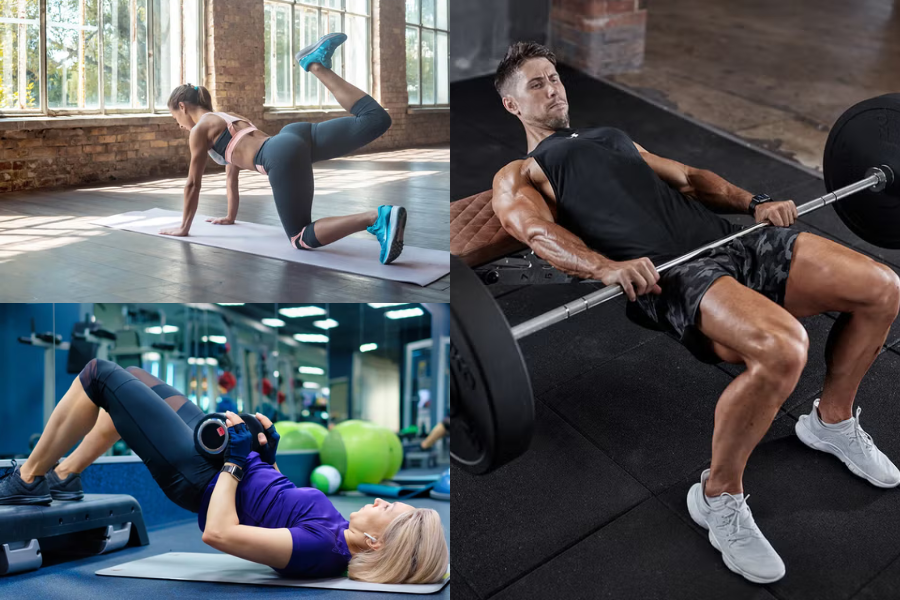
- Glute bridge on the floor
- Reverse lunge
- Basic squat
- Floor hip extension (on hands and knees, extending one leg back)
Each of these teaches you to hinge at the hips, keep your core engaged, and feel your glutes fire. Move slowly, keep your knees in line with your toes, and avoid arching your lower back at the top of each rep.
You can build a simple beginner circuit by picking three of these moves and doing 2 to 3 sets of 10 to 12 reps each, two to three times per week.
Progress to intermediate glute workouts
Once bodyweight moves feel solid and you can hold form easily, you can add resistance and more challenging variations.
Add load and complexity
Intermediate glute exercises that build strength and stability include:
- Bulgarian split squats
- Sumo squats with a kettlebell
- Single leg glute bridge pulses
- Donkey kicks
- Kettlebell swings
These moves introduce unilateral work, where one leg works at a time, which is excellent for balance and hip stability. They also reinforce the hip hinge pattern that keeps your lower back safe.
Aim for 3 sets of 8 to 12 reps with a weight that feels challenging by the last few reps but does not break your form.
Try advanced glute workout options
If you are more experienced and comfortable with free weights, you can move into heavier, more advanced glute training. This is where you focus on heavier loads and explosive power.
Heavy lifts and power moves
Advanced exercises for glute strength and size include:
- Barbell hip thrusts
- Barbell lunges
- Stiff leg deadlifts or Romanian deadlifts
- Hill sprints
- Sliding leg curls
These moves target your posterior chain, especially the glutes and hamstrings, and can improve athletic performance and posture. Studies up to 2019 show that many bilateral exercises like deadlifts, squats, lunges, and split squats elicit very high gluteus maximus activation levels greater than 60 percent of maximal voluntary isometric contraction, which makes them excellent choices for glute strength.
The barbell hip thrust and its variations are especially effective. Research has found that even relatively low loads, around 36 to 40 percent of your one rep max, can produce high glute activation. Foot positioning, such as slight external rotation or hip abduction at about 30 degrees, can further influence how much your glutes fire.
For hypertrophy, guidance from Gymshark suggests performing 8 to 12 reps per set at about 60 to 80 percent of your one rep max on these compound lifts. Heavier sets such as 5 sets of 5 reps at 80 to 90 percent can also help build strength, as long as your technique is solid.
Focus on compound glute exercises
Compound exercises work multiple joints and muscle groups at once, so you get more overall benefit per set. They should be the backbone of your glute workout routine.
Key compound moves to prioritize
Six powerful compound exercises for glute development include:
- Barbell hip thrusts
- Back squats
- Front squats
- Bulgarian split squats
- Conventional deadlifts
- Romanian deadlifts
These lifts train your glutes through hip extension and, in some cases, deeper ranges of motion. Research on squat variations shows that barbell position, stance width, and squat depth all influence glute activation. Deeper squats may induce greater functional and hypertrophic gains for many lifters.
Step up variations are also very effective. Studies up to 2019 found that step ups, including lateral, diagonal, and cross over versions, produced some of the highest gluteus maximus activation levels due to the stabilization demands of standing on one leg.
Try centering each workout around 2 of these compound moves, then add 1 to 2 smaller isolation exercises if you have time.
Do not skip isolation and lateral work
While heavy compound lifts are vital, they do not always fully target the glute medius and minimus, which help with hip stability. That is where isolation and lateral movements come in.
Target all three glute muscles
To train the entire glute complex, add exercises such as:
- Banded side steps or lateral walks
- Clamshells
- Single leg bridges
- Cable kickbacks or banded kickbacks
- Frog pumps
Experts like Glute God emphasize that training all three glute muscles is key, not just loading heavy hip thrusts or squats. High rep, light resistance work with bands can fully wake up your glutes and prepare them for heavier lifts. Aim for sets of 15 to 20 reps here, with a strong squeeze at the top of each rep.
Use the mind muscle connection
How you do your reps matters as much as which exercises you choose. Rushing through sets without feeling your glutes work leads to wasted effort.
Practice intentional contractions
The mind muscle connection means you are mentally focused on the muscle you are trying to train. During glute exercises, consciously squeeze your glutes and imagine them doing the lifting rather than your quads or lower back.
Guidance cited by Glute God, based on research from the European Journal of Sports Science, suggests that actively contracting your glutes and holding the contraction for about one second at the top of each rep can significantly increase muscle activation and gains.
This could mean:
- Pausing for one second at the top of a bridge or hip thrust
- Squeezing your glutes hard at the top of a squat before lowering again
- Pushing the floor away and driving through your heels on lunges and deadlifts
Slow your reps slightly so you can feel each phase of the movement.
Apply progressive overload safely
Progressive overload is the process of gradually making your workouts more challenging so your muscles keep adapting. Without it, your progress will stall even if you do the “right” exercises.
Ways to increase the challenge
You can create progressive overload in several ways, as highlighted by brands like Gymshark and programs that track weights and reps:
- Increase the weight on your lifts
- Add more reps or sets over time
- Slow down the lowering phase to increase time under tension
- Reduce rest periods slightly between sets
You do not need to change everything at once. Pick one variable at a time and track what you do so you can see clear improvements from week to week.
At the same time, avoid jumping up in weight so quickly that your form breaks. Poor form and limited range of motion, like shallow squats or half rep hip thrusts, reduce glute activation and increase your risk of injury. Trainer supervision or filming your lifts can help you stay honest about your technique.
Respect rest and recovery
Muscles grow when you rest, not while you are lifting. Ignoring recovery is one of the quickest ways to stall your glute gains.
Plan rest days
Experts like Glute God and Adam Rosante recommend at least one rest day between heavy glute sessions, and often two to three days before working the same muscle group hard again. If you are very sore or notice your performance dipping, it can be a sign you need more recovery.
On rest or lighter days, focus on:
- Walking
- Gentle yoga
- Easy cycling or jogging
These active recovery options keep blood flowing without overtaxing your glutes, which can help them repair and grow.
Getting enough sleep and fueling your body with adequate protein and overall calories will also support muscle growth. Even the best glute workout routine will not deliver if your body does not have the resources to rebuild.
Put it all together
If you want a simple way to start, you can combine everything here into a basic three day glute focused week:
- Warm up with light cardio, dynamic stretches, and 2 to 3 activation drills
- Choose 2 compound lifts such as squats, deadlifts, or hip thrusts
- Add 1 to 2 isolation or lateral exercises like band walks or clamshells
- Focus on 8 to 12 controlled reps for most sets, with a strong squeeze at the top
- Increase the challenge slightly from week to week
With consistency and attention to form, this structure will help you build stronger, more powerful glutes that support everything else you want to do in the gym, and outside of it.
About The Author


