Transform Your Shape with the Best Glute Workout for Women
A strong, well shaped butt is about much more than looks. The right glute workout for women can improve your posture, protect your back, boost athletic performance, and make everyday movements feel easier. With a bit of consistency, you can build glutes that are powerful, stable, and noticeably more lifted.
Below, you will learn what your glute muscles do, why they matter for your whole body, and how to structure a simple, progressive glute training plan you can actually stick with.
Understand your glute muscles
Your glutes are not just one muscle. You have three that work together every time you walk, stand up, or climb stairs.
The three main glute muscles
- Gluteus maximus: The largest muscle in your body and the primary driver of hip extension. It is responsible for most of your butt shape and the power you feel when you sprint or push up from a squat.
- Gluteus medius: Sits on the outer side of your hip and helps with hip abduction, or moving your leg out to the side. It keeps your pelvis level when you stand on one leg.
- Gluteus minimus: The smallest and deepest of the three. It assists the glute medius and helps stabilize your hip and pelvis.
These muscles are crucial for lower body strength and posture in women. They support your spine, hips, and knees during daily activities and workouts.
Why strong glutes matter for women
When your glutes are weak, other muscles step in to compensate. That often leads to:
- Tight hip flexors from too much sitting
- Poor posture and a forward tilted pelvis
- Extra strain on your lower back and knees
- Less power during sprints, jumps, and heavy lifts
Experts note that glutes act as a kind of gateway between your spine and lower legs, helping stabilize your upper body, pelvis, and hips whenever you walk, stand, or squat. If they are not doing their job, your entire movement pattern can be affected.
For women who are pregnant or planning pregnancy, strong glutes are even more helpful. Active glute muscles support the pelvic floor and may reduce the risk of back pain as your belly grows and your center of gravity shifts.
Spot the signs of inactive glutes
Before you dive into a tough glute workout, it helps to notice whether your glutes are actually firing.
You may have underactive glutes if you:
- Feel squats and lunges mostly in your quads or lower back
- Struggle to balance on one leg
- Notice your knees caving inward when you squat
- Constantly feel tightness in your hip flexors, quads, or hamstrings
Women who sit for long periods often develop low back pain because their inactive glutes allow the pelvis to shift forward and compress the lower back. If this sounds familiar, you are not alone, and you can change it with targeted training.
Activate your glutes before you train
Glute activation is a short warmup that helps you wake up the right muscles before your workout. It improves blood flow, creates a better mind muscle connection, and helps your glutes contribute more during every rep.
Simple glute activation sequence
Try this quick sequence before glute day or any lower body workout:
-
Glute bridges
Lie on your back with knees bent and feet flat, hip width apart. Press through your heels to lift your hips off the floor while you squeeze your glutes. Pause at the top for 2 seconds, then lower slowly. This move is a classic way to help you feel your glutes working before you add load. -
Lateral band walks
Place a looped resistance band around your lower thighs or ankles. Slightly bend your knees and take controlled steps to the side, keeping tension on the band. Your outer glutes should light up as you move. -
Banded clam shells
Lie on your side with knees bent and a band just above your knees. Keeping your feet together, open your top knee while you keep your hips stacked. Focus on squeezing through the outer hip and glute.
Spend about 5 to 8 minutes on these activation drills. You want your glutes to feel warm and engaged, not exhausted, before you start your main workout.
Build your glute workout for women
An effective glute workout for women includes three pieces: activation, strength work, and recovery. You do not need fancy machines to get results, but you do need consistency and progression.
How often to train your glutes
Many trainers recommend targeting your glutes 2 to 3 times per week with at least 24 to 48 hours of active recovery between sessions. This frequency gives your muscles enough stimulus to grow and enough time to recover.
Some glute specialists suggest that an optimal training range can go up to 6 days per week depending on your genetics, exercise selection, effort, and overall program design. For most women, especially if you are balancing other workouts, 2 to 3 dedicated glute days is a realistic and effective starting point.
Beginner bodyweight glute workout
If you are new to strength training or working out at home without equipment, bodyweight exercises are more than enough to build strength and shape.
Try this routine 2 to 3 times per week:
-
Air squats
3 sets of 10 to 15 reps
Stand with feet just wider than hip width. Sit your hips back and down like a chair, keep your chest lifted, and press through your heels to stand tall. -
Glute bridges
3 sets of 12 to 15 reps
Focus on driving through your heels and fully squeezing your glutes at the top of each rep. -
Split squats
3 sets of 8 to 10 reps per leg
Take a staggered stance, one foot forward and one back. Lower your back knee toward the floor while keeping your torso upright, then push through the front heel to stand. -
Curtsy lunges
2 sets of 10 reps per leg
Step one leg diagonally behind you into a curtsy position. Bend both knees, then push through the front heel to come back up. -
Single leg Romanian deadlifts (RDLs)
2 sets of 8 reps per leg
Stand on one leg, hinge at your hips while sending the other leg back, and lower your torso until you feel a stretch in your hamstring. Squeeze your glute to return to standing.
These exercises target all three glute muscles. You can expect noticeable changes in strength and shape in roughly six weeks if you train at least twice per week and support your workouts with enough protein and recovery.
Intermediate dumbbell and band workout
Once bodyweight feels easy, add resistance bands or dumbbells to keep progressing. Progressive overload, increasing reps, load, or time under tension, is essential for continued glute growth.
Here is a sample intermediate workout:
-
Dumbbell squats or heel raised squats
3 sets of 8 to 12 reps
Hold dumbbells at your sides or at your shoulders. Elevating your heels slightly can help you sit deeper while keeping tension in your glutes and quads. -
Hip thrusts
3 sets of 8 to 12 reps
Rest your upper back on a sturdy bench or box, feet flat on the floor. Place a dumbbell or barbell across your hips. Drive through your heels to lift your hips, squeeze your glutes hard at the top, and lower with control. -
Reverse lunges
3 sets of 8 to 10 reps per leg
Step one foot back and lower into a lunge, then push through the front heel to return to standing. Holding dumbbells adds challenge and helps build strength and balance. -
Single leg Romanian deadlifts with dumbbells
3 sets of 8 reps per leg
This variation increases the challenge for your hamstrings and glutes while training balance and stability. -
Lateral band walks or banded crab walks
2 sets of 15 to 20 steps each direction
Use a resistance band around your legs to keep constant tension on your outer glutes.
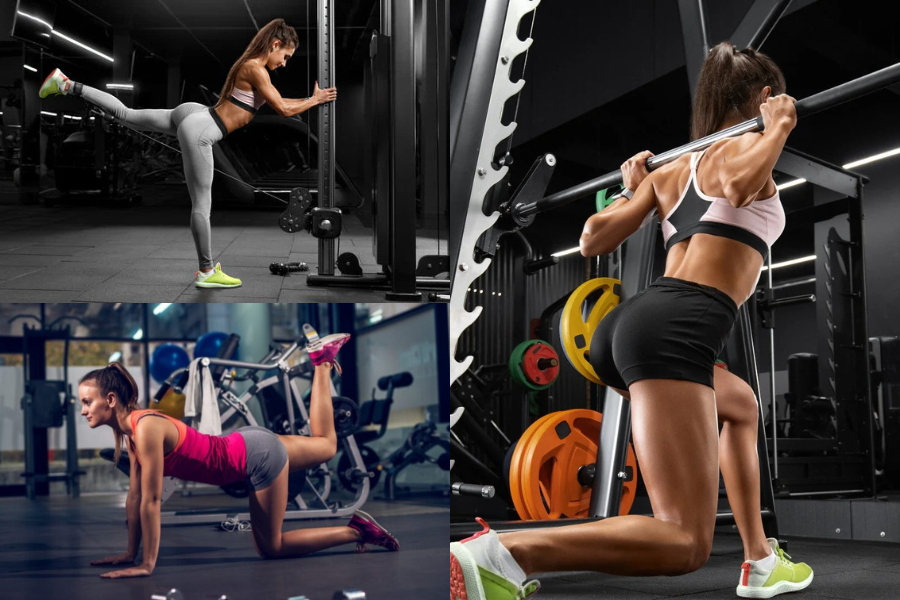
If you prefer machines, you can also combine lunges or squats with cable rows. Lowering the pulley increases glute and lower body activation, and pulling at an angle adds a bit of rotational stress that recruits more glute fibers.
Advanced glute training ideas
When you are comfortable with the basics, you can move into heavier lifts and more specialized exercises:
- Barbell hip thrusts with bumper plates for maximum gluteus maximus activation
- Barbell deadlifts and Romanian deadlifts for powerful posterior chain strength
- Bulgarian split squats with dumbbells for deep glute and quad work
- Cable hip abductions and side plank hip abductions to target the upper glutes
Targeting your upper glutes, especially the glute medius and minimus, helps create a lifted, rounded shape at the top of your butt. Single leg and abduction moves like lateral band walks, side planks with leg lifts, and walking lunges are particularly useful here.
If you train your upper glutes at least twice a week, and up to three times when possible, you can usually see visible changes in 4 to 8 weeks, with more dramatic results over 3 to 6 months depending on your genetics, nutrition, and how consistently you train.
Train glutes effectively at home
You do not have to belong to a gym to get a great glute workout. Many women see real size and strength gains using bodyweight and a couple of bands.
At home, focus on:
- Slow, controlled movements
- Engaging your core to avoid lower back strain
- Increasing difficulty over time with more reps, added holds, or stronger bands
Exercises like standing glute kickbacks, hip thrusts using a couch or bench, Bulgarian split squats, and banded clamshells are all easy to do in a small space. If you want more challenge, add dumbbells, a backpack filled with books, or a heavier band.
Support your glute growth with recovery
Your glutes grow when you rest, not while you are lifting. Training your glutes up to three times per week works best when you give equal attention to recovery.
Helpful recovery habits include:
- Stretching and light mobility work for hips after workouts
- Foam rolling tight quads, hip flexors, and glutes
- Drinking enough water throughout the day
- Getting quality sleep so your body can repair muscle tissue
- Eating enough protein and overall calories to support muscle growth
Many structured programs, like six week glute focused challenges, build in three strength sessions per week, each 45 to 60 minutes, with rest and lighter movement days in between. This kind of schedule is realistic and sustainable if you are juggling work, family, and other commitments.
If you stay consistent with 2 to 3 thoughtful glute workouts each week, use activation drills so the right muscles are firing, and gradually make your exercises more challenging, you can build stronger, more defined glutes in as little as a month or two.
Start where you are today. Pick one of the beginner or intermediate routines, add a simple warmup, and commit to it for the next four weeks. Your hips, back, and legs will feel the difference long before the mirror shows it, and that improved strength will carry into every part of your life.
About The Author