Simple Chest Exercises for Bigger Chest That Really Work
A bigger chest is not just about how much you can bench. The right chest exercises for bigger chest growth focus on form, angle, and consistency, not ego lifting. When you get those details right, you can add noticeable size and definition in a matter of weeks, even if you are a beginner.
Below, you will find simple, effective moves and clear instructions so you can feel your pecs working instead of your shoulders or elbows complaining.
Understand your chest muscles
Before you load the bar, it helps to know what you are trying to grow. Your chest is mainly made up of the pectoralis major, which has two key areas:
- The clavicular head, often called the upper chest
- The sternal head, often called the mid and lower chest
You build a fuller chest by training both areas through different angles and ranges of motion. Presses at a flat angle hit more of the mid and inner chest, while incline presses and certain fly movements shift more work to the upper chest, as explained in RP Strength’s 2024 chest training guide.
Your goal is not to rush heavier weight. Your goal is to move your chest through a full range of motion, stretch the muscle under control, and then press or squeeze hard on the way up.
Warm up properly before you press
Cold muscles are tight muscles. Tight muscles are easier to strain. A short warm up makes your workouts safer and more productive.
Start each chest session with 5 to 10 minutes of:
- Light cardio, such as brisk walking or cycling
- Dynamic arm swings and shoulder circles
- Gentle band pull-aparts or very light cable rows
Then do 2 light sets of a pressing movement with very easy weight. Focus only on control, shoulder comfort, and feeling your pecs switch on. This improves flexibility and range of motion, and it reduces your risk of sprains or tears once the sets get harder.
Master your bench press form
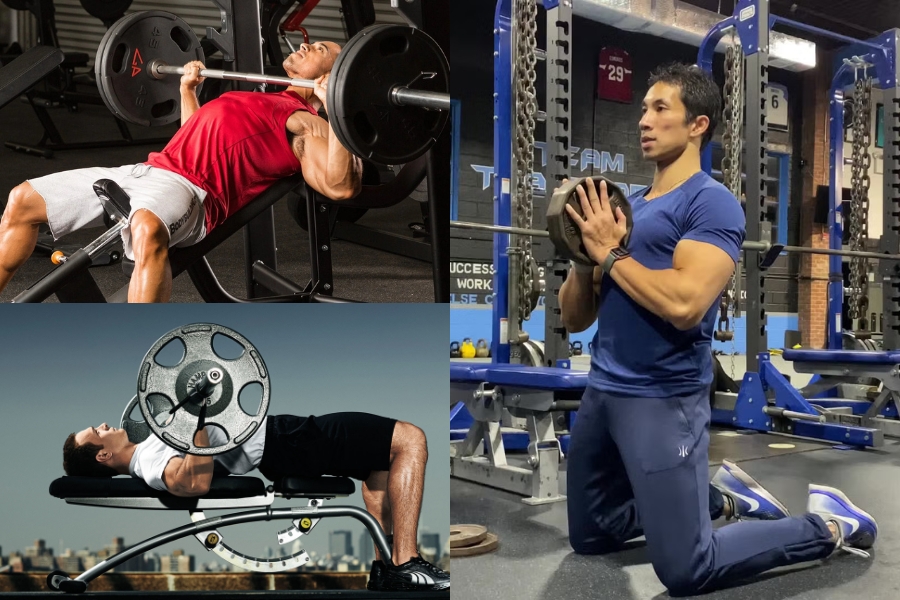
The bench press is a staple in almost every chest workout, and it deserves its place. It lets you use heavy weight, it targets the entire chest, and it also involves the front of your shoulders and triceps for extra strength. To make it a true chest builder instead of a shoulder wrecker, pay close attention to technique.
Set your shoulder blades first
Lie flat on the bench with your feet planted firmly on the floor. Before you touch the bar, pinch your shoulder blades together as if you are trying to hold a pencil between them. This is called scapular retraction.
This stable base helps you:
- Protect your shoulders
- Keep the chest lifted and engaged
- Reduce the urge to push mostly with your arms
Once your shoulder blades are set, they should stay that way throughout the set.
Find the right elbow angle
A common beginner mistake is flaring the elbows straight out at 90 degrees from your torso. This puts a lot of stress on your shoulders and takes tension off the chest.
Instead, aim for about a 45 degree angle between your upper arm and your torso. From above, your arms will look like they are halfway between tucked and flared. This position lets you:
- Use more chest and lat muscle
- Reduce shoulder pain
- Perform more reps with better control
Lower the bar to your mid chest or lower chest, touch lightly, then press up while keeping that elbow angle consistent.
Use a full range of motion
You might see lifters doing half reps with big weights, but that is not ideal for muscle growth. For hypertrophy, full range of motion is key.
Bring the bar all the way down to touch your chest under control. With dumbbells, lower until your hands drop slightly below shoulder level. Avoid bouncing the weight. Deep, controlled reps create a strong stretch under load, which is a major signal for growth, and they can actually be safer for your joints than short, choppy movements.
Add dumbbell presses for stability and stretch
Barbells are great for pushing heavy loads, but dumbbells give you freedom of movement and a bigger stretch. Many lifters find dumbbell presses easier on their shoulders and better for feeling the chest work.
Because each arm moves independently, dumbbells also force your smaller stabilizing muscles to work harder. This helps you build balanced strength on both sides, instead of letting your stronger arm quietly take over.
Use the same 45 degree upper arm angle you use on the barbell bench. Start with the dumbbells directly above your chest, palms facing forward or slightly in, then lower slowly until your hands are a little lower than your chest line. Press back up while squeezing your pecs together at the top.
Use incline presses for upper chest
If you want a bigger, more defined upper chest, you need incline work. Simply benching flat will not fully develop the clavicular head of your pecs.
Set the bench between 30 and 45 degrees. Steeper than that shifts too much work into your shoulders. Many beginners also make the mistake of pressing almost straight up, so their arms are nearly vertical over their head at the top. That angle strains the shoulders and reduces upper chest activation.
Instead, think about two simple rules:
- Keep your forearms vertical at the bottom of the rep
- Lower the weight to the upper chest or just below the collarbone
Whether you use a barbell or dumbbells, your forearms should stay perpendicular to the ground through the movement. This alignment keeps tension where you want it, across the upper chest fibers, and helps you avoid awkward shoulder positions.
Build your lower chest with dips
Bodyweight dips are one of the most powerful chest exercises for bigger chest growth, especially in the lower portion. When you lean your torso forward slightly and keep your elbows moving out a bit rather than tightly tucked, your chest takes the lead.
Key cues:
- Start at the top with your arms just short of lockout
- Lean your chest forward and let your legs drift slightly behind you
- Lower until you feel a strong stretch across the chest, then press back up
Stopping just short of full lockout at the top keeps more tension in the pecs and less in the triceps. Once bodyweight feels comfortable, you can add weight with a belt or by holding a dumbbell between your legs to keep progress moving.
Shape and isolate with fly variations
Presses are your heavy, foundation lifts. Fly movements are your fine-tuning tools. They create a big stretch and a hard squeeze with moderate weight, which is perfect for extra hypertrophy without as much joint stress.
Cable flys in particular are useful because they keep constant tension on the chest. By adjusting the cable height, you can emphasize different regions:
- High to low flys to slightly emphasize lower chest
- Low to high flys to hit more upper chest
- Mid-height flys for overall pec engagement
Dumbbell flys also work well, especially if you control the bottom position and avoid dropping too low. Think of hugging a tree: arms open wide, chest stretched, then bring your hands together in a smooth arc while focusing on squeezing the pecs, not pressing with your arms.
Do not skip your back training
If you only train chest, you eventually create imbalances. Overdeveloped pecs and undertrained back muscles can pull your shoulders forward, hurt your posture, and even make your chest look smaller and less defined.
Balancing your pressing with rowing helps you:
- Keep the shoulders healthy
- Stand taller, which makes your chest appear bigger
- Support heavier bench and incline presses
Include horizontal rows and vertical pulls in the same week as your chest work to keep your upper body development even.
Use volume and intensity the smart way
You do not have to live in the gym to see results, but you do need enough work per week. Research summarized by Gymshark suggests that at least 10 quality sets of chest work per week, across different angles, is a strong starting point for muscle growth.
A practical weekly setup might look like this:
2 to 3 chest-focused sessions per week, each using 2 to 4 different exercises, for a total of 10 to 18 sets across the week.
Most of your sets should fall in the 8 to 15 rep range. That is a sweet spot for hypertrophy while still letting you focus on form. Over time, you can also sprinkle in intensity techniques such as:
- Drop sets, where you reduce weight after reaching failure and continue
- Partial reps at the end of a set, only when your regular form starts to break
- Pauses at the bottom or midpoint of a rep to increase time under tension
Use these sparingly. They are tools to push past plateaus, not to replace basic, high quality sets.
Avoid ego lifting and common mistakes
Heavy weight with poor form is one of the fastest ways to stall your chest progress. When you load more than you can control, your shoulders, triceps, and even your lower back try to take over. Your pecs get less stimulus, and your risk of injury jumps.
Watch out for these habits:
- Flaring your elbows out at 90 degrees
- Bouncing the bar off your chest
- Cutting your range of motion short just to move more weight
- Letting your shoulders roll forward off the bench
Choose a weight that lets you keep solid technique and feel your chest doing most of the work. If a spotter needs to help on every rep, it is too heavy.
Train consistently and support growth with nutrition
Chest training alone will not build the physique you want if your recovery and nutrition are out of sync. You need enough food, especially protein and total calories, to repair and grow muscle tissue.
Pair your chest workouts with:
- A protein-rich diet spaced through the day
- Enough carbohydrates to fuel your training energy
- Sleep in the 7 to 9 hour range most nights
When your training, nutrition, and rest line up, the simple chest exercises for bigger chest development you have learned here can start to show visible results in a few weeks and keep improving over the months ahead.
Start with one or two changes in your next workout, such as fixing your elbow angle on bench or adding an incline dumbbell press. As your technique improves, then slowly turn up the volume and intensity. Your chest will follow.
About The Author