Top Good Shoulder Workouts for Men to Sculpt Strong Shoulders
Good shoulder workouts for men do more than build size. They also protect your joints, improve posture, and boost strength in your pressing and pulling lifts. With the right mix of exercises and smart programming, you can build strong, broad shoulders without beating up your joints.
Below, you will find a complete guide to good shoulder workouts for men, including the best exercises, how to program them, and common mistakes to avoid.
Understand your shoulder muscles
To build impressive and healthy shoulders, you need to know what you are training.
Your shoulders are mainly made up of:
- Anterior delts (front): help with pressing and lifting your arms in front of you
- Lateral delts (side): create width and that capped, V-shape look
- Posterior delts (rear): support posture and pulling strength
- Rotator cuff: small stabilizer muscles that keep the shoulder joint centered
- Upper back support muscles: traps and rhomboids, which help keep your shoulders aligned
Good shoulder workouts for men target all of these areas instead of hammering just the front delts with presses and front raises.
Safest and strongest compound shoulder exercises
Start your shoulder training with big compound lifts. These moves let you use heavier loads and recruit multiple muscles at once.
Overhead shoulder press
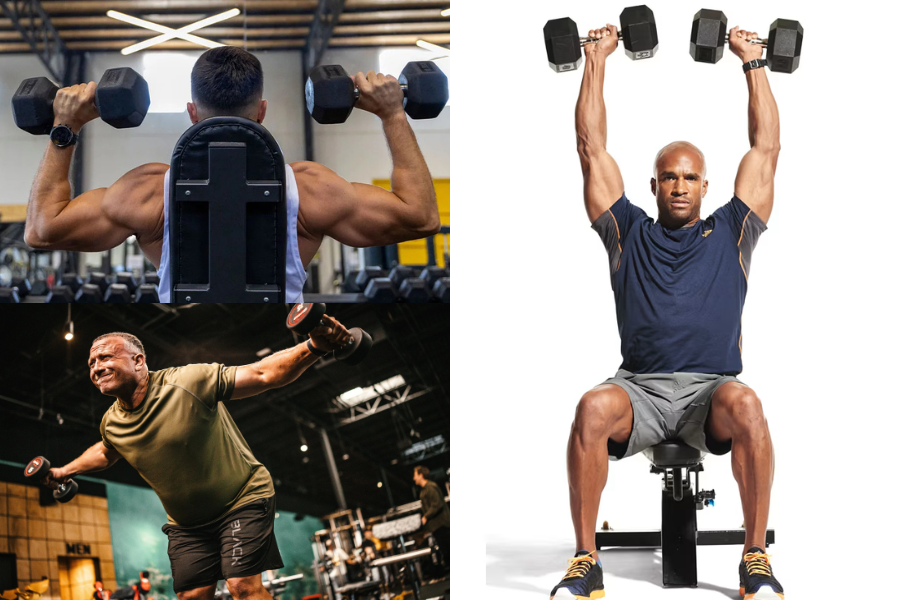
The overhead shoulder press is often ranked as one of the best shoulder exercises for men. It primarily targets your anterior delts and secondarily hits your lateral delts, traps, triceps, and upper chest.
You can perform it seated or standing with dumbbells or a barbell. A standing barbell press challenges your core stability and full-body control, while seated dumbbells help you focus on each arm.
Aim for 3 to 4 sets of 6 to 10 reps in the beginning of your workout. Keep your ribs down, brace your core, and press the weight directly overhead rather than out in front of you.
Behind-the-neck presses are not recommended because they pull your shoulders into an unnatural position and can cause long-term damage according to Ebenezer Samuel, C.S.C.S., fitness director at Men’s Health, as quoted in Men’s Health. Stick with a normal barbell or dumbbell overhead press in front of your head for comfort and safety.
Landmine press
If you have limited overhead mobility or your shoulders feel cranky when you press straight up, the landmine press is a smart alternative. You press a barbell that is anchored at one end on a landmine attachment or in a corner, so the path is at a diagonal instead of straight overhead.
This angle lets you train your anterior and lateral delts with less strain on the shoulder joint. The landmine press is highlighted in the 2024 Gymshark guide as a great option for those with mobility issues, as referenced at Gymshark.
You can perform it standing or half kneeling. Half kneeling helps you stay stable and reduces stress on your lower back. Use 3 to 4 sets of 8 to 12 reps.
Push press
The push press blends strength and power. You dip slightly at the knees and then drive the bar overhead with your legs and shoulders together. This explosive style targets fast twitch muscle fibers, which are important for muscle growth and athletic performance.
The push press also challenges your core stability and teaches you to transfer force from the lower body to the upper body. Variations include single arm push presses and using a wall to assist beginners while they work on shoulder and thoracic spine mobility, as highlighted in training coverage from Men’s Health.
Program the push press earlier in your workout for 3 to 5 sets of 3 to 6 reps. Focus on crisp, powerful reps, not grinding.
Key isolation moves for size and shape
Once your big lifts are done, isolation exercises let you focus on specific heads of the delts so you can round out your shoulders and address weak spots.
Lateral raises for width
If your main goal is wider shoulders, lateral raises should be a priority. They isolate the lateral delts, which are the primary muscles that give you a broad, capped look from the front and back. Both dumbbells and cables work well.
The research you have points out that heavy, sloppy lateral raises are not your friend. Swinging your hips and bending your elbows deeply just moves the load away from your shoulders and into other muscles or momentum. A better approach is to:
- Use a weight you can control
- Keep your arms mostly straight with a soft bend
- Raise your arms until they are about shoulder height
- Pause briefly at the top
- Lower with control
You can also perform lateral raises lying sideways on an incline bench or behind-the-body cable lateral raises to increase the stretch on the side delts. Some coaches have reported good results from training the side delts twice a week for roughly 8 total sets, pushing most of those sets within 3 to 5 reps of failure.
Start with 3 to 4 sets of 10 to 15 reps. Increase weight only after you can perform 15 to 20 clean reps with solid form.
Rear delt flyes for balance and posture
Rear delt flyes are essential if you want your shoulders to look full from all angles and if you care about posture. The posterior delts help pull your shoulders back and support rowing and pulling strength, yet they are often neglected.
You can perform rear delt flyes on an incline bench, seated on a machine, or bent over with dumbbells. Focus on:
- Keeping your chest up and neck neutral
- Driving your elbows out and slightly back
- Squeezing your upper back and rear delts at the top
Aim for 3 to 4 sets of 12 to 20 reps. You do not need big weights here. Control and muscle feel matter more.
Arnold press for all three heads
The Arnold press, popularized by Arnold Schwarzenegger, is a twisting variation of the dumbbell shoulder press. You start with your palms facing you at the bottom, then rotate your hands as you press until your palms face forward at the top.
This move hits all three heads of the deltoid: front, lateral, and rear. It is a great way to build size and shape, but because it is more complex and potentially stressful if overused, many coaches suggest doing it about once per week in moderation, as described by Men’s Health at Men’s Health.
Use 3 sets of 8 to 12 reps, and move in a smooth, controlled arc.
Why you can skip most front raises
Front raises mainly target your anterior delts. However, your front delts already get plenty of work from any overhead pressing and most chest pressing movements.
If you have limited training time, you will usually get more benefit by focusing on lateral and rear delt work. This creates more balanced development and reduces the chance of rolling your shoulders forward.
Shoulder health, mobility, and “bulletproofing”
Strong shoulders are useful only if they are healthy. Good shoulder workouts for men always reserve time for mobility and rotator cuff work.
Smart warm up
Before heavy pressing, warm your shoulders with:
- Light band pull aparts
- Arm circles
- Banded external rotations
- A few light sets of your main exercise
This increases blood flow, improves mobility, and can help you avoid the sharp pains that come from pressing cold.
Rotator cuff and upper back work
To “bulletproof” your shoulders and improve joint stability, build the small stabilizers around the joint. Exercises like mini band external rotations and resistance band face pulls strengthen the rotator cuff and mid back, which help keep the ball of your shoulder centered in the socket.
Coaches often recommend these moves several times per week since they are low load but high benefit. According to training guides from Gymshark, consistent face pulls and external rotations can support posture and reduce injury risk.
Avoid the classic standing dumbbell external rotation where you hold a dumbbell at your side and rotate your forearm outward. Gravity is not loading the shoulder in a helpful way in that position. A cable machine or resistance band, where the resistance is aligned with the rotation of your shoulder, is far more effective.
Include 2 to 3 sets of 15 to 20 reps of face pulls and external rotations near the end of your upper body sessions.
Programming good shoulder workouts for men
Putting the right exercises together is where your progress really happens.
Frequency and volume
Men’s Health fitness director Ebenezer Samuel, C.S.C.S., suggests you do not dedicate an entire day to smashing your shoulders with heavy work. Instead, train shoulders alongside other muscle groups to avoid overloading this relatively small and delicate joint, as reported at Men’s Health.
For most lifters, a good starting point is:
- Frequency: 2 times per week
- Total shoulder work: 9 to 15 sets per week in the hypertrophy rep range of 8 to 12 reps at roughly 70 to 80 percent of your one rep max, as highlighted in Gymshark’s 2024 training guidance at Gymshark
Distribute those sets across compounds and isolation moves so that every head of the delt gets attention.
Sample upper body session with shoulder focus
Here is a simple template you can adapt:
- Overhead shoulder press: 4 sets of 6 to 10 reps
- Pull ups or lat pulldowns: 3 sets of 6 to 10 reps
- Dumbbell bench press: 3 sets of 8 to 12 reps
- Lateral raises: 3 sets of 12 to 15 reps
- Rear delt flyes: 3 sets of 15 to 20 reps
- Face pulls: 2 to 3 sets of 15 to 20 reps
On your second day, you can swap in the landmine press or push press, and adjust the rep ranges slightly for variety.
Progressive overload without wrecking your joints
To build muscle, you need to gradually increase the challenge over time. You can:
- Add small amounts of weight
- Add a rep or two per set
- Add an extra set for a key exercise
- Slow the lowering phase for more time under tension
The key is not to chase weight at the expense of form. The research you have notes that lifters who only increased weight after they could handle 15 to 20 controlled lateral raise reps saw strength go up about 20 percent in 3 months while keeping technique solid.
Apply that same mindset to all your shoulder work. Own the weight before you move up.
Common shoulder training mistakes to avoid
Even good shoulder workouts for men can turn into problems if you fall into a few common traps.
- Overusing behind the neck presses, which put your shoulders in a risky position and can cause long-term issues
- Relying on heavy barbell upright rows, which require excessive internal rotation and often feel uncomfortable. If you like upright rows, use dumbbells so your shoulders can move more freely
- Swinging through lateral raises with too much weight, which reduces delt involvement and increases injury risk
- Ignoring rear delts and rotator cuff work, which can lead to rounded shoulders and instability
- Training only in low rep strength ranges and never spending time in the 8 to 12 rep hypertrophy zone
Keep your technique honest, use a manageable load, and respect your joint health as much as you respect your desire for size.
Nutrition tips to support shoulder growth
Training is only half of the muscle building equation. If you want noticeable changes in shoulder size and width, your diet needs to support that goal.
A meta analysis of muscle gain research suggests that being in a calorie surplus is critical for adding significant muscle mass. Some fat gain is almost unavoidable during a real building phase, but the tradeoff is increased muscle size across your body, including your shoulders.
Focus on:
- Eating in a small, consistent surplus
- Getting enough protein spread across your meals
- Staying hydrated to support joint health and performance
Pair this with progressive shoulder workouts and you will see much better results than if you try to grow in a long term calorie deficit.
If you structure your training around solid compounds like the overhead press and landmine press, then add smart isolation moves like lateral raises, rear delt flyes, and face pulls, you will build strong, broad, and stable shoulders over time. Start with one or two changes from this guide in your next workout, track how you feel, and build from there.
About The Author