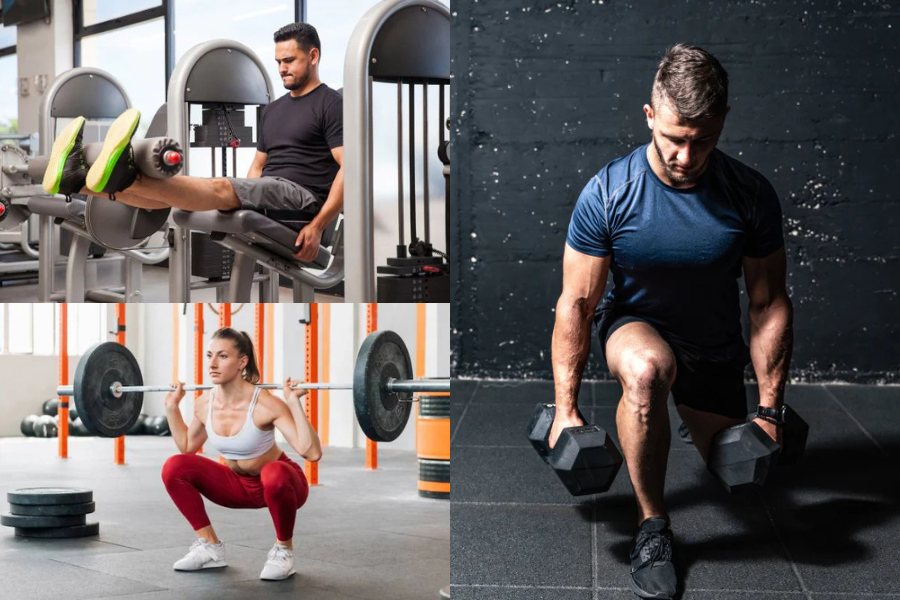
Avoid Common Mistakes with These Quad Isolation Exercises
A few well chosen quad isolation exercises can transform how your legs look and feel, but they are also easy to get wrong. When you rely on them to build stronger, more defined quads, small mistakes in form, volume, or exercise order can stall progress or irritate your knees.
Below, you will learn how quad isolation exercises work, the most common errors to avoid, and how to fit them into an effective lower body routine so you actually see results.
Understand what quad isolation exercises do
Quad isolation exercises focus movement at a single joint, usually the knee, so your quadriceps do almost all of the work. Your body is often supported by a bench or machine, which means stabilizer muscles like your hips and core get a break.
This makes isolation work especially helpful when you want to:
- Add extra volume for quad growth without exhausting your whole body
- Bring up lagging quads that do not get enough stimulus from squats and deadlifts
- Address muscle imbalances between legs
Research on exercises like the seated leg extension highlights that isolation moves are very effective for hypertrophy and for correcting muscular imbalances because they minimize help from hamstrings and glutes. Used alongside your compound lifts, they become a targeted tool rather than a replacement for big movements.
Pick the right quad isolation exercises
Not every leg exercise that burns your thighs is truly quad focused. Start with a small shortlist of proven quad isolation exercises and learn them well.
Leg extensions
The leg extension is usually considered the gold standard of quad isolation. Your hips and back are supported by the machine, your lower leg moves around the knee joint, and your quads drive the entire motion.
According to guidance from Gymshark, the leg extension targets the quadriceps almost exclusively and is highly effective for maximum quad growth because the rest of your body stays supported and relaxed. That means you can recover faster and use leg extensions more often in your weekly training.
You can also:
- Work one leg at a time to fix side to side differences
- Add a brief isometric hold at the top to intensify the contraction
Banded leg extensions
If you work out at home or want a joint friendly variation, banded leg extensions are a strong option. The resistance of the band increases as you straighten your knee, which keeps tension high at the top of the rep without heavy weights.
Guidelines suggest 3 to 4 sets of 12 to 20 reps with 45 to 60 seconds rest to focus on endurance and muscle engagement, while keeping stress on the joints low. This makes banded extensions ideal for finishers or for extra volume on days when you are already tired.
Split squats and Bulgarian split squats
These are technically compound exercises because both the knee and hip are involved, but with the right stance you can make them very quad dominant. Each leg works independently, which helps you correct imbalances and build stability.
The research notes that split squats are effective for targeting quads and glutes, improving lower body stability, and addressing side to side strength gaps when you perform around 3 to 4 sets of 8 to 12 reps per leg. Bulgarian split squats with a shorter stance and upright torso will bias the quads even more.
Sissy squats
Sissy squats are an advanced option that almost remove the hips from the movement. You rise onto your tiptoes and allow your knees to travel fully over your toes, which puts intense tension on the quadriceps.
Because the movement is demanding, it is often best to start with a support like a bar, pole, or resistance band to hold onto while you learn the motion. Once your strength and balance improve, you can move to bodyweight only or to a stable setup like a smith machine for more load.
Avoid form mistakes that stress your knees
You want your quads to feel the work, not your joints. Good setup and controlled movement will protect your knees and make every rep more effective.
Rushing the movement
Speed is one of the most common issues with quad isolation exercises. If you kick the weight up and drop it back down with momentum, your joints and connective tissues absorb more of the load while your quads do less.
Instead, think in counts:
- Lift in 1 to 2 seconds
- Pause briefly at the top
- Lower in 2 to 3 seconds under control
This tempo also fits the recommendation that isolation moves work well in moderate to high rep ranges, such as 10 to 30 reps for leg extensions, to limit knee stress while still creating a strong growth stimulus.
Poor knee and foot alignment
When your knees cave in or your feet twist, the tension shifts away from the parts of your quads you are trying to develop. Consistent alignment will keep the load where you want it.
Key checks:
- Knees track in line with your second or third toe
- Feet are planted firmly, not rolling inward or outward
- On split squats, your front knee follows the same path forward over the toes rather than collapsing inward
Foot position matters for quad engagement. Raising your heel on a plate or slant board and deliberately tracking your knee over your toes increases knee flexion and quad involvement while reducing hip and glute takeover, both in squats and in isolation work like leg extensions.
Using too much weight
Because your body is supported on many quad isolation exercises, it is tempting to stack the weight. The problem is that your joints, especially your knees, may not appreciate it.
Leg extensions and similar movements do not need maximal loads to build size. In fact, experts suggest using moderate weights for higher rep ranges on isolations and saving lower rep, heavier work for compound lifts like squats and hack squats. If you cannot move through the full range of motion without swinging or jerking, the weight is probably too heavy.
Program quad isolation exercises with your compounds
Even the best isolation work cannot fully replace multi joint movements. Your goal is to combine them so you get the strength and muscle benefits of big lifts plus the detail work of isolations.
Do compounds first, isolations later
You will get more from your training if you start sessions with exercises that use the most muscle groups. Think front squats, hack squats, or leg press when your energy and focus are highest.
Guidance from Gymshark recommends this exact structure: perform compound exercises first, then move to quad isolation exercises like leg extensions so you can lock in extra quad growth without secondary muscle compensation. This also keeps your core and hips fresher for heavy work.
A simple lower body day might look like:
- Front squats
- Hack squats or leg press
- Leg extensions
- Split squats or lunges
Use isolation work to fine tune volume
Isolation moves are less taxing on your whole system, so they are a smart way to add sets without overwhelming your recovery. They also let you nudge up frequency or volume during later training phases when your base strength is already good.
RP Strength suggests adding less fatiguing isolation exercises such as leg extensions to later blocks in a program, rather than more demanding compound lifts, to manage fatigue and reduce injury risk. This helps you keep progressing without feeling constantly worn down.
Aim for:
- At least two quad focused exercises per workout
- Around five or more total sets of quad work per session
- Two quad focused days per week, with at least 48 hours between them for recovery
Adjust frequency and volume for your goals
Your training schedule should match what you want most, whether that is strength, size, or a blend of both.
If you chase strength, your main compound quad lifts will sit in the 70 to 85 percent of one rep max range with lower reps. For muscle growth, moderate intensity around 50 to 70 percent of one rep max with higher volume works better. Quad isolation exercises fit naturally into that moderate intensity, higher rep approach.
Most people do well training quads 2 to 3 times per week. If you increase frequency, you can rotate exercise choices to spread stress across different tissues and help guard against overuse issues, as suggested by RP Strength. For instance, you could emphasize leg extensions on one day and banded variations or split squats on another.
Quick rule of thumb: if your knees feel worse session after session, lower the load or volume on your isolation work before you blame the compound lifts.
Use unilateral and finishing work wisely
Single leg and finisher style sets are powerful tools, especially for symmetry and that end of workout quad burn.
Unilateral quad work, such as lunges with an elevated front foot or Bulgarian split squats with a shorter stance, helps correct imbalances, improves balance and core stability, and ensures each leg pulls its own weight. You can alternate legs or perform all reps on one side before switching, depending on what feels more stable.
Finishers like high rep leg extensions or banded extensions at the end of a session create a strong pump, help you fully exhaust the muscles, and add volume without significantly taxing your whole body. Short rest periods, sometimes under 30 seconds, work well on these isolation sets because systemic fatigue is low.
If you enjoy isometric work, holding the top of a leg extension for 20 to 30 seconds keeps peak tension on the quadriceps and can improve muscular control and stability. These long holds are also useful in rehab settings when you need strength gains with very controlled motion.
Put it all together
When you treat quad isolation exercises as a focused tool instead of an afterthought, they can dramatically improve your quad size, definition, and symmetry. Choose a few exercises that suit your equipment, use controlled form and alignment, and let your compounds set the foundation of your routine.
From there, small tweaks like heel elevation, single leg focus, and well planned finishers will help you avoid common mistakes and make every rep count.
About The Author





