The Ultimate Glute Workout for Men to Build Muscle
A strong, well built backside is not just about looks. The right glute workout for men can boost your strength on big lifts, protect your knees and lower back, and make you more explosive in sports. If your legs grow easily but your glutes lag behind, you are not alone and you can fix it with smarter training.
Below, you will build a clear plan: the best exercises, how to structure your workout, and what to avoid so you actually grow muscle instead of just feeling a burn.
Why glute training matters for men
Your glutes are some of the most powerful muscles in your body. They are responsible for hip extension, pelvic stability, and a big share of your overall core strength. Every time you sprint, jump, climb stairs, or lock out a deadlift, your glutes should be doing a lot of the work.
When you skip proper glute training, several things can happen over time:
- Your hip flexors tighten from too much sitting
- Your glutes get weaker and “switch off,” often called gluteal amnesia or “dead butt syndrome”
- Your lower back and hamstrings compensate, which can increase the risk of back and knee pain
Coaches like Bret Contreras, founder of Glute Lab in San Diego, highlight that strong glutes power hip extension, stabilize your pelvis, and can reduce back issues by supporting your spine and spreading out the workload across your lower body.
Well developed glutes also protect against knee, hip, and lower back injuries. Look at elite sprinters or top hockey players and you will usually see powerful glutes that help them accelerate, cut, and absorb impact efficiently.
Common mistakes men make with glute workouts
If you feel your glutes only mildly sore after leg day while your quads are destroyed, you might be running into a few classic errors.
Picking the wrong primary movements
Fitness coach Jeremy Ethier points out that one of the biggest mistakes is choosing exercises that do not really train hip extension. The main job of your glutes is to extend the hip, so your program should be built around movements like:
- Back squats
- Leg presses with a hip heavy setup
- Bulgarian split squats
- Deadlifts and Romanian deadlifts
- Hip thrusts
If your leg days are dominated by leg extensions, machine work, and random “booty band” moves, you are not giving your glutes enough heavy, productive work.
Letting other muscles take over
Even when you pick the right exercises, form can shift the tension away from your glutes:
- Quads take over when you squat too upright and focus only on your knees instead of sitting back and driving through your hips
- Lower back and hamstrings dominate deadlifts and hip hinges if you overarch your spine or do not lock out with your glutes
- You rush reps and bounce at the bottom, instead of pausing and driving through your heels and midfoot
Ethier also stresses that you need to challenge the glutes in different positions, including when they are fully shortened. If you never squeeze hard at the top of a hip thrust, for example, you are leaving growth on the table.
Overusing booty bands on every exercise
Coach Mark Carroll flags another modern trap: wrapping a band around your knees for almost every glute movement. While bands have a place, constantly adding lateral resistance to hip thrusts and bridges can divert tension away from the glute max and reduce how much load you can use.
According to Carroll, this co contraction of stabilizing muscles means you lift lighter, feel a lot of “burn” around the sides of your hips, but do not challenge the big glute muscle that actually drives growth.
Use bands strategically, not automatically.
The three glute muscles you need to target
To build a complete, athletic look you want all three glute muscles involved:
- Gluteus maximus: This is the largest muscle, mainly responsible for hip extension and most of the size and shape
- Gluteus medius: Helps rotate the leg and stabilizes your pelvis when you stand on one leg or move laterally
- Gluteus minimus: Smaller muscle that also assists with leg rotation and hip stability
A smart glute workout for men will mix:
- Heavy compound lifts for the glute max
- Unilateral and abduction moves for the glute med and minimus
- Explosive or athletic drills if you care about speed and jumping
Your ultimate glute workout for men (gym version)
Here is a focused lower body day centered around glute growth. You can run this 1 to 2 times per week, depending on your overall training split.
Warm up and activation (5 to 10 minutes)
If you sit a lot during the day, activation work helps you actually feel your glutes in the main lifts:
- 1 to 2 sets of bodyweight glute bridges, 12 to 15 slow reps
- 1 set of quadruped hip extensions per leg, 12 to 15 reps
- Light dynamic stretches for hips and hamstrings
The quadruped hip extension is also recommended for better pelvic stability and reducing knee pain, since it encourages proper hip extension with less stress on the knees.
Main strength block
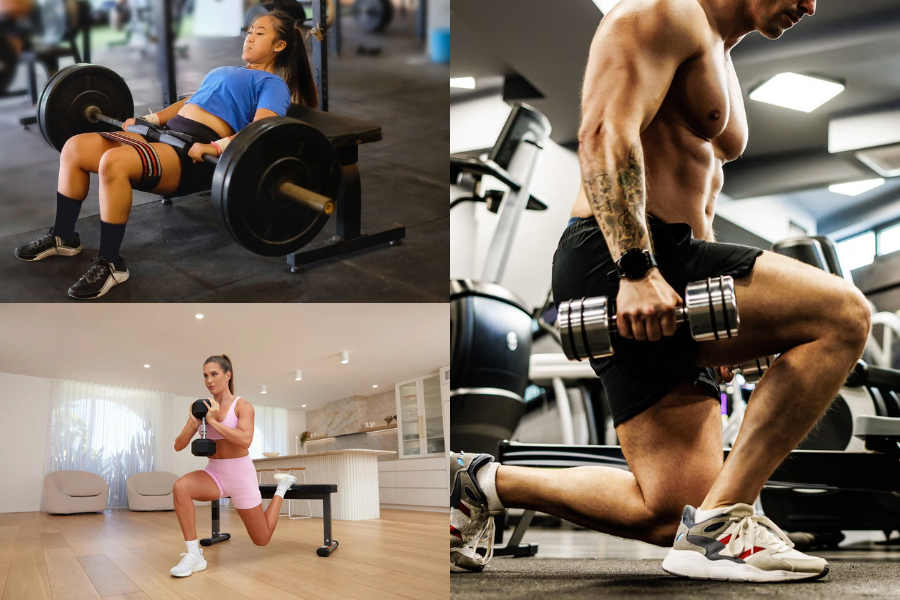
- Hip thrust or barbell hip thrust
- 3 to 4 sets of 6 to 10 reps
- Focus on a full lockout at the top and a strong 1 to 2 second squeeze
The hip thrust is one of the most effective exercises for isolating the glutes. It lets you train the muscles hard, several times per week, while recovering quicker than from heavy squats.
- Romanian deadlift (barbell or dumbbell)
- 3 to 4 sets of 6 to 10 reps
- Push your hips back, keep a slight knee bend, and maintain a neutral spine
Classic hip hinge lifts like the Romanian deadlift, conventional deadlift, and sumo deadlift are all powerful glute builders because they demand strong hip extension to finish the rep.
- Bulgarian split squat or reverse lunge
- 3 sets of 8 to 12 reps per leg
- Take a moderate to long stance and lean slightly forward to keep the emphasis on glutes rather than quads
Even if you do not love Bulgarian split squats, a unilateral squat pattern of some kind is worth keeping. It hits the glute max hard and also challenges your glute med and minimus to keep your pelvis steady.
Secondary hypertrophy block
- Back extension or 45 degree hip extension
- 3 sets of 10 to 15 reps
- Round slightly at the upper back, then extend by squeezing your glutes, not hyperextending your lower back
- Cable or machine hip abduction
- 2 to 3 sets of 12 to 20 reps
- Control the movement and hold a brief squeeze at the end range
You can cycle in bench hip abduction or pulse goblet squats for variety. Pulse goblet squats, where you stay in the bottom half of the squat for 20 reps, keep constant tension on the glutes and can burn out the muscles after your heavy work.
Optional athletic finisher
If performance is a goal, add one explosive exercise at the end:
- Barbell jump squats, 5 sets of 5 reps at about 70 percent of your back squat one rep max
This move teaches you to use your glutes explosively to drive out of the bottom, which can carry over to sprinting, jumping, and even faster, more powerful squats.
Glute workout for men at home (bodyweight only)
No gym access yet You can still build a strong foundation at home with bodyweight glute exercises.
A 2024 Gymshark guide notes that you can increase difficulty by adding reps, slowing the tempo, using isometric holds, or moving to single leg variations. Over time, that progressive overload is what drives growth.
Here is a simple at home routine you can do 2 to 3 times per week:
- Air squats, 3 sets of 15 to 20 reps
- Glute bridges, 3 sets of 12 to 20 reps with a 2 second hold at the top
- Split squats, 3 sets of 10 to 15 reps per leg
- Single leg Romanian deadlifts (bodyweight), 3 sets of 10 to 12 reps per leg
- Curtsy lunges or crab walks, 2 to 3 sets of 12 to 15 reps per side
This combination hits your glute max with squats, bridges, and split squats, while the single leg deadlifts, curtsy lunges, and crab walks challenge your glute med and minimus for stability.
Beginners can notice visible changes in as little as six weeks with consistent work, especially if you train the glutes twice a week and keep your protein intake up. For more advanced lifters, expect 16 to 24 weeks of focused, progressive training before you see dramatic growth.
Programming tips for maximum glute growth
You can have the best exercises in the world and still stall if your overall plan is off. A few key points matter most.
Train often enough, but not too much
For most men, 2 dedicated glute or lower body days per week is ideal. If you love hip thrusts, you can include them 3 to 4 times per week as the research and coaching practice around them suggest they are easy to recover from compared to heavy squats.
Spread volume across the week instead of crushing your glutes in a single marathon session.
Progress gradually and track it
You will not grow if your weights and reps never change. Aim to:
- Add a small amount of weight every 1 to 2 weeks on your main lifts, or
- Add 1 to 2 reps to a set while keeping form tight
Over time, you want to see a clear upward trend in hip thrust, deadlift, and unilateral leg strength.
Eat enough to support muscle gain
Mark Carroll highlights that not eating enough calories is the single biggest barrier to building glutes, especially for men who have been training consistently for a while. You may not need a huge surplus, but at least hitting your total daily energy expenditure, plus adequate protein, will make a big difference.
In practice, that means:
- Plenty of lean protein to support muscle repair
- Enough carbs to fuel hard training sessions
- Do not diet aggressively if your main goal right now is glute size and strength
Remember that muscle building is a slow process. Carroll notes that maximizing glute growth usually needs a 16 to 24 week block of consistent training and supportive nutrition, not just a few good workouts.
Simple cues to feel your glutes working
If you struggle to “find” your glutes, adjust your setup and focus:
- During hip thrusts and bridges, tuck your chin slightly, keep your ribs down, and think “drive my hips to the ceiling, then squeeze” instead of just lifting the weight
- In deadlifts and RDLs, imagine pushing the floor away with your feet and finishing the rep by driving your hips forward, not leaning back
- On squats and split squats, sit your hips back, keep your weight through your midfoot and heel, and think “stand up by pushing the floor down”
Over time, this mind muscle connection will help you recruit your glutes more effectively and reduce the tendency for your back and hamstrings to take over.
If you consistently feel only your quads or lower back after leg day, it is usually a form or exercise selection issue, not that your glutes “cannot grow.”
Putting it all together
A smart glute workout for men is not about copying the latest trendy move. It is about:
- Centering your program around hip thrusts, squats, and hip hinges
- Adding targeted unilateral and abduction work for full development
- Using activation drills if you sit a lot or struggle to feel your glutes
- Progressing your weights and reps over months, not days
- Eating enough to give your body the raw materials to build muscle
Start by picking one of the routines above, gym or at home, and follow it without constant changes for at least 8 to 12 weeks. Take notes on the weights you use and how your glutes feel from session to session. With consistency, your strength, your posture, and yes, your physique will all show the difference.
About The Author