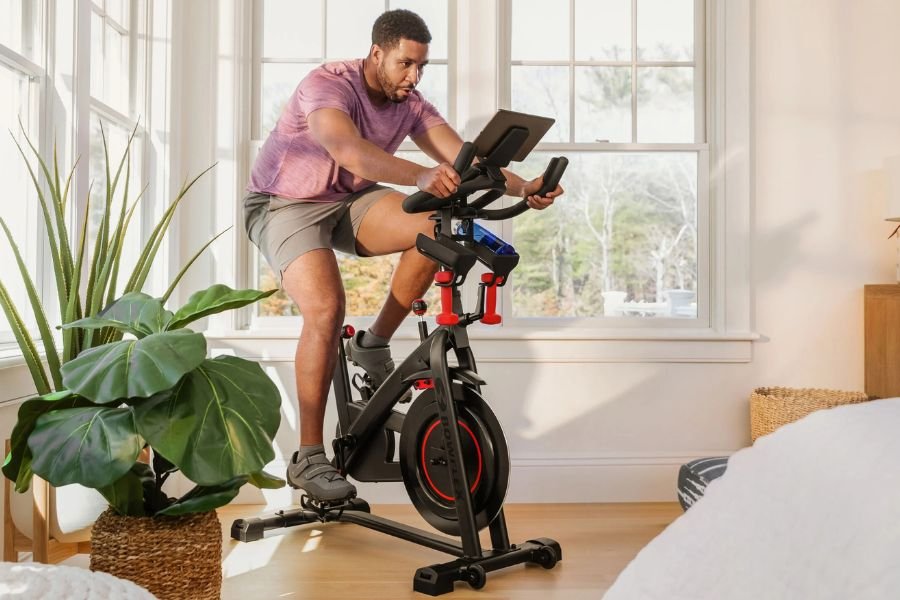
Effective Exercise Bike Workouts You’ll Love Trying Today
A good exercise bike workout gives you more than tired legs. The right session can help you burn calories, build strength, improve heart health, and still be kind to your joints. With a few simple approaches, exercise bike workouts can fit your schedule, your fitness level, and your goals.
Below, you will find clear, step by step ideas you can try today, whether you are a beginner or ready for more challenging rides.
Why exercise bike workouts work so well
Stationary cycling gives you a strong aerobic workout while putting less stress on your joints than running or many other cardio options. You work your heart, lungs, and major lower body muscles in a controlled, low impact way, which is helpful if you have sensitive knees or are coming back from injury (Healthline).
Depending on your effort level and body weight, exercise bike workouts can burn between 100 and 400 calories in about 30 minutes, and over 600 calories in an hour at higher intensities (Healthline, Defined). That makes cycling a practical option if you want to support weight loss or weight maintenance.
Stationary bikes also help strengthen your quads, hamstrings, glutes, and calves. Air bikes or models with moving handles add some upper body work as well (Defined). Over time, regular rides improve your cardiovascular fitness, circulation, and lung capacity, which means daily activities feel easier (NutroOne).
Set up your bike for comfort and safety
A comfortable setup makes your workouts feel better and helps you avoid common aches.
Start by adjusting your seat height. A simple rule is to line the saddle up roughly with your hip when you stand next to the bike. When you sit and place your heel on the pedal at the bottom of the stroke, your leg should be almost straight. That way, when you clip in or place the ball of your foot on the pedal, your knee has a slight bend, which reduces strain on your knees and hamstrings (CAROL Bike).
If your bike allows, move the seat forward or back until your front knee is roughly over the middle of the pedal when the pedal is at 3 o’clock. Keep your shoulders relaxed and your elbows soft, not locked. This simple positioning helps you pedal efficiently and stay comfortable during longer sessions.
Always start with a proper warm up
A warm up prepares your muscles and your heart for harder work and can lower your risk of injury. For exercise bike workouts, aim for 5 to 10 minutes of easy pedaling at low resistance. Gradually increase your cadence until your breathing is a little heavier but you could still hold a conversation (CAROL Bike).
You can also add a few 20 to 30 second gentle pickups, where you pedal slightly faster, followed by the same amount of time back at your comfortable pace. This approach boosts blood flow to your legs and helps your joints feel ready for the main part of your ride.
Try this beginner friendly 20 minute workout
If you are new to indoor cycling, your main goal is consistency, not intensity. Exercise bike workouts are especially beginner friendly because you control both speed and resistance. Verywell Fit recommends starting with just a few minutes at a time and slowly building up, rather than pushing too hard on day one (Verywell Fit).
Here is a simple 20 minute session you can try:
-
Minutes 0 to 5
Warm up with very light resistance. Keep your effort at about 3 out of 10, where 1 is complete rest and 10 is an all out sprint. -
Minutes 5 to 12
Increase the resistance slightly. Pedal at a steady, comfortable pace, effort around 4 out of 10. -
Minutes 12 to 17
Add gentle intervals. For 1 minute, raise your effort to 6 out of 10, then go back to 4 out of 10 for 1 minute. Repeat this 3 times. -
Minutes 17 to 20
Cool down with light resistance and slow pedaling. Let your breathing and heart rate come back toward normal.
As this starts to feel easier, you can follow a progression like the one Verywell Fit suggests. Gradually add five minute blocks that alternate 3 minutes of baseline effort with 2 minutes at a slightly higher intensity, until you reach 30 minutes per session (Verywell Fit).
Build endurance with steady rides
Endurance focused exercise bike workouts help your heart, lungs, and muscles handle longer periods of activity. This type of training is a good match if you want to walk up stairs without getting winded or prepare for longer outdoor rides.
A classic approach is to stay mostly in a low to moderate intensity range, sometimes called Zone 2. At this effort, your breathing is deeper than rest but you can still speak in full sentences. Reddit fitness communities often recommend this low intensity, steady riding as the foundation of your cycling routine, with higher intensity intervals added later (Reddit Fitness).
A simple endurance workout might look like this:
- 5 to 10 minutes easy warm up
- 15 to 30 minutes of steady riding at 4 to 5 out of 10 effort
- 5 minutes cool down
As your fitness improves, you can slowly increase the main block by 5 minutes at a time. NutroOne notes that gradually increasing intensity and duration is key for building stamina and resilience over time (NutroOne).
Burn more calories with interval workouts
If you are short on time or want to increase calorie burn, high intensity intervals can help. Interval training alternates periods of harder effort with easy recovery. This style of riding can burn more calories in less time and improve cardiovascular fitness (Healthline).
A moderate interval workout could be:
- 5 to 10 minutes warm up
- 8 to 10 rounds of:
- 30 seconds at 7 to 8 out of 10 effort
- 90 seconds easy at 3 out of 10
- 5 minutes cool down
For more advanced riders, very short, very hard sprints are another option. For example, the CAROL Bike uses a REHIT protocol with 2 x 20 second all out intervals in its signature workout. Research on this type of training shows it can deplete up to 30% of your muscle glycogen, boost your calorie afterburn, and improve aerobic fitness in as little as 5 minutes of riding (CAROL Bike).
If you try all out sprints, make sure you are already comfortable with moderate intervals and always respect your current fitness level.
Listen to your body. If you feel dizzy, nauseous, or experience chest pain, stop your workout and seek medical advice before returning to exercise.
Use heart rate or effort to guide intensity
You do not need advanced gadgets to benefit from exercise bike workouts, but tools like heart rate zones can make your training more precise. For example, CAROL Bike uses five zones based on a threshold heart rate determined by a 20 minute test. Riders then train from low intensity recovery at about 60 to 64% of threshold up to supra maximal efforts at 95 to 100% (CAROL Bike).
If you do not have a heart rate monitor, a simple 1 to 10 rate of perceived exertion scale works well. Many structured workouts, including those highlighted by Health.com, use this approach instead of exact RPM targets so that each rider can adjust for their own fitness level (Health).
Paying attention to either heart rate or perceived effort helps you stay in the right training zone, whether your goal is easy recovery, fat burning endurance, or intense intervals.
Track the right metrics to see progress
Watching your numbers improve over time is motivating. During your rides, you can keep an eye on:
- Time and distance
- Speed
- Power in watts, if your bike has this feature
- Cadence in revolutions per minute (RPM)
- Calories burned
- Rate of perceived exertion
Tracking these metrics lets you compare sessions and notice trends. CAROL Bike highlights how monitoring speed, power, cadence, and other data helps you tailor workout intensity and maximize results (CAROL Bike).
You can keep things simple with a notebook or use an app that connects to your bike. Apps like Zwift, TrainerRoad, and the Peloton app also offer guided exercise bike workouts that can keep you engaged, especially if you like structured plans or group class energy (Reddit Fitness).
How often you should ride each week
For general health and fitness, the Centers for Disease Control and Prevention recommend at least 150 minutes per week of moderate intensity aerobic activity. That could be 30 minutes a day on your exercise bike, five days a week, which also aligns with guidance from NordicTrack and Defined for improving cardiovascular health and supporting better sleep and blood pressure (NordicTrack, Defined).
Verywell Fit suggests doing at least three cardio sessions per week and mixing types of exercise, such as cycling plus walking or strength training. This variety helps you avoid overuse injuries and burnout while still burning plenty of calories (Verywell Fit).
If you are just starting out, even 10 minutes at a time is useful. Focus on building a consistent habit with shorter, regular rides rather than occasional very long sessions. That steady routine is what builds lasting fitness (Reddit Fitness).
When to be cautious or talk to your doctor
Exercise bike workouts are usually safe for many people, including those with joint issues. Studies have found that indoor cycling can reduce knee pain and improve function for people with osteoarthritis, and that it tends to be gentle on knees, hips, and ankles compared to higher impact activities (NordicTrack, Defined).
Still, if you have an illness, a recent injury, or you are taking medication that affects your heart rate, it is wise to check with your healthcare provider before starting a new routine. Verywell Fit specifically recommends getting medical advice in these cases so you can exercise safely (Verywell Fit).
Putting it all together
Exercise bike workouts can be as simple or as structured as you want. You might begin with 20 minutes of easy riding three times a week, then slowly layer in steady endurance sessions and short bursts of intervals as your fitness grows. Along the way, small habits like proper bike setup, consistent warm ups, and basic tracking help you feel better on the bike and see progress off it.
You can start today by choosing one idea from this guide. Set your seat correctly, try the beginner 20 minute ride, or add a short interval block to your usual session. Over time, these modest changes add up to better health, more energy, and a workout routine you actually look forward to.
About The Author


